

153
Microscopic Templating
Template
(a)
(c)
Templated carbon
Silica sphere as template
Macroporous carbon
SBA-15 as template
Mesoporous carbon
Microporous carbon
Zeolite Y as template
Components and Materials for Electrochemical Supercapacitors
The Maxsorb commercial carbon made in Kansai, Japan is produced by
KOH activation of petroleum coke at 700°C and achieves over 3100 m 2 .g –1 [32].
Wan et al. [33] demonstrated that Maxsorb carbon can produce capacitance
in aqueous electrolyte of 225 F.g –1 at 1 A.g –1 current density. In the same test,
they showed that polymeric-activated carbon derived from KOH activation
of resorcinol–formaldehyde exhibited only 1673 m 2 .g –1 surface area but was
able to reach 325 F.g –1 in aqueous electrolyte [33].
4.2.8.2 Templated Active Carbons
As carbon electrode technology moves forward, researchers have room to
play with advanced carbon structures that have higher pore orders and
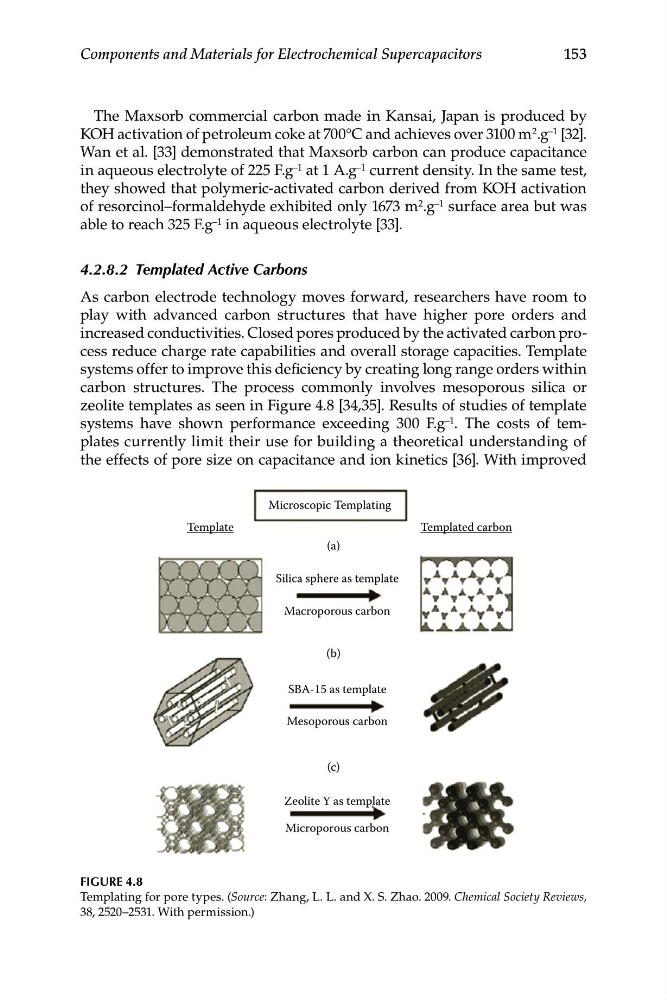
increased conductivities. Closed pores produced by the activated carbon process reduce charge rate capabilities and overall storage capacities. Template
systems offer to improve this deficiency by creating long range orders within
carbon structures. The process commonly involves mesoporous silica or
zeolite templates as seen in Figure 4.8 [34,35]. Results of studies of template
systems have shown performance exceeding 300 F.g –1 . The costs of templates currently limit their use for building a theoretical understanding of
the effects of pore size on capacitance and ion kinetics [36]. With improved
(b)
FIGURE 4.8
Templating for pore types. (Source: Zhang, L. L. and X. S. Zhao. 2009. Chemical Society Reviews,
38, 2520–2531. With permission.)
Microscopic Templating
Template
(a)
(c)
Templated carbon
Silica sphere as template
Macroporous carbon
SBA-15 as template
Mesoporous carbon
Microporous carbon
Zeolite Y as template
Components and Materials for Electrochemical Supercapacitors
The Maxsorb commercial carbon made in Kansai, Japan is produced by
KOH activation of petroleum coke at 700°C and achieves over 3100 m 2 .g –1 [32].
Wan et al. [33] demonstrated that Maxsorb carbon can produce capacitance
in aqueous electrolyte of 225 F.g –1 at 1 A.g –1 current density. In the same test,
they showed that polymeric-activated carbon derived from KOH activation
of resorcinol–formaldehyde exhibited only 1673 m 2 .g –1 surface area but was
able to reach 325 F.g –1 in aqueous electrolyte [33].
4.2.8.2 Templated Active Carbons
As carbon electrode technology moves forward, researchers have room to
play with advanced carbon structures that have higher pore orders and
increased conductivities. Closed pores produced by the activated carbon process reduce charge rate capabilities and overall storage capacities. Template
systems offer to improve this deficiency by creating long range orders within
carbon structures. The process commonly involves mesoporous silica or
zeolite templates as seen in Figure 4.8 [34,35]. Results of studies of template
systems have shown performance exceeding 300 F.g –1 . The costs of templates currently limit their use for building a theoretical understanding of
the effects of pore size on capacitance and ion kinetics [36]. With improved
(b)
FIGURE 4.8
Templating for pore types. (Source: Zhang, L. L. and X. S. Zhao. 2009. Chemical Society Reviews,
38, 2520–2531. With permission.)