

10
8
6
4
2
0
–2
–4
–6
–8
–10
–12
AC1 ox
AC2 ox
I (mA)
–1.4 –1.2 –1 –0.8 –0.6 –0.4 –0.2
0
0.2
0.4
0.6
0.8
E (V) vs. Hg/Hg 2 SO 4
130
Electrochemical Supercapacitors for Energy Storage and Delivery
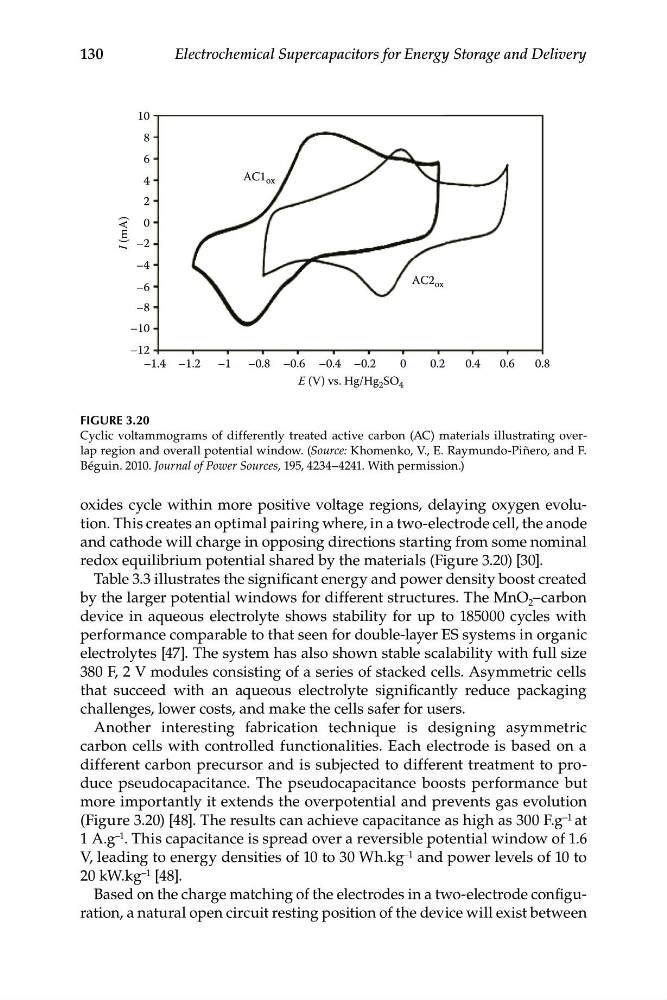
FIGURE 3.20
Cyclic voltammograms of differently treated active carbon (AC) materials illustrating overlap region and overall potential window. (Source: Khomenko, V., E. Raymundo-Piñero, and F.
Béguin. 2010. Journal of Power Sources, 195, 4234–4241. With permission.)
oxides cycle within more positive voltage regions, delaying oxygen evolution. This creates an optimal pairing where, in a two-electrode cell, the anode
and cathode will charge in opposing directions starting from some nominal
redox equilibrium potential shared by the materials (Figure 3.20) [30].
Table 3.3 illustrates the significant energy and power density boost created
by the larger potential windows for different structures. The MnO 2 –carbon
device in aqueous electrolyte shows stability for up to 185000 cycles with
performance comparable to that seen for double-layer ES systems in organic
electrolytes [47]. The system has also shown stable scalability with full size
380 F, 2 V modules consisting of a series of stacked cells. Asymmetric cells
that succeed with an aqueous electrolyte significantly reduce packaging
challenges, lower costs, and make the cells safer for users.
Another interesting fabrication technique is designing asymmetric
carbon cells with controlled functionalities. Each electrode is based on a
different carbon precursor and is subjected to different treatment to produce pseudocapacitance. The pseudocapacitance boosts performance but
more importantly it extends the overpotential and prevents gas evolution
(Figure 3.20) [48]. The results can achieve capacitance as high as 300 F.g –1 at
1 A.g –1 . This capacitance is spread over a reversible potential window of 1.6
V, leading to energy densities of 10 to 30 Wh.kg –1 and power levels of 10 to
20 kW.kg –1 [48].
Based on the charge matching of the electrodes in a two-electrode configuration, a natural open circuit resting position of the device will exist between