

131
Fundamentals of Electrochemical Pseudocapacitors
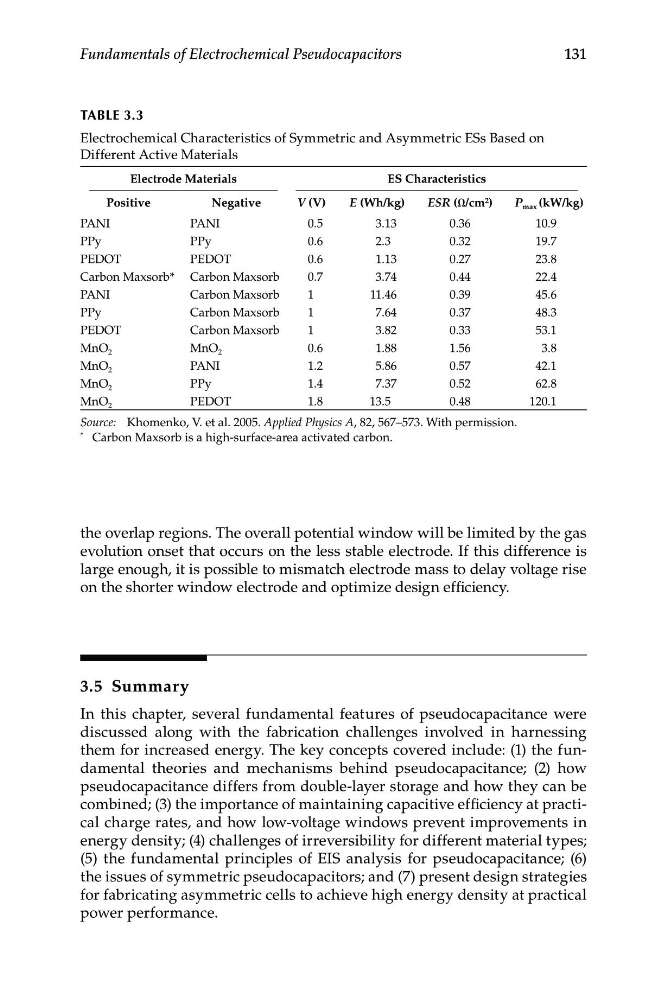
TABLE 3.3
Electrochemical Characteristics of Symmetric and Asymmetric ESs Based on
Different Active Materials
Electrode Materials
ES Characteristics
Positive
Negative
V (V)
E (Wh/kg)
ESR (Ω/cm 2 )
P max (kW/kg)
PANI
PANI
0.5
3.13
0.36
10.9
PPy
PPy
0.6
2.3
0.32
19.7
PEDOT
PEDOT
0.6
1.13
0.27
23.8
Carbon Maxsorb* Carbon Maxsorb
0.7
3.74
0.44
22.4
PANI
Carbon Maxsorb
1
11.46
0.39
45.6
PPy
Carbon Maxsorb
1
7.64
0.37
48.3
PEDOT
Carbon Maxsorb
1
3.82
0.33
53.1
MnO 2
MnO 2
0.6
1.88
1.56
3.8
MnO 2
PANI
1.2
5.86
0.57
42.1
MnO 2
PPy
1.4
7.37
0.52
62.8
MnO 2
PEDOT
1.8
13.5
0.48
120.1
Source: Khomenko, V. et al. 2005. Applied Physics A, 82, 567–573. With permission.
* Carbon Maxsorb is a high-surface-area activated carbon.
the overlap regions. The overall potential window will be limited by the gas
evolution onset that occurs on the less stable electrode. If this difference is
large enough, it is possible to mismatch electrode mass to delay voltage rise
on the shorter window electrode and optimize design efficiency.
3.5 Summary
In this chapter, several fundamental features of pseudocapacitance were
discussed along with the fabrication challenges involved in harnessing
them for increased energy. The key concepts covered include: (1) the fundamental theories and mechanisms behind pseudocapacitance; (2) how
pseudocapacitance differs from double-layer storage and how they can be
combined; (3) the importance of maintaining capacitive efficiency at practical charge rates, and how low-voltage windows prevent improvements in
energy density; (4) challenges of irreversibility for different material types;
(5) the fundamental principles of EIS analysis for pseudocapacitance; (6)
the issues of symmetric pseudocapacitors; and (7) present design strategies
for fabricating asymmetric cells to achieve high energy density at practical
power performance.
Fundamentals of Electrochemical Pseudocapacitors
TABLE 3.3
Electrochemical Characteristics of Symmetric and Asymmetric ESs Based on
Different Active Materials
Electrode Materials
ES Characteristics
Positive
Negative
V (V)
E (Wh/kg)
ESR (Ω/cm 2 )
P max (kW/kg)
PANI
PANI
0.5
3.13
0.36
10.9
PPy
PPy
0.6
2.3
0.32
19.7
PEDOT
PEDOT
0.6
1.13
0.27
23.8
Carbon Maxsorb* Carbon Maxsorb
0.7
3.74
0.44
22.4
PANI
Carbon Maxsorb
1
11.46
0.39
45.6
PPy
Carbon Maxsorb
1
7.64
0.37
48.3
PEDOT
Carbon Maxsorb
1
3.82
0.33
53.1
MnO 2
MnO 2
0.6
1.88
1.56
3.8
MnO 2
PANI
1.2
5.86
0.57
42.1
MnO 2
PPy
1.4
7.37
0.52
62.8
MnO 2
PEDOT
1.8
13.5
0.48
120.1
Source: Khomenko, V. et al. 2005. Applied Physics A, 82, 567–573. With permission.
* Carbon Maxsorb is a high-surface-area activated carbon.
the overlap regions. The overall potential window will be limited by the gas
evolution onset that occurs on the less stable electrode. If this difference is
large enough, it is possible to mismatch electrode mass to delay voltage rise
on the shorter window electrode and optimize design efficiency.
3.5 Summary
In this chapter, several fundamental features of pseudocapacitance were
discussed along with the fabrication challenges involved in harnessing
them for increased energy. The key concepts covered include: (1) the fundamental theories and mechanisms behind pseudocapacitance; (2) how
pseudocapacitance differs from double-layer storage and how they can be
combined; (3) the importance of maintaining capacitive efficiency at practical charge rates, and how low-voltage windows prevent improvements in
energy density; (4) challenges of irreversibility for different material types;
(5) the fundamental principles of EIS analysis for pseudocapacitance; (6)
the issues of symmetric pseudocapacitors; and (7) present design strategies
for fabricating asymmetric cells to achieve high energy density at practical
power performance.