

Voltage, V
5.0
4.5
4.0
3.5
3.0
2.5
2.0
1.5
1.0
0.5
0.0
Hybrid capacitor
–500 –400 –300 –200 –100
0
100 200 300 400 500
Time, sec
129
Fundamentals of Electrochemical Pseudocapacitors
FIGURE 3.19
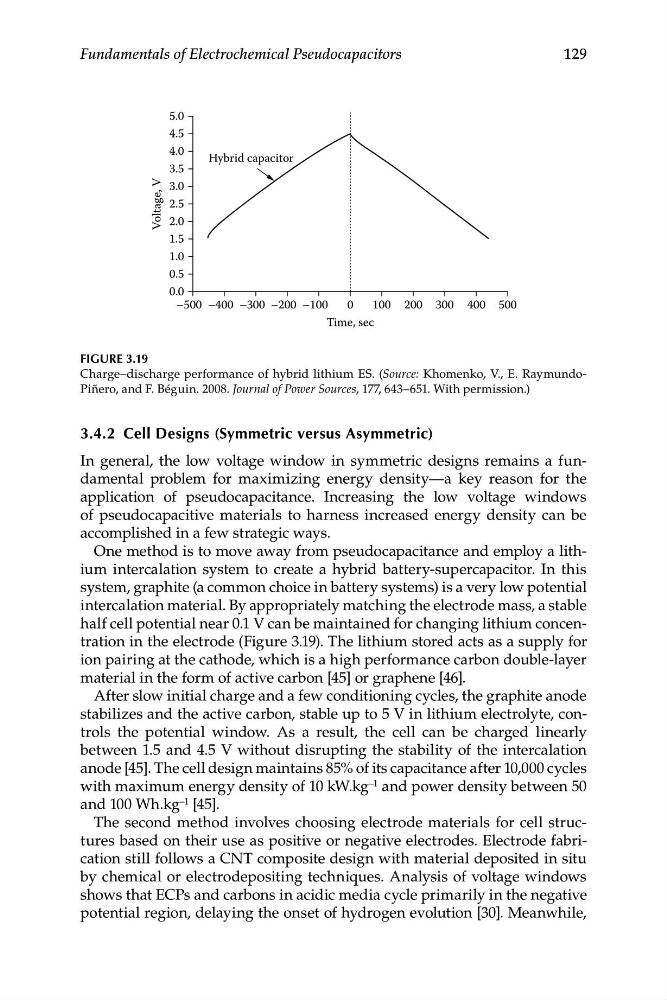
Charge–discharge performance of hybrid lithium ES. (Source: Khomenko, V., E. RaymundoPiñero, and F. Béguin. 2008. Journal of Power Sources, 177, 643–651. With permission.)
3.4.2 Cell Designs (Symmetric versus Asymmetric)
In general, the low voltage window in symmetric designs remains a fundamental problem for maximizing energy density—a key reason for the
application of pseudocapacitance. Increasing the low voltage windows
of pseudocapacitive materials to harness increased energy density can be
accomplished in a few strategic ways.
One method is to move away from pseudocapacitance and employ a lithium intercalation system to create a hybrid battery-supercapacitor. In this
system, graphite (a common choice in battery systems) is a very low potential
intercalation material. By appropriately matching the electrode mass, a stable
half cell potential near 0.1 V can be maintained for changing lithium concentration in the electrode (Figure 3.19). The lithium stored acts as a supply for
ion pairing at the cathode, which is a high performance carbon double-layer
material in the form of active carbon [45] or graphene [46].
After slow initial charge and a few conditioning cycles, the graphite anode
stabilizes and the active carbon, stable up to 5 V in lithium electrolyte, controls the potential window. As a result, the cell can be charged linearly
between 1.5 and 4.5 V without disrupting the stability of the intercalation
anode [45]. The cell design maintains 85% of its capacitance after 10,000 cycles
with maximum energy density of 10 kW.kg –1 and power density between 50
and 100 Wh.kg –1 [45].
The second method involves choosing electrode materials for cell structures based on their use as positive or negative electrodes. Electrode fabrication still follows a CNT composite design with material deposited in situ
by chemical or electrodepositing techniques. Analysis of voltage windows
shows that ECPs and carbons in acidic media cycle primarily in the negative
potential region, delaying the onset of hydrogen evolution [30]. Meanwhile,
5.0
4.5
4.0
3.5
3.0
2.5
2.0
1.5
1.0
0.5
0.0
Hybrid capacitor
–500 –400 –300 –200 –100
0
100 200 300 400 500
Time, sec
129
Fundamentals of Electrochemical Pseudocapacitors
FIGURE 3.19
Charge–discharge performance of hybrid lithium ES. (Source: Khomenko, V., E. RaymundoPiñero, and F. Béguin. 2008. Journal of Power Sources, 177, 643–651. With permission.)
3.4.2 Cell Designs (Symmetric versus Asymmetric)
In general, the low voltage window in symmetric designs remains a fundamental problem for maximizing energy density—a key reason for the
application of pseudocapacitance. Increasing the low voltage windows
of pseudocapacitive materials to harness increased energy density can be
accomplished in a few strategic ways.
One method is to move away from pseudocapacitance and employ a lithium intercalation system to create a hybrid battery-supercapacitor. In this
system, graphite (a common choice in battery systems) is a very low potential
intercalation material. By appropriately matching the electrode mass, a stable
half cell potential near 0.1 V can be maintained for changing lithium concentration in the electrode (Figure 3.19). The lithium stored acts as a supply for
ion pairing at the cathode, which is a high performance carbon double-layer
material in the form of active carbon [45] or graphene [46].
After slow initial charge and a few conditioning cycles, the graphite anode
stabilizes and the active carbon, stable up to 5 V in lithium electrolyte, controls the potential window. As a result, the cell can be charged linearly
between 1.5 and 4.5 V without disrupting the stability of the intercalation
anode [45]. The cell design maintains 85% of its capacitance after 10,000 cycles
with maximum energy density of 10 kW.kg –1 and power density between 50
and 100 Wh.kg –1 [45].
The second method involves choosing electrode materials for cell structures based on their use as positive or negative electrodes. Electrode fabrication still follows a CNT composite design with material deposited in situ
by chemical or electrodepositing techniques. Analysis of voltage windows
shows that ECPs and carbons in acidic media cycle primarily in the negative
potential region, delaying the onset of hydrogen evolution [30]. Meanwhile,