

0.6
–0.8
–0.6
–0.4
–0.2
15
0.4
0
0.2
0.4
10
0.6
0.8
2 m V/s
100 m V/s
Current Density [A/g]
0.2
5
0
0
–0.2
–5
–0.4
–10
–0.6
–15
E [V vs. Hg/Hg 2 SO 4 ]
Current Density [A/g]
124
Electrochemical Supercapacitors for Energy Storage and Delivery
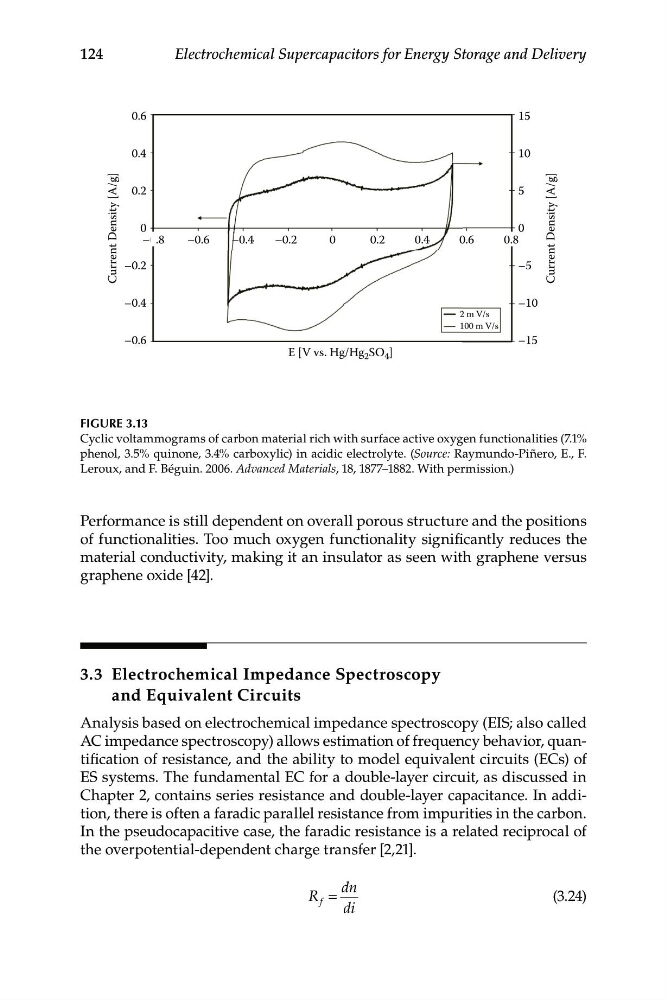
FIGURE 3.13
Cyclic voltammograms of carbon material rich with surface active oxygen functionalities (7.1%
phenol, 3.5% quinone, 3.4% carboxylic) in acidic electrolyte. (Source: Raymundo-Piñero, E., F.
Leroux, and F. Béguin. 2006. Advanced Materials, 18, 1877–1882. With permission.)
Performance is still dependent on overall porous structure and the positions
of functionalities. Too much oxygen functionality significantly reduces the
material conductivity, making it an insulator as seen with graphene versus
graphene oxide [42].
3.3 Electrochemical Impedance Spectroscopy
and Equivalent Circuits
Analysis based on electrochemical impedance spectroscopy (EIS; also called
AC impedance spectroscopy) allows estimation of frequency behavior, quantification of resistance, and the ability to model equivalent circuits (ECs) of
ES systems. The fundamental EC for a double-layer circuit, as discussed in
Chapter 2, contains series resistance and double-layer capacitance. In addition, there is often a faradic parallel resistance from impurities in the carbon.
In the pseudocapacitive case, the faradic resistance is a related reciprocal of
the overpotential-dependent charge transfer [2,21].
dn
R f =
(3.24)
di
–0.8
–0.6
–0.4
–0.2
15
0.4
0
0.2
0.4
10
0.6
0.8
2 m V/s
100 m V/s
Current Density [A/g]
0.2
5
0
0
–0.2
–5
–0.4
–10
–0.6
–15
E [V vs. Hg/Hg 2 SO 4 ]
Current Density [A/g]
124
Electrochemical Supercapacitors for Energy Storage and Delivery
FIGURE 3.13
Cyclic voltammograms of carbon material rich with surface active oxygen functionalities (7.1%
phenol, 3.5% quinone, 3.4% carboxylic) in acidic electrolyte. (Source: Raymundo-Piñero, E., F.
Leroux, and F. Béguin. 2006. Advanced Materials, 18, 1877–1882. With permission.)
Performance is still dependent on overall porous structure and the positions
of functionalities. Too much oxygen functionality significantly reduces the
material conductivity, making it an insulator as seen with graphene versus
graphene oxide [42].
3.3 Electrochemical Impedance Spectroscopy
and Equivalent Circuits
Analysis based on electrochemical impedance spectroscopy (EIS; also called
AC impedance spectroscopy) allows estimation of frequency behavior, quantification of resistance, and the ability to model equivalent circuits (ECs) of
ES systems. The fundamental EC for a double-layer circuit, as discussed in
Chapter 2, contains series resistance and double-layer capacitance. In addition, there is often a faradic parallel resistance from impurities in the carbon.
In the pseudocapacitive case, the faradic resistance is a related reciprocal of
the overpotential-dependent charge transfer [2,21].
dn
R f =
(3.24)
di