

> C = NH + 2e
– + 2H
+
> CH – NH 2
> C – NHOH + 2e
– + 2H
+
N
N
N
N
(–)
+ e
– + H
+
> C – NH 2 + H 2 O
H
123
Fundamentals of Electrochemical Pseudocapacitors
Relative Conductivity
1.07
1.06
1.05
1.04
1.03
1.02
1.01
1
0.99
–0.5
0.1M KCl
0.1M HCl
–0.3
–0.1
0.1
0.3
0.5
0.7
E(V) vs. SCE
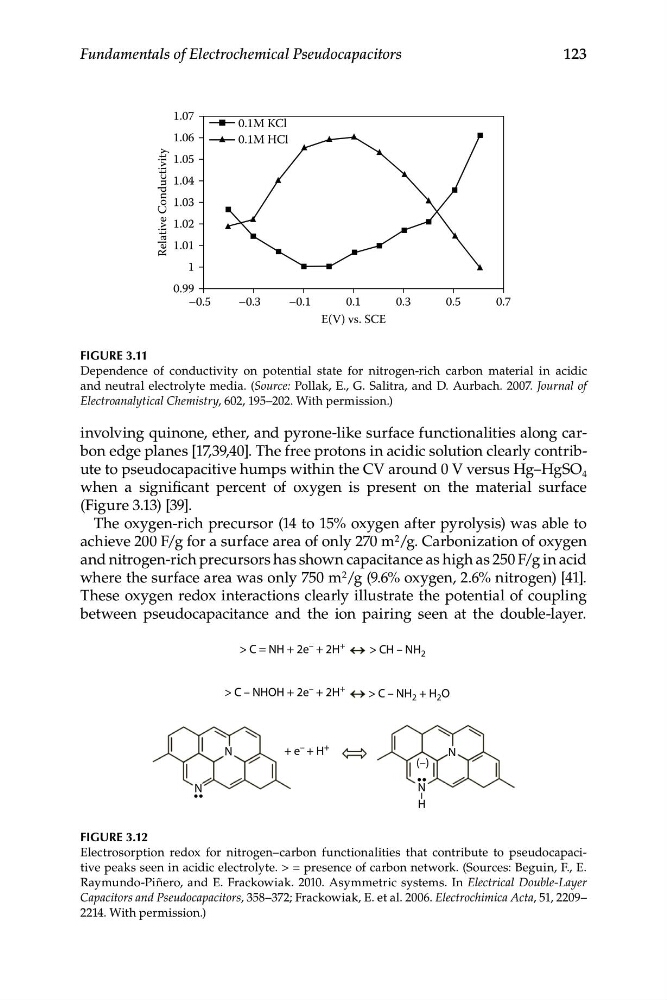
FIGURE 3.11
Dependence of conductivity on potential state for nitrogen-rich carbon material in acidic
and neutral electrolyte media. (Source: Pollak, E., G. Salitra, and D. Aurbach. 2007. Journal of
Electroanalytical Chemistry, 602, 195–202. With permission.)
involving quinone, ether, and pyrone-like surface functionalities along carbon edge planes [17,39,40]. The free protons in acidic solution clearly contribute to pseudocapacitive humps within the CV around 0 V versus Hg–HgSO 4
when a significant percent of oxygen is present on the material surface
(Figure 3.13) [39].
The oxygen-rich precursor (14 to 15% oxygen after pyrolysis) was able to
achieve 200 F/g for a surface area of only 270 m 2 /g. Carbonization of oxygen
and nitrogen-rich precursors has shown capacitance as high as 250 F/g in acid
where the surface area was only 750 m 2 /g (9.6% oxygen, 2.6% nitrogen) [41].
These oxygen redox interactions clearly illustrate the potential of coupling
between pseudocapacitance and the ion pairing seen at the double-layer.
FIGURE 3.12
Electrosorption redox for nitrogen–carbon functionalities that contribute to pseudocapacitive peaks seen in acidic electrolyte. > = presence of carbon network. (Sources: Beguin, F., E.
Raymundo-Piñero, and E. Frackowiak. 2010. Asymmetric systems. In Electrical Double-Layer
Capacitors and Pseudocapacitors, 358–372; Frackowiak, E. et al. 2006. Electrochimica Acta, 51, 2209–
2214. With permission.)
– + 2H
+
> CH – NH 2
> C – NHOH + 2e
– + 2H
+
N
N
N
N
(–)
+ e
– + H
+
> C – NH 2 + H 2 O
H
123
Fundamentals of Electrochemical Pseudocapacitors
Relative Conductivity
1.07
1.06
1.05
1.04
1.03
1.02
1.01
1
0.99
–0.5
0.1M KCl
0.1M HCl
–0.3
–0.1
0.1
0.3
0.5
0.7
E(V) vs. SCE
FIGURE 3.11
Dependence of conductivity on potential state for nitrogen-rich carbon material in acidic
and neutral electrolyte media. (Source: Pollak, E., G. Salitra, and D. Aurbach. 2007. Journal of
Electroanalytical Chemistry, 602, 195–202. With permission.)
involving quinone, ether, and pyrone-like surface functionalities along carbon edge planes [17,39,40]. The free protons in acidic solution clearly contribute to pseudocapacitive humps within the CV around 0 V versus Hg–HgSO 4
when a significant percent of oxygen is present on the material surface
(Figure 3.13) [39].
The oxygen-rich precursor (14 to 15% oxygen after pyrolysis) was able to
achieve 200 F/g for a surface area of only 270 m 2 /g. Carbonization of oxygen
and nitrogen-rich precursors has shown capacitance as high as 250 F/g in acid
where the surface area was only 750 m 2 /g (9.6% oxygen, 2.6% nitrogen) [41].
These oxygen redox interactions clearly illustrate the potential of coupling
between pseudocapacitance and the ion pairing seen at the double-layer.
FIGURE 3.12
Electrosorption redox for nitrogen–carbon functionalities that contribute to pseudocapacitive peaks seen in acidic electrolyte. > = presence of carbon network. (Sources: Beguin, F., E.
Raymundo-Piñero, and E. Frackowiak. 2010. Asymmetric systems. In Electrical Double-Layer
Capacitors and Pseudocapacitors, 358–372; Frackowiak, E. et al. 2006. Electrochimica Acta, 51, 2209–
2214. With permission.)