

30
20
10
0
–10
–20
CNTs/PANI
GNS/PANI
GNS/CNTs/PANI
PANI
Current/A g
–1
–0.8
–0.6
–0.4
–0.2
0.0
0.2
0.4
Potential/V vs. Hg/HgO
122
Electrochemical Supercapacitors for Energy Storage and Delivery
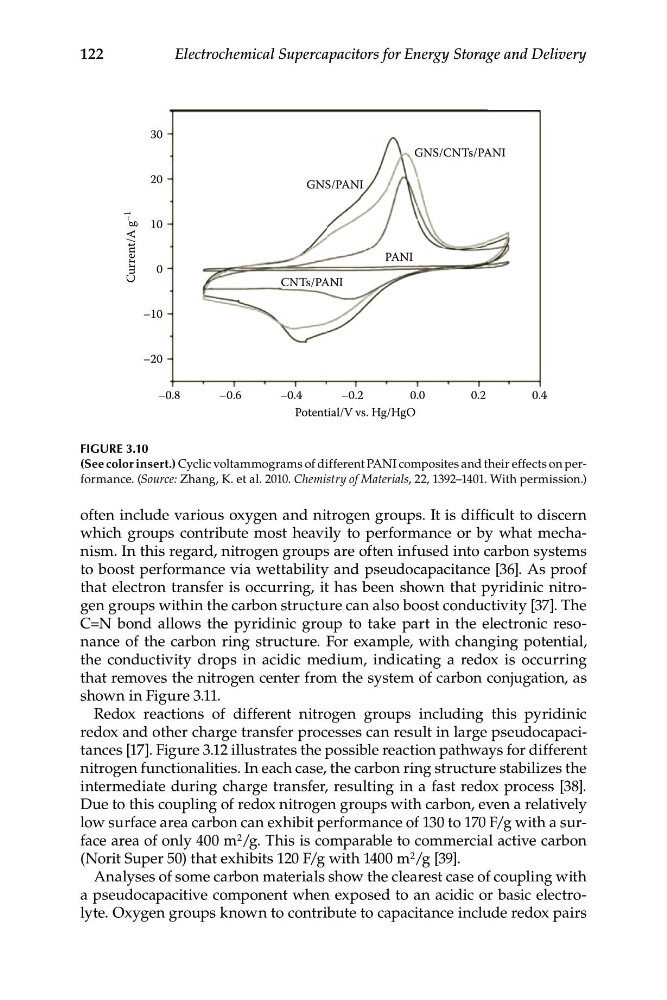
FIGURE 3.10
(See color insert.) Cyclic voltammograms of different PANI composites and their effects on performance. (Source: Zhang, K. et al. 2010. Chemistry of Materials, 22, 1392–1401. With permission.)
often include various oxygen and nitrogen groups. It is difficult to discern
which groups contribute most heavily to performance or by what mechanism. In this regard, nitrogen groups are often infused into carbon systems
to boost performance via wettability and pseudocapacitance [36]. As proof
that electron transfer is occurring, it has been shown that pyridinic nitrogen groups within the carbon structure can also boost conductivity [37]. The
C=N bond allows the pyridinic group to take part in the electronic resonance of the carbon ring structure. For example, with changing potential,
the conductivity drops in acidic medium, indicating a redox is occurring
that removes the nitrogen center from the system of carbon conjugation, as
shown in Figure 3.11.
Redox reactions of different nitrogen groups including this pyridinic
redox and other charge transfer processes can result in large pseudocapacitances [17]. Figure 3.12 illustrates the possible reaction pathways for different
nitrogen functionalities. In each case, the carbon ring structure stabilizes the
intermediate during charge transfer, resulting in a fast redox process [38].
Due to this coupling of redox nitrogen groups with carbon, even a relatively
low surface area carbon can exhibit performance of 130 to 170 F/g with a surface area of only 400 m 2 /g. This is comparable to commercial active carbon
(Norit Super 50) that exhibits 120 F/g with 1400 m 2 /g [39].
Analyses of some carbon materials show the clearest case of coupling with
a pseudocapacitive component when exposed to an acidic or basic electrolyte. Oxygen groups known to contribute to capacitance include redox pairs
20
10
0
–10
–20
CNTs/PANI
GNS/PANI
GNS/CNTs/PANI
PANI
Current/A g
–1
–0.8
–0.6
–0.4
–0.2
0.0
0.2
0.4
Potential/V vs. Hg/HgO
122
Electrochemical Supercapacitors for Energy Storage and Delivery
FIGURE 3.10
(See color insert.) Cyclic voltammograms of different PANI composites and their effects on performance. (Source: Zhang, K. et al. 2010. Chemistry of Materials, 22, 1392–1401. With permission.)
often include various oxygen and nitrogen groups. It is difficult to discern
which groups contribute most heavily to performance or by what mechanism. In this regard, nitrogen groups are often infused into carbon systems
to boost performance via wettability and pseudocapacitance [36]. As proof
that electron transfer is occurring, it has been shown that pyridinic nitrogen groups within the carbon structure can also boost conductivity [37]. The
C=N bond allows the pyridinic group to take part in the electronic resonance of the carbon ring structure. For example, with changing potential,
the conductivity drops in acidic medium, indicating a redox is occurring
that removes the nitrogen center from the system of carbon conjugation, as
shown in Figure 3.11.
Redox reactions of different nitrogen groups including this pyridinic
redox and other charge transfer processes can result in large pseudocapacitances [17]. Figure 3.12 illustrates the possible reaction pathways for different
nitrogen functionalities. In each case, the carbon ring structure stabilizes the
intermediate during charge transfer, resulting in a fast redox process [38].
Due to this coupling of redox nitrogen groups with carbon, even a relatively
low surface area carbon can exhibit performance of 130 to 170 F/g with a surface area of only 400 m 2 /g. This is comparable to commercial active carbon
(Norit Super 50) that exhibits 120 F/g with 1400 m 2 /g [39].
Analyses of some carbon materials show the clearest case of coupling with
a pseudocapacitive component when exposed to an acidic or basic electrolyte. Oxygen groups known to contribute to capacitance include redox pairs