

104
Electrochemical Supercapacitors for Energy Storage and Delivery
⎛ nF
⎞
2 2
exp ⎜
(E
o
RT
O X /R d
− E ⎟
n F
⎝
⎠ dE
i =
dC
o
RT
(3.5)
O X ⎡
⎛ nF
⎢1
o
⎞ ⎤
2 dt
+ exp ⎜
(E
⎣
⎝ R RT
O X /R d
− E ⎟⎥
⎠⎦
Note that
dE
dt
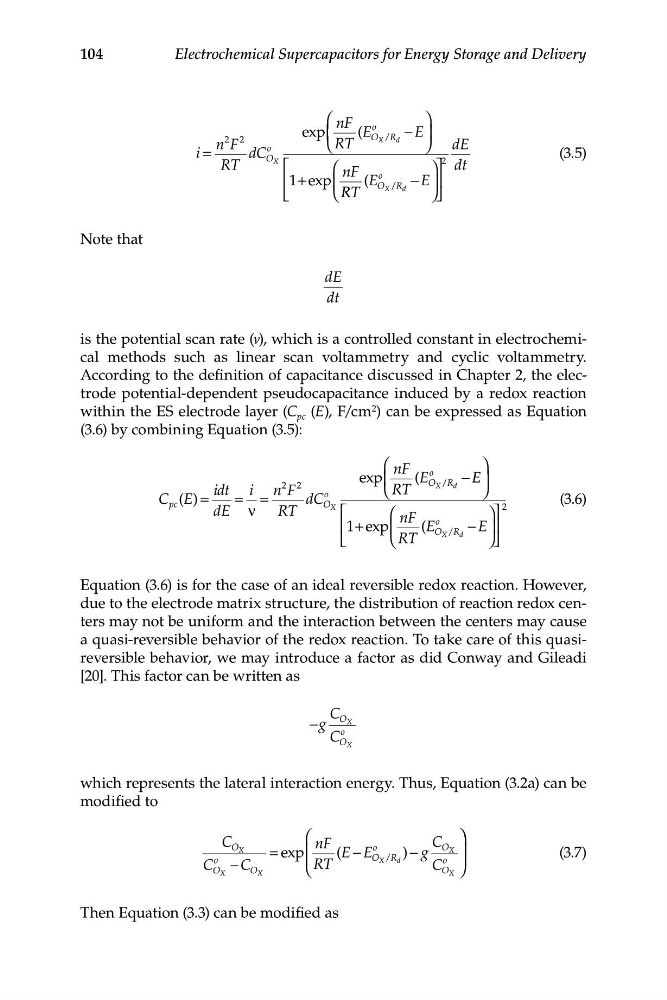
is the potential scan rate (ν), which is a controlled constant in electrochemical methods such as linear scan voltammetry and cyclic voltammetry.
According to the definition of capacitance discussed in Chapter 2, the electrode potential-dependent pseudocapacitance induced by a redox reaction
within the ES electrode layer (C pc (E), F/cm 2 ) can be expressed as Equation
(3.6) by combining Equation (3.5):
⎛ nF o
⎞
exp ⎜
(E
idt i n
− E E ⎟
2 2
F
o
⎝ RT
O X /R d
⎠
C E
pc ( ) =
= =
dC
(3.6)
dE ν RT
O X ⎡
⎛
⎞ ⎤
2
nF
⎢1+ exp ⎜
(E
o
O /R − E ⎟⎥
⎣
⎝ RT
X
d
⎠⎦
Equation (3.6) is for the case of an ideal reversible redox reaction. However,
due to the electrode matrix structure, the distribution of reaction redox centers may not be uniform and the interaction between the centers may cause
a quasi-reversible behavior of the redox reaction. To take care of this quasireversible behavior, we may introduce a factor as did Conway and Gileadi
[20]. This factor can be written as
C
−g
O X
C
o
O X
which represents the lateral interaction energy. Thus, Equation (3.2a) can be
modified to
C
⎛
⎞ ⎞
O X
nF
o
C
= exp ⎜
(E E
−
) − g
O
⎟
o
(3.7)
⎜
X
−
C
O X /R d
o ⎟
O
C
RT
X
O X
⎝
C O X ⎠
Then Equation (3.3) can be modified as
Electrochemical Supercapacitors for Energy Storage and Delivery
⎛ nF
⎞
2 2
exp ⎜
(E
o
RT
O X /R d
− E ⎟
n F
⎝
⎠ dE
i =
dC
o
RT
(3.5)
O X ⎡
⎛ nF
⎢1
o
⎞ ⎤
2 dt
+ exp ⎜
(E
⎣
⎝ R RT
O X /R d
− E ⎟⎥
⎠⎦
Note that
dE
dt
is the potential scan rate (ν), which is a controlled constant in electrochemical methods such as linear scan voltammetry and cyclic voltammetry.
According to the definition of capacitance discussed in Chapter 2, the electrode potential-dependent pseudocapacitance induced by a redox reaction
within the ES electrode layer (C pc (E), F/cm 2 ) can be expressed as Equation
(3.6) by combining Equation (3.5):
⎛ nF o
⎞
exp ⎜
(E
idt i n
− E E ⎟
2 2
F
o
⎝ RT
O X /R d
⎠
C E
pc ( ) =
= =
dC
(3.6)
dE ν RT
O X ⎡
⎛
⎞ ⎤
2
nF
⎢1+ exp ⎜
(E
o
O /R − E ⎟⎥
⎣
⎝ RT
X
d
⎠⎦
Equation (3.6) is for the case of an ideal reversible redox reaction. However,
due to the electrode matrix structure, the distribution of reaction redox centers may not be uniform and the interaction between the centers may cause
a quasi-reversible behavior of the redox reaction. To take care of this quasireversible behavior, we may introduce a factor as did Conway and Gileadi
[20]. This factor can be written as
C
−g
O X
C
o
O X
which represents the lateral interaction energy. Thus, Equation (3.2a) can be
modified to
C
⎛
⎞ ⎞
O X
nF
o
C
= exp ⎜
(E E
−
) − g
O
⎟
o
(3.7)
⎜
X
−
C
O X /R d
o ⎟
O
C
RT
X
O X
⎝
C O X ⎠
Then Equation (3.3) can be modified as