

Fundamentals of Electrochemical Pseudocapacitors
103
where E
o
O X /R d
is the standard electrode potential (25°C, 1.0 atm) of Reaction
(3.I), C OX and C Rd are the concentrations of O X and reductant R d within the
entire electrode layer (mol.cm –3 ), E is the electrode potential (V), R is the universal gas constant (8.314 J/K·mol), and T is the temperature (K). If the initial
state of the electrode layer contains only oxidant with a concentration of C
o
O X
,
the consumption of O X due to electrochemical reaction will produce R d with a
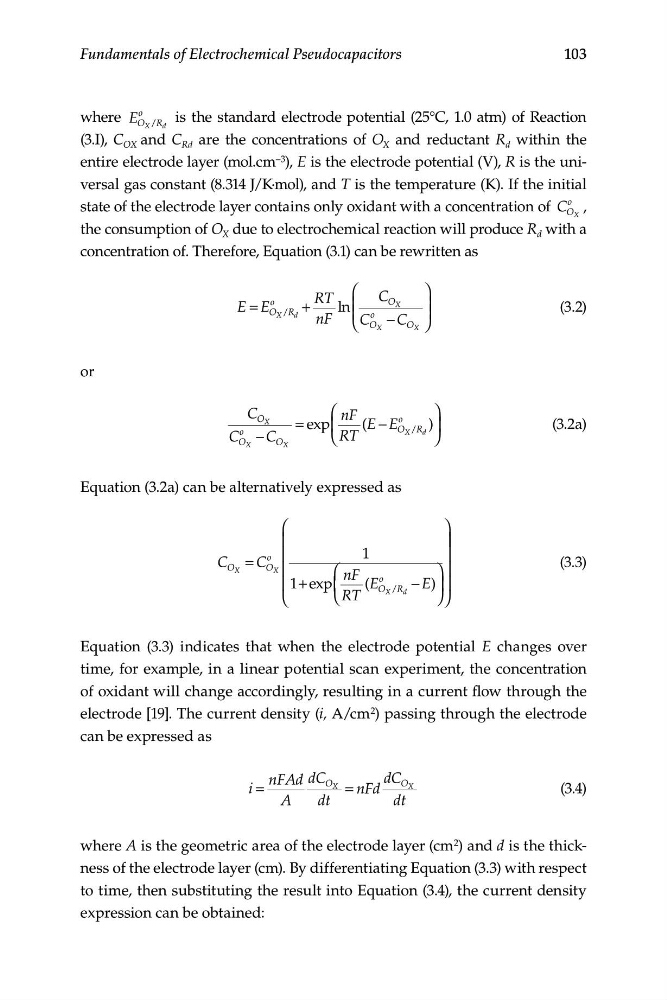
concentration of. Therefore, Equation (3.1) can be rewritten as
⎛ C
⎞
RT
E E
o
=
X /R
ln
⎜
O
⎟
O
d
+
⎜
X
nF
⎝ C
o
(3.2)
⎟
O −
C O
X
X ⎠
or
C
O
⎛ nF
⎞
X
o
=
exp
⎜
(E E
−
o
)
(3.2a)
C O −
O /R ⎟
X
C
⎝
X
RT
d
O X
⎠
Equation (3.2a) can be alternatively expressed as
⎛
⎞
⎜
⎟ ⎟
o ⎜
1
⎟
C O =
C O
X
X
(3.3)
⎜
⎛
nF
⎞
⎟
⎜
1 e
+ xp ⎜
(E
o
−
⎟ ⎟
⎝
⎝
/R
RT
O X d
E
)
⎠
⎠
Equation (3.3) indicates that when the electrode potential E changes over
time, for example, in a linear potential scan experiment, the concentration
of oxidant will change accordingly, resulting in a current flow through the
electrode [19]. The current density (i, A/cm 2 ) passing through the electrode
can be expressed as
nFAd dC
dC
i
=
O X
=
nFd
O X
(3.4)
A
dt
dt
where A is the geometric area of the electrode layer (cm 2 ) and d is the thickness of the electrode layer (cm). By differentiating Equation (3.3) with respect
to time, then substituting the result into Equation (3.4), the current density
expression can be obtained:
103
where E
o
O X /R d
is the standard electrode potential (25°C, 1.0 atm) of Reaction
(3.I), C OX and C Rd are the concentrations of O X and reductant R d within the
entire electrode layer (mol.cm –3 ), E is the electrode potential (V), R is the universal gas constant (8.314 J/K·mol), and T is the temperature (K). If the initial
state of the electrode layer contains only oxidant with a concentration of C
o
O X
,
the consumption of O X due to electrochemical reaction will produce R d with a
concentration of. Therefore, Equation (3.1) can be rewritten as
⎛ C
⎞
RT
E E
o
=
X /R
ln
⎜
O
⎟
O
d
+
⎜
X
nF
⎝ C
o
(3.2)
⎟
O −
C O
X
X ⎠
or
C
O
⎛ nF
⎞
X
o
=
exp
⎜
(E E
−
o
)
(3.2a)
C O −
O /R ⎟
X
C
⎝
X
RT
d
O X
⎠
Equation (3.2a) can be alternatively expressed as
⎛
⎞
⎜
⎟ ⎟
o ⎜
1
⎟
C O =
C O
X
X
(3.3)
⎜
⎛
nF
⎞
⎟
⎜
1 e
+ xp ⎜
(E
o
−
⎟ ⎟
⎝
⎝
/R
RT
O X d
E
)
⎠
⎠
Equation (3.3) indicates that when the electrode potential E changes over
time, for example, in a linear potential scan experiment, the concentration
of oxidant will change accordingly, resulting in a current flow through the
electrode [19]. The current density (i, A/cm 2 ) passing through the electrode
can be expressed as
nFAd dC
dC
i
=
O X
=
nFd
O X
(3.4)
A
dt
dt
where A is the geometric area of the electrode layer (cm 2 ) and d is the thickness of the electrode layer (cm). By differentiating Equation (3.3) with respect
to time, then substituting the result into Equation (3.4), the current density
expression can be obtained: