

102
Electrochemical Supercapacitors for Energy Storage and Delivery
anode and cathode materials that exhibit extended voltage stability and
higher capacitance.
For example, in an acidic medium, carbon electrodes exhibit stronger stability in the negative region due to hydrogen electrosorption [17]. In this
approach, the carbon anode seems to work well with respect to another
pseudocapacitive cathode material with overpotential in the positive regime
to boost performance and the potential window. Furthermore, to determine acceptable materials it is important to understand the charge regimes,
identify operable characteristics, and be able to quantify resistances due to
faradic components in the system.
3.2 E lectrochemical Pseudocapacitance of
Electrode–Electrolyte Interface
3.2.1 Fundamental Electrochemistry of Pseudocapacitance
As discussed above, in a typical ES electrode layer containing both doublelayer and redox materials, two processes happen during charge or discharge.
One is the accumulation of static charge within the double-layer, producing double-layer capacitance, and the other is the charge release or storage
induced by the redox reaction, producing pseudocapacitance. For doublelayer processes, we provided a detailed discussion in Chapter 2. As discussed above, only reversible or quasi-reversible redox materials are desired
for pseudocapacitance generation by an ES. In this section, we will focus on
the reversible (or quasi-reversible) redox reactions and discuss their fundamental electrochemistry.
Assuming that the redox material particles and/or reaction sites are uniformly distributed in the electrode layer and both the oxidant (O X ) and
the reductant (R d ) are insoluble in the electrolyte, the redox process can be
expressed as
O X + ne – ↔R d
(3.I)
where n is the overall electron transfer number involved in Reaction (3.I).
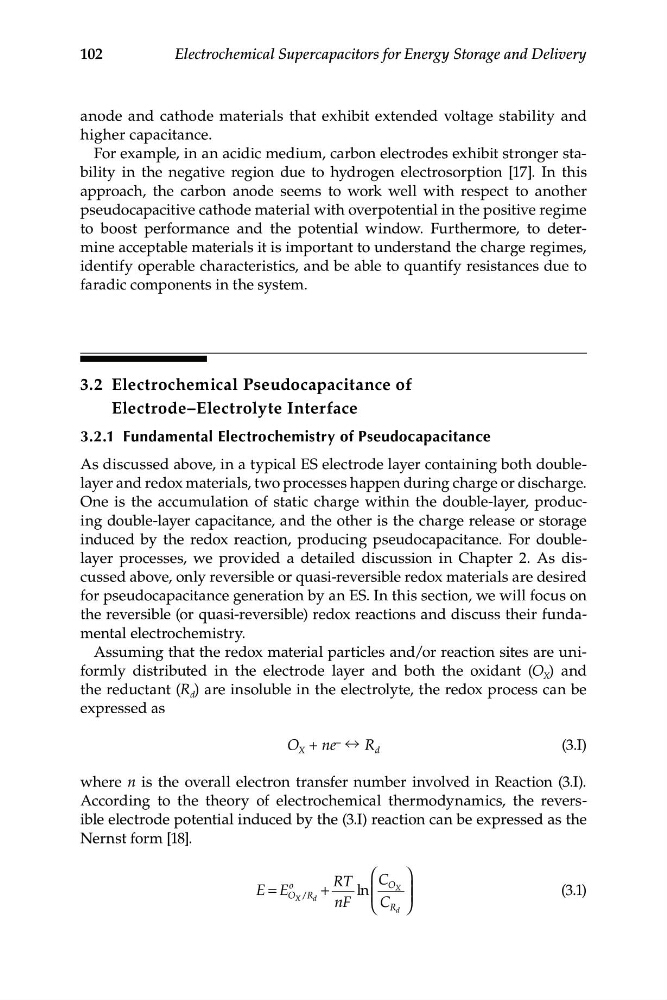
According to the theory of electrochemical thermodynamics, the reversible electrode potential induced by the (3.I) reaction can be expressed as the
Nernst form [18].
⎛
⎞
RT
C
E E O
o
X /R d
+
nF
⎜ ⎜
⎝ C
O
R d
⎟ ⎟
⎠
(3.1)
=
ln
X
Electrochemical Supercapacitors for Energy Storage and Delivery
anode and cathode materials that exhibit extended voltage stability and
higher capacitance.
For example, in an acidic medium, carbon electrodes exhibit stronger stability in the negative region due to hydrogen electrosorption [17]. In this
approach, the carbon anode seems to work well with respect to another
pseudocapacitive cathode material with overpotential in the positive regime
to boost performance and the potential window. Furthermore, to determine acceptable materials it is important to understand the charge regimes,
identify operable characteristics, and be able to quantify resistances due to
faradic components in the system.
3.2 E lectrochemical Pseudocapacitance of
Electrode–Electrolyte Interface
3.2.1 Fundamental Electrochemistry of Pseudocapacitance
As discussed above, in a typical ES electrode layer containing both doublelayer and redox materials, two processes happen during charge or discharge.
One is the accumulation of static charge within the double-layer, producing double-layer capacitance, and the other is the charge release or storage
induced by the redox reaction, producing pseudocapacitance. For doublelayer processes, we provided a detailed discussion in Chapter 2. As discussed above, only reversible or quasi-reversible redox materials are desired
for pseudocapacitance generation by an ES. In this section, we will focus on
the reversible (or quasi-reversible) redox reactions and discuss their fundamental electrochemistry.
Assuming that the redox material particles and/or reaction sites are uniformly distributed in the electrode layer and both the oxidant (O X ) and
the reductant (R d ) are insoluble in the electrolyte, the redox process can be
expressed as
O X + ne – ↔R d
(3.I)
where n is the overall electron transfer number involved in Reaction (3.I).
According to the theory of electrochemical thermodynamics, the reversible electrode potential induced by the (3.I) reaction can be expressed as the
Nernst form [18].
⎛
⎞
RT
C
E E O
o
X /R d
+
nF
⎜ ⎜
⎝ C
O
R d
⎟ ⎟
⎠
(3.1)
=
ln
X