

101
Fundamentals of Electrochemical Pseudocapacitors
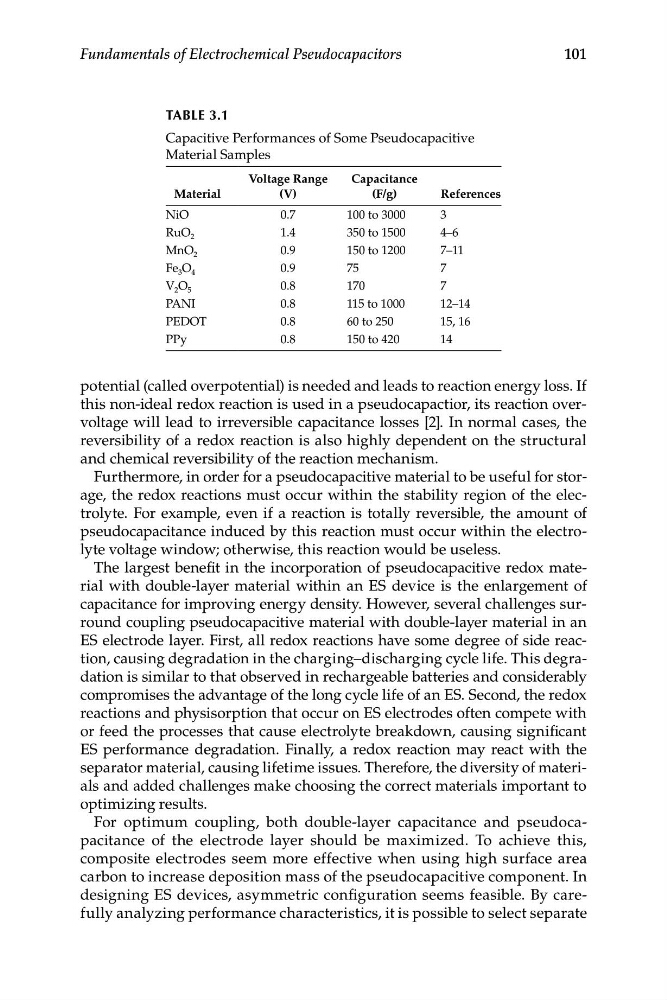
TABLE 3.1
Capacitive Performances of Some Pseudocapacitive
Material Samples
Voltage Range
Capacitance
Material
(V)
(F/g)
References
NiO
0.7
100 to 3000
3
RuO 2
1.4
350 to 1500
4–6
MnO 2
0.9
150 to 1200
7–11
Fe 3 O 4
0.9
75
7
V 2 O 5
0.8
170
7
PANI
0.8
115 to 1000
12–14
PEDOT
0.8
60 to 250
15, 16
PPy
0.8
150 to 420
14
potential (called overpotential) is needed and leads to reaction energy loss. If
this non-ideal redox reaction is used in a pseudocapactior, its reaction overvoltage will lead to irreversible capacitance losses [2]. In normal cases, the
reversibility of a redox reaction is also highly dependent on the structural
and chemical reversibility of the reaction mechanism.
Furthermore, in order for a pseudocapacitive material to be useful for storage, the redox reactions must occur within the stability region of the electrolyte. For example, even if a reaction is totally reversible, the amount of
pseudocapacitance induced by this reaction must occur within the electrolyte voltage window; otherwise, this reaction would be useless.
The largest benefit in the incorporation of pseudocapacitive redox material with double-layer material within an ES device is the enlargement of
capacitance for improving energy density. However, several challenges surround coupling pseudocapacitive material with double-layer material in an
ES electrode layer. First, all redox reactions have some degree of side reaction, causing degradation in the charging–discharging cycle life. This degradation is similar to that observed in rechargeable batteries and considerably
compromises the advantage of the long cycle life of an ES. Second, the redox
reactions and physisorption that occur on ES electrodes often compete with
or feed the processes that cause electrolyte breakdown, causing significant
ES performance degradation. Finally, a redox reaction may react with the
separator material, causing lifetime issues. Therefore, the diversity of materials and added challenges make choosing the correct materials important to
optimizing results.
For optimum coupling, both double-layer capacitance and pseudocapacitance of the electrode layer should be maximized. To achieve this,
composite electrodes seem more effective when using high surface area
carbon to increase deposition mass of the pseudocapacitive component. In
designing ES devices, asymmetric configuration seems feasible. By carefully analyzing performance characteristics, it is possible to select separate
Fundamentals of Electrochemical Pseudocapacitors
TABLE 3.1
Capacitive Performances of Some Pseudocapacitive
Material Samples
Voltage Range
Capacitance
Material
(V)
(F/g)
References
NiO
0.7
100 to 3000
3
RuO 2
1.4
350 to 1500
4–6
MnO 2
0.9
150 to 1200
7–11
Fe 3 O 4
0.9
75
7
V 2 O 5
0.8
170
7
PANI
0.8
115 to 1000
12–14
PEDOT
0.8
60 to 250
15, 16
PPy
0.8
150 to 420
14
potential (called overpotential) is needed and leads to reaction energy loss. If
this non-ideal redox reaction is used in a pseudocapactior, its reaction overvoltage will lead to irreversible capacitance losses [2]. In normal cases, the
reversibility of a redox reaction is also highly dependent on the structural
and chemical reversibility of the reaction mechanism.
Furthermore, in order for a pseudocapacitive material to be useful for storage, the redox reactions must occur within the stability region of the electrolyte. For example, even if a reaction is totally reversible, the amount of
pseudocapacitance induced by this reaction must occur within the electrolyte voltage window; otherwise, this reaction would be useless.
The largest benefit in the incorporation of pseudocapacitive redox material with double-layer material within an ES device is the enlargement of
capacitance for improving energy density. However, several challenges surround coupling pseudocapacitive material with double-layer material in an
ES electrode layer. First, all redox reactions have some degree of side reaction, causing degradation in the charging–discharging cycle life. This degradation is similar to that observed in rechargeable batteries and considerably
compromises the advantage of the long cycle life of an ES. Second, the redox
reactions and physisorption that occur on ES electrodes often compete with
or feed the processes that cause electrolyte breakdown, causing significant
ES performance degradation. Finally, a redox reaction may react with the
separator material, causing lifetime issues. Therefore, the diversity of materials and added challenges make choosing the correct materials important to
optimizing results.
For optimum coupling, both double-layer capacitance and pseudocapacitance of the electrode layer should be maximized. To achieve this,
composite electrodes seem more effective when using high surface area
carbon to increase deposition mass of the pseudocapacitive component. In
designing ES devices, asymmetric configuration seems feasible. By carefully analyzing performance characteristics, it is possible to select separate