

81
Fundamentals of Electrochemical Double-Layer Supercapacitors
(
ΔC
ΔE m ) = E
m
m
max
( ) max C m
and
( ΔE M ) = E M
max
( )
ΔC m .
max C m
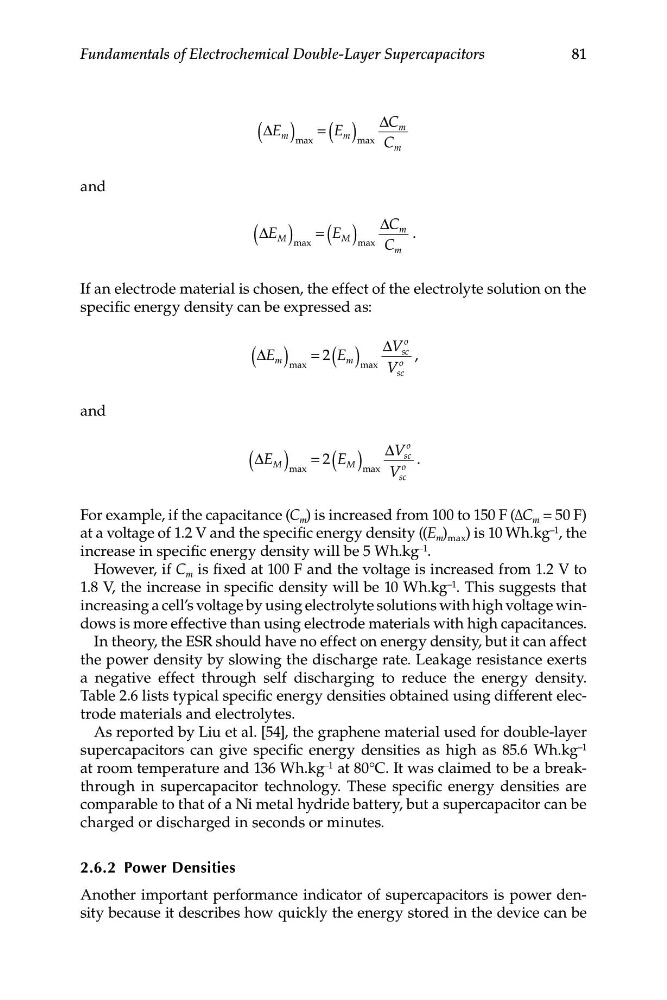
If an electrode material is chosen, the effect of the electrolyte solution on the
specific energy density can be expressed as:
( )
ΔV
ΔE
=
o
2 ( )
E
sc
m
m
,
max
max V
o
sc
and
( ΔE M ) = E M
max
2 ( ) max
ΔV
o
sc
V
o
.
sc
For example, if the capacitance (C m ) is increased from 100 to 150 F (ΔC m = 50 F)
at a voltage of 1.2 V and the specific energy density ((E m ) max ) is 10 Wh.kg –1 , the
increase in specific energy density will be 5 Wh.kg –1 .
However, if C m is fixed at 100 F and the voltage is increased from 1.2 V to
1.8 V, the increase in specific density will be 10 Wh.kg –1 . This suggests that
increasing a cell’s voltage by using electrolyte solutions with high voltage windows is more effective than using electrode materials with high capacitances.
In theory, the ESR should have no effect on energy density, but it can affect
the power density by slowing the discharge rate. Leakage resistance exerts
a negative effect through self discharging to reduce the energy density.
Table 2.6 lists typical specific energy densities obtained using different electrode materials and electrolytes.
As reported by Liu et al. [54], the graphene material used for double-layer
supercapacitors can give specific energy densities as high as 85.6 Wh.kg –1
at room temperature and 136 Wh.kg –1 at 80°C. It was claimed to be a breakthrough in supercapacitor technology. These specific energy densities are
comparable to that of a Ni metal hydride battery, but a supercapacitor can be
charged or discharged in seconds or minutes.
2.6.2 Power Densities
Another important performance indicator of supercapacitors is power density because it describes how quickly the energy stored in the device can be
Fundamentals of Electrochemical Double-Layer Supercapacitors
(
ΔC
ΔE m ) = E
m
m
max
( ) max C m
and
( ΔE M ) = E M
max
( )
ΔC m .
max C m
If an electrode material is chosen, the effect of the electrolyte solution on the
specific energy density can be expressed as:
( )
ΔV
ΔE
=
o
2 ( )
E
sc
m
m
,
max
max V
o
sc
and
( ΔE M ) = E M
max
2 ( ) max
ΔV
o
sc
V
o
.
sc
For example, if the capacitance (C m ) is increased from 100 to 150 F (ΔC m = 50 F)
at a voltage of 1.2 V and the specific energy density ((E m ) max ) is 10 Wh.kg –1 , the
increase in specific energy density will be 5 Wh.kg –1 .
However, if C m is fixed at 100 F and the voltage is increased from 1.2 V to
1.8 V, the increase in specific density will be 10 Wh.kg –1 . This suggests that
increasing a cell’s voltage by using electrolyte solutions with high voltage windows is more effective than using electrode materials with high capacitances.
In theory, the ESR should have no effect on energy density, but it can affect
the power density by slowing the discharge rate. Leakage resistance exerts
a negative effect through self discharging to reduce the energy density.
Table 2.6 lists typical specific energy densities obtained using different electrode materials and electrolytes.
As reported by Liu et al. [54], the graphene material used for double-layer
supercapacitors can give specific energy densities as high as 85.6 Wh.kg –1
at room temperature and 136 Wh.kg –1 at 80°C. It was claimed to be a breakthrough in supercapacitor technology. These specific energy densities are
comparable to that of a Ni metal hydride battery, but a supercapacitor can be
charged or discharged in seconds or minutes.
2.6.2 Power Densities
Another important performance indicator of supercapacitors is power density because it describes how quickly the energy stored in the device can be