

80
Electrochemical Supercapacitors for Energy Storage and Delivery
1 C m
E =
V
2
m
(2.66)
2 M
sc
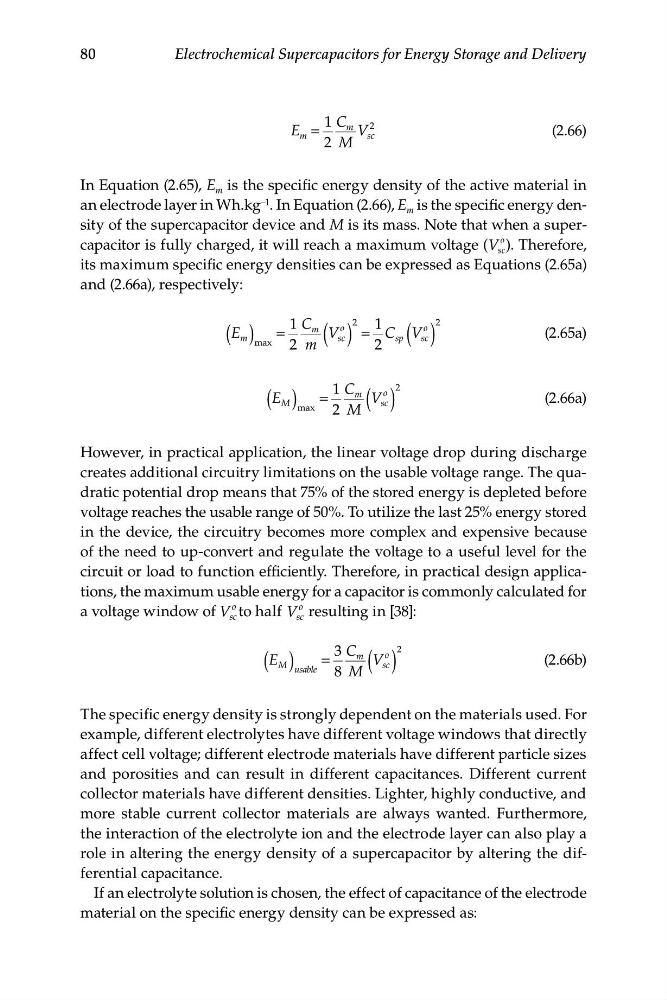
In Equation (2.65), E m is the specific energy density of the active material in
an electrode layer in Wh.kg –1 . In Equation (2.66), E m is the specific energy density of the supercapacitor device and M is its mass. Note that when a supercapacitor is fully charged, it will reach a maximum voltage (V
o
sc ). Therefore,
its maximum specific energy densities can be expressed as Equations (2.65a)
and (2.66a), respectively:
( )
1 C
( )
2
2
E
=
m V
o
1
o
m
sc
= C sp V sc
(2.65a)
max
2 m
2
( )
1 C
2
( )
E M
=
m
( V
o
sc )
(2.66a)
max
2 M
However, in practical application, the linear voltage drop during discharge
creates additional circuitry limitations on the usable voltage range. The quadratic potential drop means that 75% of the stored energy is depleted before
voltage reaches the usable range of 50%. To utilize the last 25% energy stored
in the device, the circuitry becomes more complex and expensive because
of the need to up-convert and regulate the voltage to a useful level for the
circuit or load to function efficiently. Therefore, in practical design applications, the maximum usable energy for a capacitor is commonly calculated for
a voltage window of V
o
o
sc to half V sc resulting in [38]:
3 C
2
( )
E
m
o
M
=
V
8 M
( sc
e
)
(2.66b)
usabl
The specific energy density is strongly dependent on the materials used. For
example, different electrolytes have different voltage windows that directly
affect cell voltage; different electrode materials have different particle sizes
and porosities and can result in different capacitances. Different current
collector materials have different densities. Lighter, highly conductive, and
more stable current collector materials are always wanted. Furthermore,
the interaction of the electrolyte ion and the electrode layer can also play a
role in altering the energy density of a supercapacitor by altering the differential capacitance.
If an electrolyte solution is chosen, the effect of capacitance of the electrode
material on the specific energy density can be expressed as:
Electrochemical Supercapacitors for Energy Storage and Delivery
1 C m
E =
V
2
m
(2.66)
2 M
sc
In Equation (2.65), E m is the specific energy density of the active material in
an electrode layer in Wh.kg –1 . In Equation (2.66), E m is the specific energy density of the supercapacitor device and M is its mass. Note that when a supercapacitor is fully charged, it will reach a maximum voltage (V
o
sc ). Therefore,
its maximum specific energy densities can be expressed as Equations (2.65a)
and (2.66a), respectively:
( )
1 C
( )
2
2
E
=
m V
o
1
o
m
sc
= C sp V sc
(2.65a)
max
2 m
2
( )
1 C
2
( )
E M
=
m
( V
o
sc )
(2.66a)
max
2 M
However, in practical application, the linear voltage drop during discharge
creates additional circuitry limitations on the usable voltage range. The quadratic potential drop means that 75% of the stored energy is depleted before
voltage reaches the usable range of 50%. To utilize the last 25% energy stored
in the device, the circuitry becomes more complex and expensive because
of the need to up-convert and regulate the voltage to a useful level for the
circuit or load to function efficiently. Therefore, in practical design applications, the maximum usable energy for a capacitor is commonly calculated for
a voltage window of V
o
o
sc to half V sc resulting in [38]:
3 C
2
( )
E
m
o
M
=
V
8 M
( sc
e
)
(2.66b)
usabl
The specific energy density is strongly dependent on the materials used. For
example, different electrolytes have different voltage windows that directly
affect cell voltage; different electrode materials have different particle sizes
and porosities and can result in different capacitances. Different current
collector materials have different densities. Lighter, highly conductive, and
more stable current collector materials are always wanted. Furthermore,
the interaction of the electrolyte ion and the electrode layer can also play a
role in altering the energy density of a supercapacitor by altering the differential capacitance.
If an electrolyte solution is chosen, the effect of capacitance of the electrode
material on the specific energy density can be expressed as: