

82
5 InGaN/GaN Multiple Quantum Wells Materials …
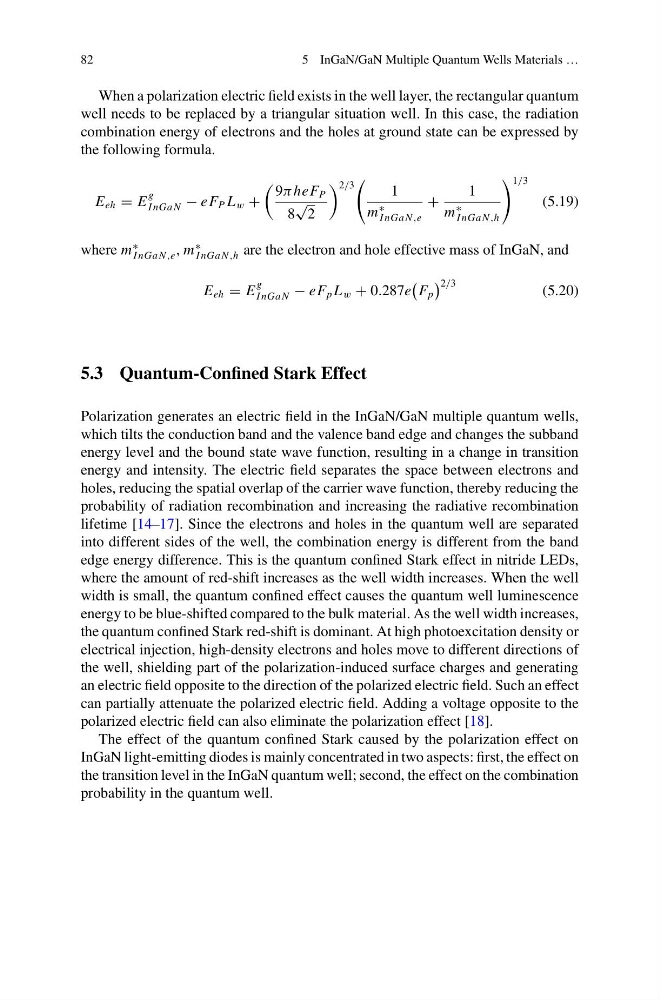
When a polarization electric field exists in the well layer, the rectangular quantum
well needs to be replaced by a triangular situation well. In this case, the radiation
combination energy of electrons and the holes at ground state can be expressed by
the following formula.
E eh = E
g
I nGaN − eF P L w +
9π heF P
8
√
2
2/3
1
m
∗
I nGaN,e
+
1
m
∗
I nGaN,h
1/3
(5.19)
where m
∗
I nGaN,e , m
∗
I nGaN,h are the electron and hole effective mass of InGaN, and
E eh = E
g
I nGaN − eF p L w + 0.287e
F p
2/3
(5.20)
5.3 Quantum-Confined Stark Effect
Polarization generates an electric field in the InGaN/GaN multiple quantum wells,
which tilts the conduction band and the valence band edge and changes the subband
energy level and the bound state wave function, resulting in a change in transition
energy and intensity. The electric field separates the space between electrons and
holes, reducing the spatial overlap of the carrier wave function, thereby reducing the
probability of radiation recombination and increasing the radiative recombination
lifetime [14–17]. Since the electrons and holes in the quantum well are separated
into different sides of the well, the combination energy is different from the band
edge energy difference. This is the quantum confined Stark effect in nitride LEDs,
where the amount of red-shift increases as the well width increases. When the well
width is small, the quantum confined effect causes the quantum well luminescence
energy to be blue-shifted compared to the bulk material. As the well width increases,
the quantum confined Stark red-shift is dominant. At high photoexcitation density or
electrical injection, high-density electrons and holes move to different directions of
the well, shielding part of the polarization-induced surface charges and generating
an electric field opposite to the direction of the polarized electric field. Such an effect
can partially attenuate the polarized electric field. Adding a voltage opposite to the
polarized electric field can also eliminate the polarization effect [18].
The effect of the quantum confined Stark caused by the polarization effect on
InGaN light-emitting diodes is mainly concentrated in two aspects: first, the effect on
the transition level in the InGaN quantum well; second, the effect on the combination
probability in the quantum well.
5 InGaN/GaN Multiple Quantum Wells Materials …
When a polarization electric field exists in the well layer, the rectangular quantum
well needs to be replaced by a triangular situation well. In this case, the radiation
combination energy of electrons and the holes at ground state can be expressed by
the following formula.
E eh = E
g
I nGaN − eF P L w +
9π heF P
8
√
2
2/3
1
m
∗
I nGaN,e
+
1
m
∗
I nGaN,h
1/3
(5.19)
where m
∗
I nGaN,e , m
∗
I nGaN,h are the electron and hole effective mass of InGaN, and
E eh = E
g
I nGaN − eF p L w + 0.287e
F p
2/3
(5.20)
5.3 Quantum-Confined Stark Effect
Polarization generates an electric field in the InGaN/GaN multiple quantum wells,
which tilts the conduction band and the valence band edge and changes the subband
energy level and the bound state wave function, resulting in a change in transition
energy and intensity. The electric field separates the space between electrons and
holes, reducing the spatial overlap of the carrier wave function, thereby reducing the
probability of radiation recombination and increasing the radiative recombination
lifetime [14–17]. Since the electrons and holes in the quantum well are separated
into different sides of the well, the combination energy is different from the band
edge energy difference. This is the quantum confined Stark effect in nitride LEDs,
where the amount of red-shift increases as the well width increases. When the well
width is small, the quantum confined effect causes the quantum well luminescence
energy to be blue-shifted compared to the bulk material. As the well width increases,
the quantum confined Stark red-shift is dominant. At high photoexcitation density or
electrical injection, high-density electrons and holes move to different directions of
the well, shielding part of the polarization-induced surface charges and generating
an electric field opposite to the direction of the polarized electric field. Such an effect
can partially attenuate the polarized electric field. Adding a voltage opposite to the
polarized electric field can also eliminate the polarization effect [18].
The effect of the quantum confined Stark caused by the polarization effect on
InGaN light-emitting diodes is mainly concentrated in two aspects: first, the effect on
the transition level in the InGaN quantum well; second, the effect on the combination
probability in the quantum well.