

5.3 Quantum-Constrained Stark Effect
83
5.3.1 Effect on Transition Energy Levels
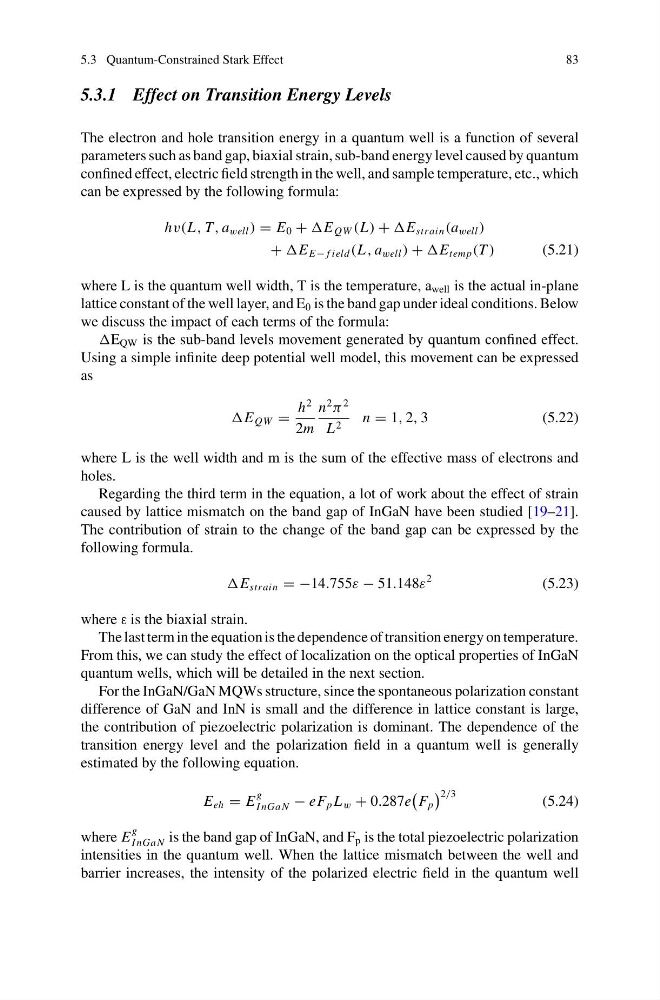
The electron and hole transition energy in a quantum well is a function of several
parameters such as band gap, biaxial strain, sub-band energy level caused by quantum
confined effect, electric field strength in the well, and sample temperature, etc., which
can be expressed by the following formula:
hv(L , T, a well ) = E 0 + E QW (L) + E strain (a well )
+ E E− f ield (L , a well ) + E temp (T )
(5.21)
where L is the quantum well width, T is the temperature, a well is the actual in-plane
lattice constant of the well layer, and E 0 is the band gap under ideal conditions. Below
we discuss the impact of each terms of the formula:
E QW is the sub-band levels movement generated by quantum confined effect.
Using a simple infinite deep potential well model, this movement can be expressed
as
E QW =
h
2
2m
n
2
π
2
L 2 n = 1, 2, 3
(5.22)
where L is the well width and m is the sum of the effective mass of electrons and
holes.
Regarding the third term in the equation, a lot of work about the effect of strain
caused by lattice mismatch on the band gap of InGaN have been studied [19–21].
The contribution of strain to the change of the band gap can be expressed by the
following formula.
E strain = −14.755ε − 51.148ε
2
(5.23)
where ε is the biaxial strain.
The last term in the equation is the dependence of transition energy on temperature.
From this, we can study the effect of localization on the optical properties of InGaN
quantum wells, which will be detailed in the next section.
For the InGaN/GaN MQWs structure, since the spontaneous polarization constant
difference of GaN and InN is small and the difference in lattice constant is large,
the contribution of piezoelectric polarization is dominant. The dependence of the
transition energy level and the polarization field in a quantum well is generally
estimated by the following equation.
E eh = E
g
I nGaN − eF p L w + 0.287e
F p
2/3
(5.24)
where E
g
I nGaN is the band gap of InGaN, and F p is the total piezoelectric polarization
intensities in the quantum well. When the lattice mismatch between the well and
barrier increases, the intensity of the polarized electric field in the quantum well
83
5.3.1 Effect on Transition Energy Levels
The electron and hole transition energy in a quantum well is a function of several
parameters such as band gap, biaxial strain, sub-band energy level caused by quantum
confined effect, electric field strength in the well, and sample temperature, etc., which
can be expressed by the following formula:
hv(L , T, a well ) = E 0 + E QW (L) + E strain (a well )
+ E E− f ield (L , a well ) + E temp (T )
(5.21)
where L is the quantum well width, T is the temperature, a well is the actual in-plane
lattice constant of the well layer, and E 0 is the band gap under ideal conditions. Below
we discuss the impact of each terms of the formula:
E QW is the sub-band levels movement generated by quantum confined effect.
Using a simple infinite deep potential well model, this movement can be expressed
as
E QW =
h
2
2m
n
2
π
2
L 2 n = 1, 2, 3
(5.22)
where L is the well width and m is the sum of the effective mass of electrons and
holes.
Regarding the third term in the equation, a lot of work about the effect of strain
caused by lattice mismatch on the band gap of InGaN have been studied [19–21].
The contribution of strain to the change of the band gap can be expressed by the
following formula.
E strain = −14.755ε − 51.148ε
2
(5.23)
where ε is the biaxial strain.
The last term in the equation is the dependence of transition energy on temperature.
From this, we can study the effect of localization on the optical properties of InGaN
quantum wells, which will be detailed in the next section.
For the InGaN/GaN MQWs structure, since the spontaneous polarization constant
difference of GaN and InN is small and the difference in lattice constant is large,
the contribution of piezoelectric polarization is dominant. The dependence of the
transition energy level and the polarization field in a quantum well is generally
estimated by the following equation.
E eh = E
g
I nGaN − eF p L w + 0.287e
F p
2/3
(5.24)
where E
g
I nGaN is the band gap of InGaN, and F p is the total piezoelectric polarization
intensities in the quantum well. When the lattice mismatch between the well and
barrier increases, the intensity of the polarized electric field in the quantum well