

68
4 Epitaxial of III-Nitride LED Materials
due to the smaller tensile stress during the cooling process. If AlGaN is used as
the buffer layer, the content of Al component should be greater than 6% to reduce
the tensile strain in the epitaxial layer [45]; (4) For microelectronic materials, semiinsulating AlN can improve the high-voltage breakdown capability of the buffer
layer.
Studies by Davis et al. [52] show that AlN grows mostly in the polycrystalline
state between 500 and 1050 °C. At temperature above 1100 °C, it is possible for AlN
to form single crystal. Since the saturated vapor pressure of N in AlN is lower than
that of GaN [53], the high temperature annealing process has little effect on AlN
and does not form a three-dimensional growth process similar to that of GaN buffer
layer. High temperature growth condition is mostly used for AlN on SiC substrate.
Studies have shown that [54] nucleation of AlN or GaN directly on SiC substrate
will exist as Al polar plane or Ga polar plane. Nitride grown by nitridation will
appear as N polar plane. Since the polarity of AlN directly affects the polarity of
the subsequent GaN material, we can determine the surface polarity characteristics
of the GaN epitaxial layer according to the nitridation condition. Even if the lattice
mismatch of AlN and SiC substrates is only 1%, the epitaxial growth of AlN on SiC
substrate is still heteroepitaxy, which is manifested by the presence of the stacking
faults of Si/C and Al/N diatomic layers at the interface between AlN epitaxial layer
and SiC substrate [55]. Coupled with the weak migration of Al atoms on the surface
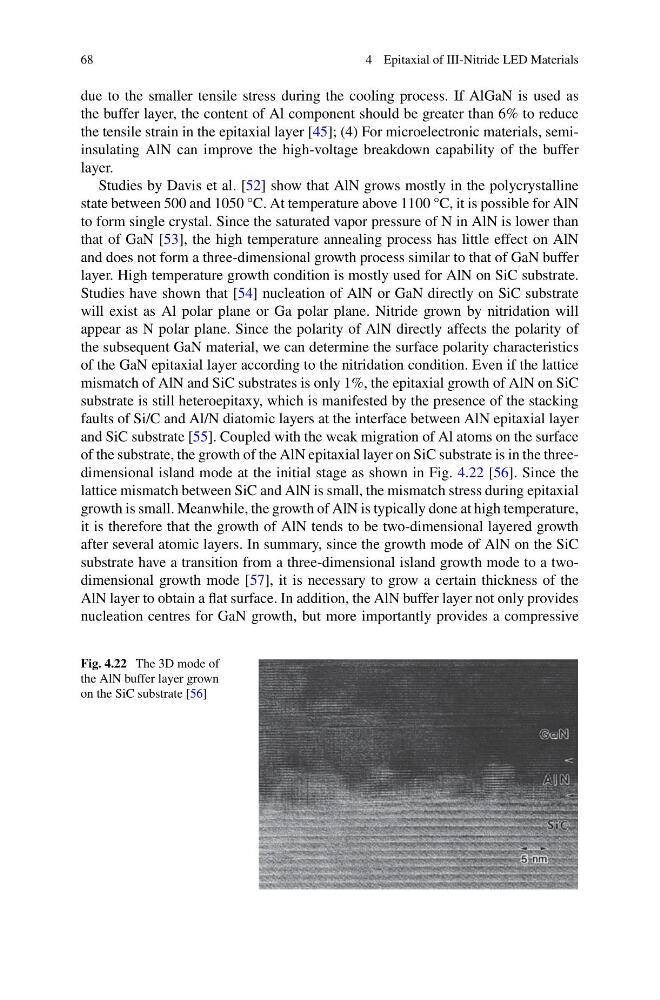
of the substrate, the growth of the AlN epitaxial layer on SiC substrate is in the threedimensional island mode at the initial stage as shown in Fig. 4.22 [56]. Since the
lattice mismatch between SiC and AlN is small, the mismatch stress during epitaxial
growth is small. Meanwhile, the growth of AlN is typically done at high temperature,
it is therefore that the growth of AlN tends to be two-dimensional layered growth
after several atomic layers. In summary, since the growth mode of AlN on the SiC
substrate have a transition from a three-dimensional island growth mode to a twodimensional growth mode [57], it is necessary to grow a certain thickness of the
AlN layer to obtain a flat surface. In addition, the AlN buffer layer not only provides
nucleation centres for GaN growth, but more importantly provides a compressive
Fig. 4.22 The 3D mode of
the AlN buffer layer grown
on the SiC substrate [56]
4 Epitaxial of III-Nitride LED Materials
due to the smaller tensile stress during the cooling process. If AlGaN is used as
the buffer layer, the content of Al component should be greater than 6% to reduce
the tensile strain in the epitaxial layer [45]; (4) For microelectronic materials, semiinsulating AlN can improve the high-voltage breakdown capability of the buffer
layer.
Studies by Davis et al. [52] show that AlN grows mostly in the polycrystalline
state between 500 and 1050 °C. At temperature above 1100 °C, it is possible for AlN
to form single crystal. Since the saturated vapor pressure of N in AlN is lower than
that of GaN [53], the high temperature annealing process has little effect on AlN
and does not form a three-dimensional growth process similar to that of GaN buffer
layer. High temperature growth condition is mostly used for AlN on SiC substrate.
Studies have shown that [54] nucleation of AlN or GaN directly on SiC substrate
will exist as Al polar plane or Ga polar plane. Nitride grown by nitridation will
appear as N polar plane. Since the polarity of AlN directly affects the polarity of
the subsequent GaN material, we can determine the surface polarity characteristics
of the GaN epitaxial layer according to the nitridation condition. Even if the lattice
mismatch of AlN and SiC substrates is only 1%, the epitaxial growth of AlN on SiC
substrate is still heteroepitaxy, which is manifested by the presence of the stacking
faults of Si/C and Al/N diatomic layers at the interface between AlN epitaxial layer
and SiC substrate [55]. Coupled with the weak migration of Al atoms on the surface
of the substrate, the growth of the AlN epitaxial layer on SiC substrate is in the threedimensional island mode at the initial stage as shown in Fig. 4.22 [56]. Since the
lattice mismatch between SiC and AlN is small, the mismatch stress during epitaxial
growth is small. Meanwhile, the growth of AlN is typically done at high temperature,
it is therefore that the growth of AlN tends to be two-dimensional layered growth
after several atomic layers. In summary, since the growth mode of AlN on the SiC
substrate have a transition from a three-dimensional island growth mode to a twodimensional growth mode [57], it is necessary to grow a certain thickness of the
AlN layer to obtain a flat surface. In addition, the AlN buffer layer not only provides
nucleation centres for GaN growth, but more importantly provides a compressive
Fig. 4.22 The 3D mode of
the AlN buffer layer grown
on the SiC substrate [56]