

3.2 Polarization Effect of Group III Nitride Materials
23
3.2 Polarization Effect of Group III Nitride Materials
3.2.1 Polarization Effect
The wurtzite structure nitride semiconductor crystal does not have central symmetry.
Taking GaN as an example, in the c-axis direction, the plane formed by Ga atoms
(Ga plane) is separated from the plane formed by N atoms (N plane). This results in
the spontaneous polarization effects due to the misalignment between the positive
and negative charge centers. The polarization direction is along the c-axis [0001]
direction. Usually, the (0001) plane is called the c-plane, the {1–100} plane is the
m-plane, the {11–20} plane is the a-plane, and the {1–102} plane is the r-plane [6].
The c-plane is a polar plane. The epitaxial growth of GaN on the sapphire substrate
along the c-axis direction is a relatively mature method for obtaining a better-quality
crystal. The most studied group III nitride semiconductor devices are based on the
c-plane Ga-polar face. In order to reduce the influence of the polarization effect on
the performance of the device, nitride devices built on non-polar surfaces such as aand m-plane or semi-polar r-plane at a certain angle with respect to the c-plane have
also been studied. Although there are still many difficulties in the quality of epitaxial
crystals, many studies have reported the high-performance devices on non-polar or
semi-polar crystal planes, where the performance of the devices is close to that built
on polar materials.
The spontaneous polarization of Group III nitrides is negative, indicating that
the spontaneous intensity is in the opposite direction of [0001]. The spontaneous
polarization of GaN, InN, and AlN are −0.034C/m
2 , −0.042C/m
2 , and −0.090 C/m
2 ,
respectively. The Vegard interpolation method is used to calculate the spontaneous
polarization of the ternary compound A x B 1-x N:
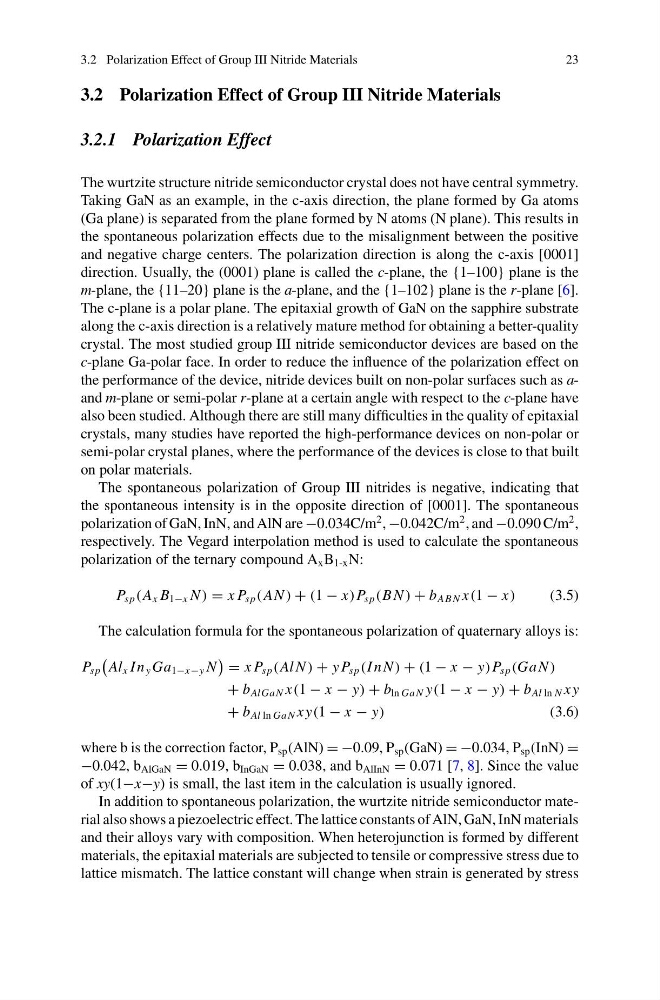
P sp (A x B 1−x N ) = x P sp (AN ) + (1 − x)P sp (B N ) + b AB N x(1 − x)
(3.5)
The calculation formula for the spontaneous polarization of quaternary alloys is:
P sp
Al x I n y Ga 1−x−y N
= x P sp (Al N ) + y P sp (I nN ) + (1 − x − y)P sp (Ga N )
+ b AlGa N x(1 − x − y) + b ln Ga N y(1 − x − y) + b Al ln N x y
+ b Al ln Ga N x y(1 − x − y)
(3.6)
where b is the correction factor, P sp (AlN) = −0.09, P sp (GaN) = −0.034, P sp (InN) =
−0.042, b AlGaN = 0.019, b InGaN = 0.038, and b AlInN = 0.071 [7, 8]. Since the value
of xy(1−x−y) is small, the last item in the calculation is usually ignored.
In addition to spontaneous polarization, the wurtzite nitride semiconductor material also shows a piezoelectric effect. The lattice constants of AlN, GaN, InN materials
and their alloys vary with composition. When heterojunction is formed by different
materials, the epitaxial materials are subjected to tensile or compressive stress due to
lattice mismatch. The lattice constant will change when strain is generated by stress
23
3.2 Polarization Effect of Group III Nitride Materials
3.2.1 Polarization Effect
The wurtzite structure nitride semiconductor crystal does not have central symmetry.
Taking GaN as an example, in the c-axis direction, the plane formed by Ga atoms
(Ga plane) is separated from the plane formed by N atoms (N plane). This results in
the spontaneous polarization effects due to the misalignment between the positive
and negative charge centers. The polarization direction is along the c-axis [0001]
direction. Usually, the (0001) plane is called the c-plane, the {1–100} plane is the
m-plane, the {11–20} plane is the a-plane, and the {1–102} plane is the r-plane [6].
The c-plane is a polar plane. The epitaxial growth of GaN on the sapphire substrate
along the c-axis direction is a relatively mature method for obtaining a better-quality
crystal. The most studied group III nitride semiconductor devices are based on the
c-plane Ga-polar face. In order to reduce the influence of the polarization effect on
the performance of the device, nitride devices built on non-polar surfaces such as aand m-plane or semi-polar r-plane at a certain angle with respect to the c-plane have
also been studied. Although there are still many difficulties in the quality of epitaxial
crystals, many studies have reported the high-performance devices on non-polar or
semi-polar crystal planes, where the performance of the devices is close to that built
on polar materials.
The spontaneous polarization of Group III nitrides is negative, indicating that
the spontaneous intensity is in the opposite direction of [0001]. The spontaneous
polarization of GaN, InN, and AlN are −0.034C/m
2 , −0.042C/m
2 , and −0.090 C/m
2 ,
respectively. The Vegard interpolation method is used to calculate the spontaneous
polarization of the ternary compound A x B 1-x N:
P sp (A x B 1−x N ) = x P sp (AN ) + (1 − x)P sp (B N ) + b AB N x(1 − x)
(3.5)
The calculation formula for the spontaneous polarization of quaternary alloys is:
P sp
Al x I n y Ga 1−x−y N
= x P sp (Al N ) + y P sp (I nN ) + (1 − x − y)P sp (Ga N )
+ b AlGa N x(1 − x − y) + b ln Ga N y(1 − x − y) + b Al ln N x y
+ b Al ln Ga N x y(1 − x − y)
(3.6)
where b is the correction factor, P sp (AlN) = −0.09, P sp (GaN) = −0.034, P sp (InN) =
−0.042, b AlGaN = 0.019, b InGaN = 0.038, and b AlInN = 0.071 [7, 8]. Since the value
of xy(1−x−y) is small, the last item in the calculation is usually ignored.
In addition to spontaneous polarization, the wurtzite nitride semiconductor material also shows a piezoelectric effect. The lattice constants of AlN, GaN, InN materials
and their alloys vary with composition. When heterojunction is formed by different
materials, the epitaxial materials are subjected to tensile or compressive stress due to
lattice mismatch. The lattice constant will change when strain is generated by stress