

24
3 Properties and Testing of Group III-Nitride LED Materials
in the critical thickness range. Polarized charges or piezoelectric effect will appear
at the interface resulted from the lattice strain. The total polarization of the material
is the sum of spontaneous and piezoelectric polarization.
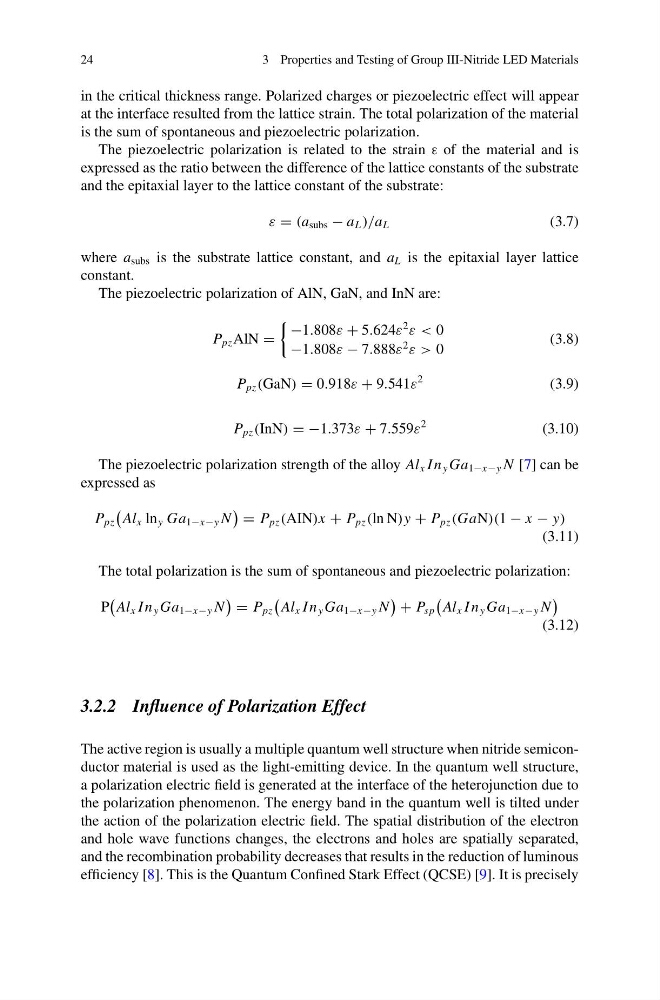
The piezoelectric polarization is related to the strain ε of the material and is
expressed as the ratio between the difference of the lattice constants of the substrate
and the epitaxial layer to the lattice constant of the substrate:
ε = (a subs − a L )/a L
(3.7)
where a subs is the substrate lattice constant, and a L is the epitaxial layer lattice
constant.
The piezoelectric polarization of AlN, GaN, and InN are:
P pz AlN =
−1.808ε + 5.624ε
2
ε < 0
−1.808ε − 7.888ε
2
ε > 0
(3.8)
P pz (GaN) = 0.918ε + 9.541ε
2
(3.9)
P pz (InN) = −1.373ε + 7.559ε
2
(3.10)
The piezoelectric polarization strength of the alloy Al x I n y Ga 1−x−y N [7] can be
expressed as
P pz
Al x ln y Ga 1−x−y N
= P pz (AIN)x + P pz (ln N)y + P pz (GaN)(1 − x − y)
(3.11)
The total polarization is the sum of spontaneous and piezoelectric polarization:
P
Al x I n y Ga 1−x−y N
= P pz
Al x I n y Ga 1−x−y N
+ P sp
Al x I n y Ga 1−x−y N
(3.12)
3.2.2 Influence of Polarization Effect
The active region is usually a multiple quantum well structure when nitride semiconductor material is used as the light-emitting device. In the quantum well structure,
a polarization electric field is generated at the interface of the heterojunction due to
the polarization phenomenon. The energy band in the quantum well is tilted under
the action of the polarization electric field. The spatial distribution of the electron
and hole wave functions changes, the electrons and holes are spatially separated,
and the recombination probability decreases that results in the reduction of luminous
efficiency [8]. This is the Quantum Confined Stark Effect (QCSE) [9]. It is precisely
3 Properties and Testing of Group III-Nitride LED Materials
in the critical thickness range. Polarized charges or piezoelectric effect will appear
at the interface resulted from the lattice strain. The total polarization of the material
is the sum of spontaneous and piezoelectric polarization.
The piezoelectric polarization is related to the strain ε of the material and is
expressed as the ratio between the difference of the lattice constants of the substrate
and the epitaxial layer to the lattice constant of the substrate:
ε = (a subs − a L )/a L
(3.7)
where a subs is the substrate lattice constant, and a L is the epitaxial layer lattice
constant.
The piezoelectric polarization of AlN, GaN, and InN are:
P pz AlN =
−1.808ε + 5.624ε
2
ε < 0
−1.808ε − 7.888ε
2
ε > 0
(3.8)
P pz (GaN) = 0.918ε + 9.541ε
2
(3.9)
P pz (InN) = −1.373ε + 7.559ε
2
(3.10)
The piezoelectric polarization strength of the alloy Al x I n y Ga 1−x−y N [7] can be
expressed as
P pz
Al x ln y Ga 1−x−y N
= P pz (AIN)x + P pz (ln N)y + P pz (GaN)(1 − x − y)
(3.11)
The total polarization is the sum of spontaneous and piezoelectric polarization:
P
Al x I n y Ga 1−x−y N
= P pz
Al x I n y Ga 1−x−y N
+ P sp
Al x I n y Ga 1−x−y N
(3.12)
3.2.2 Influence of Polarization Effect
The active region is usually a multiple quantum well structure when nitride semiconductor material is used as the light-emitting device. In the quantum well structure,
a polarization electric field is generated at the interface of the heterojunction due to
the polarization phenomenon. The energy band in the quantum well is tilted under
the action of the polarization electric field. The spatial distribution of the electron
and hole wave functions changes, the electrons and holes are spatially separated,
and the recombination probability decreases that results in the reduction of luminous
efficiency [8]. This is the Quantum Confined Stark Effect (QCSE) [9]. It is precisely