

12.4 GaN-Based Polarizing LEDs
283
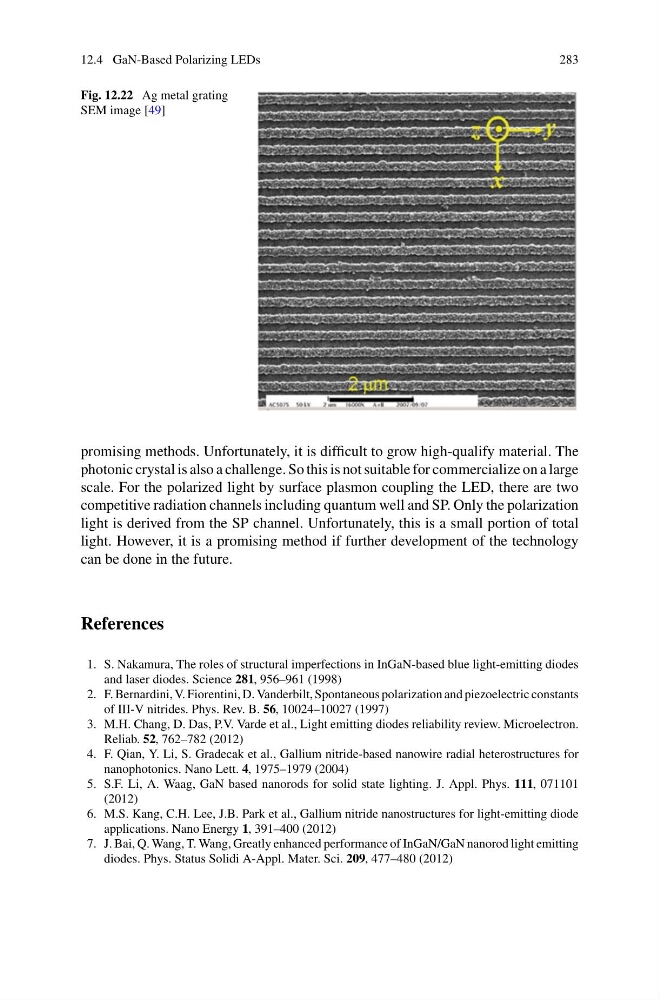
Fig. 12.22 Ag metal grating
SEM image [49]
promising methods. Unfortunately, it is difficult to grow high-qualify material. The
photonic crystal is also a challenge. So this is not suitable for commercialize on a large
scale. For the polarized light by surface plasmon coupling the LED, there are two
competitive radiation channels including quantum well and SP. Only the polarization
light is derived from the SP channel. Unfortunately, this is a small portion of total
light. However, it is a promising method if further development of the technology
can be done in the future.
References
1. S. Nakamura, The roles of structural imperfections in InGaN-based blue light-emitting diodes
and laser diodes. Science 281, 956–961 (1998)
2. F. Bernardini, V. Fiorentini, D. Vanderbilt, Spontaneous polarization and piezoelectric constants
of III-V nitrides. Phys. Rev. B. 56, 10024–10027 (1997)
3. M.H. Chang, D. Das, P.V. Varde et al., Light emitting diodes reliability review. Microelectron.
Reliab. 52, 762–782 (2012)
4. F. Qian, Y. Li, S. Gradecak et al., Gallium nitride-based nanowire radial heterostructures for
nanophotonics. Nano Lett. 4, 1975–1979 (2004)
5. S.F. Li, A. Waag, GaN based nanorods for solid state lighting. J. Appl. Phys. 111, 071101
(2012)
6. M.S. Kang, C.H. Lee, J.B. Park et al., Gallium nitride nanostructures for light-emitting diode
applications. Nano Energy 1, 391–400 (2012)
7. J. Bai, Q. Wang, T. Wang, Greatly enhanced performance of InGaN/GaN nanorod light emitting
diodes. Phys. Status Solidi A-Appl. Mater. Sci. 209, 477–480 (2012)
283
Fig. 12.22 Ag metal grating
SEM image [49]
promising methods. Unfortunately, it is difficult to grow high-qualify material. The
photonic crystal is also a challenge. So this is not suitable for commercialize on a large
scale. For the polarized light by surface plasmon coupling the LED, there are two
competitive radiation channels including quantum well and SP. Only the polarization
light is derived from the SP channel. Unfortunately, this is a small portion of total
light. However, it is a promising method if further development of the technology
can be done in the future.
References
1. S. Nakamura, The roles of structural imperfections in InGaN-based blue light-emitting diodes
and laser diodes. Science 281, 956–961 (1998)
2. F. Bernardini, V. Fiorentini, D. Vanderbilt, Spontaneous polarization and piezoelectric constants
of III-V nitrides. Phys. Rev. B. 56, 10024–10027 (1997)
3. M.H. Chang, D. Das, P.V. Varde et al., Light emitting diodes reliability review. Microelectron.
Reliab. 52, 762–782 (2012)
4. F. Qian, Y. Li, S. Gradecak et al., Gallium nitride-based nanowire radial heterostructures for
nanophotonics. Nano Lett. 4, 1975–1979 (2004)
5. S.F. Li, A. Waag, GaN based nanorods for solid state lighting. J. Appl. Phys. 111, 071101
(2012)
6. M.S. Kang, C.H. Lee, J.B. Park et al., Gallium nitride nanostructures for light-emitting diode
applications. Nano Energy 1, 391–400 (2012)
7. J. Bai, Q. Wang, T. Wang, Greatly enhanced performance of InGaN/GaN nanorod light emitting
diodes. Phys. Status Solidi A-Appl. Mater. Sci. 209, 477–480 (2012)