

282
12 Novel Nitride LED Technology
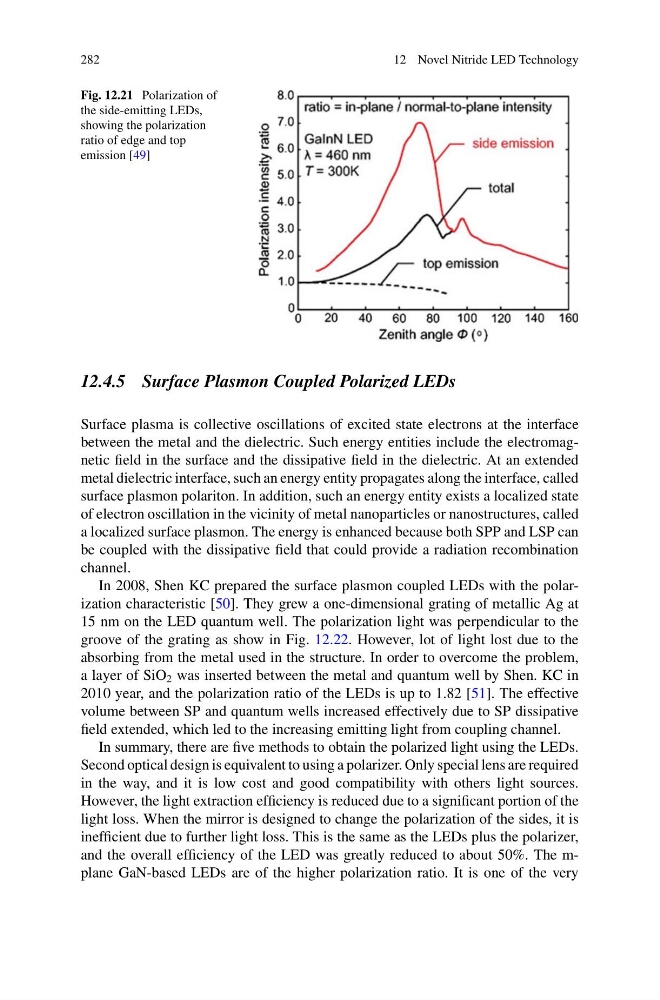
Fig. 12.21 Polarization of
the side-emitting LEDs,
showing the polarization
ratio of edge and top
emission [49]
12.4.5 Surface Plasmon Coupled Polarized LEDs
Surface plasma is collective oscillations of excited state electrons at the interface
between the metal and the dielectric. Such energy entities include the electromagnetic field in the surface and the dissipative field in the dielectric. At an extended
metal dielectric interface, such an energy entity propagates along the interface, called
surface plasmon polariton. In addition, such an energy entity exists a localized state
of electron oscillation in the vicinity of metal nanoparticles or nanostructures, called
a localized surface plasmon. The energy is enhanced because both SPP and LSP can
be coupled with the dissipative field that could provide a radiation recombination
channel.
In 2008, Shen KC prepared the surface plasmon coupled LEDs with the polarization characteristic [50]. They grew a one-dimensional grating of metallic Ag at
15 nm on the LED quantum well. The polarization light was perpendicular to the
groove of the grating as show in Fig. 12.22. However, lot of light lost due to the
absorbing from the metal used in the structure. In order to overcome the problem,
a layer of SiO 2 was inserted between the metal and quantum well by Shen. KC in
2010 year, and the polarization ratio of the LEDs is up to 1.82 [51]. The effective
volume between SP and quantum wells increased effectively due to SP dissipative
field extended, which led to the increasing emitting light from coupling channel.
In summary, there are five methods to obtain the polarized light using the LEDs.
Second optical design is equivalent to using a polarizer. Only special lens are required
in the way, and it is low cost and good compatibility with others light sources.
However, the light extraction efficiency is reduced due to a significant portion of the
light loss. When the mirror is designed to change the polarization of the sides, it is
inefficient due to further light loss. This is the same as the LEDs plus the polarizer,
and the overall efficiency of the LED was greatly reduced to about 50%. The mplane GaN-based LEDs are of the higher polarization ratio. It is one of the very
12 Novel Nitride LED Technology
Fig. 12.21 Polarization of
the side-emitting LEDs,
showing the polarization
ratio of edge and top
emission [49]
12.4.5 Surface Plasmon Coupled Polarized LEDs
Surface plasma is collective oscillations of excited state electrons at the interface
between the metal and the dielectric. Such energy entities include the electromagnetic field in the surface and the dissipative field in the dielectric. At an extended
metal dielectric interface, such an energy entity propagates along the interface, called
surface plasmon polariton. In addition, such an energy entity exists a localized state
of electron oscillation in the vicinity of metal nanoparticles or nanostructures, called
a localized surface plasmon. The energy is enhanced because both SPP and LSP can
be coupled with the dissipative field that could provide a radiation recombination
channel.
In 2008, Shen KC prepared the surface plasmon coupled LEDs with the polarization characteristic [50]. They grew a one-dimensional grating of metallic Ag at
15 nm on the LED quantum well. The polarization light was perpendicular to the
groove of the grating as show in Fig. 12.22. However, lot of light lost due to the
absorbing from the metal used in the structure. In order to overcome the problem,
a layer of SiO 2 was inserted between the metal and quantum well by Shen. KC in
2010 year, and the polarization ratio of the LEDs is up to 1.82 [51]. The effective
volume between SP and quantum wells increased effectively due to SP dissipative
field extended, which led to the increasing emitting light from coupling channel.
In summary, there are five methods to obtain the polarized light using the LEDs.
Second optical design is equivalent to using a polarizer. Only special lens are required
in the way, and it is low cost and good compatibility with others light sources.
However, the light extraction efficiency is reduced due to a significant portion of the
light loss. When the mirror is designed to change the polarization of the sides, it is
inefficient due to further light loss. This is the same as the LEDs plus the polarizer,
and the overall efficiency of the LED was greatly reduced to about 50%. The mplane GaN-based LEDs are of the higher polarization ratio. It is one of the very