

12.4 GaN-Based Polarizing LEDs
279
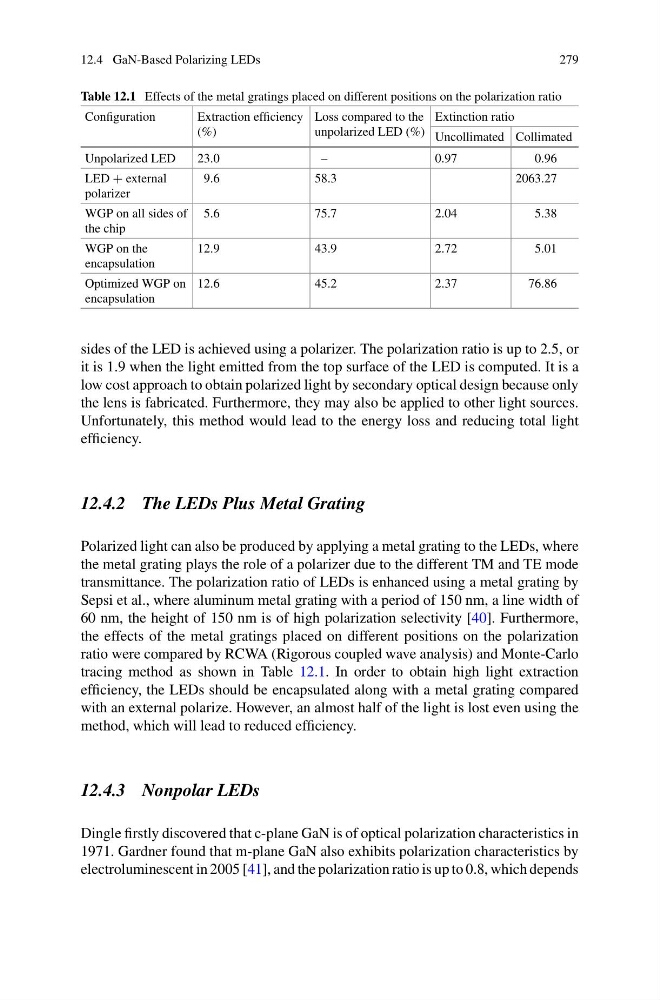
Table 12.1 Effects of the metal gratings placed on different positions on the polarization ratio
Configuration
Extraction efficiency
(%)
Loss compared to the
unpolarized LED (%)
Extinction ratio
Uncollimated Collimated
Unpolarized LED
23.0
–
0.97
0.96
LED + external
polarizer
9.6
58.3
2063.27
WGP on all sides of
the chip
5.6
75.7
2.04
5.38
WGP on the
encapsulation
12.9
43.9
2.72
5.01
Optimized WGP on
encapsulation
12.6
45.2
2.37
76.86
sides of the LED is achieved using a polarizer. The polarization ratio is up to 2.5, or
it is 1.9 when the light emitted from the top surface of the LED is computed. It is a
low cost approach to obtain polarized light by secondary optical design because only
the lens is fabricated. Furthermore, they may also be applied to other light sources.
Unfortunately, this method would lead to the energy loss and reducing total light
efficiency.
12.4.2 The LEDs Plus Metal Grating
Polarized light can also be produced by applying a metal grating to the LEDs, where
the metal grating plays the role of a polarizer due to the different TM and TE mode
transmittance. The polarization ratio of LEDs is enhanced using a metal grating by
Sepsi et al., where aluminum metal grating with a period of 150 nm, a line width of
60 nm, the height of 150 nm is of high polarization selectivity [40]. Furthermore,
the effects of the metal gratings placed on different positions on the polarization
ratio were compared by RCWA (Rigorous coupled wave analysis) and Monte-Carlo
tracing method as shown in Table 12.1. In order to obtain high light extraction
efficiency, the LEDs should be encapsulated along with a metal grating compared
with an external polarize. However, an almost half of the light is lost even using the
method, which will lead to reduced efficiency.
12.4.3 Nonpolar LEDs
Dingle firstly discovered that c-plane GaN is of optical polarization characteristics in
1971. Gardner found that m-plane GaN also exhibits polarization characteristics by
electroluminescent in 2005 [41], and the polarization ratio is up to 0.8, which depends
279
Table 12.1 Effects of the metal gratings placed on different positions on the polarization ratio
Configuration
Extraction efficiency
(%)
Loss compared to the
unpolarized LED (%)
Extinction ratio
Uncollimated Collimated
Unpolarized LED
23.0
–
0.97
0.96
LED + external
polarizer
9.6
58.3
2063.27
WGP on all sides of
the chip
5.6
75.7
2.04
5.38
WGP on the
encapsulation
12.9
43.9
2.72
5.01
Optimized WGP on
encapsulation
12.6
45.2
2.37
76.86
sides of the LED is achieved using a polarizer. The polarization ratio is up to 2.5, or
it is 1.9 when the light emitted from the top surface of the LED is computed. It is a
low cost approach to obtain polarized light by secondary optical design because only
the lens is fabricated. Furthermore, they may also be applied to other light sources.
Unfortunately, this method would lead to the energy loss and reducing total light
efficiency.
12.4.2 The LEDs Plus Metal Grating
Polarized light can also be produced by applying a metal grating to the LEDs, where
the metal grating plays the role of a polarizer due to the different TM and TE mode
transmittance. The polarization ratio of LEDs is enhanced using a metal grating by
Sepsi et al., where aluminum metal grating with a period of 150 nm, a line width of
60 nm, the height of 150 nm is of high polarization selectivity [40]. Furthermore,
the effects of the metal gratings placed on different positions on the polarization
ratio were compared by RCWA (Rigorous coupled wave analysis) and Monte-Carlo
tracing method as shown in Table 12.1. In order to obtain high light extraction
efficiency, the LEDs should be encapsulated along with a metal grating compared
with an external polarize. However, an almost half of the light is lost even using the
method, which will lead to reduced efficiency.
12.4.3 Nonpolar LEDs
Dingle firstly discovered that c-plane GaN is of optical polarization characteristics in
1971. Gardner found that m-plane GaN also exhibits polarization characteristics by
electroluminescent in 2005 [41], and the polarization ratio is up to 0.8, which depends