

278
12 Novel Nitride LED Technology
12.4 GaN-Based Polarizing LEDs
Light is an electromagnetic wave with electric and magnetic fields perpendicular to
each other. The polarization light occurs when the electric field is polarized for an
electromagnetic wave. Natural light is non-polarized, and will exhibit a polarization
phenomenon only when its symmetry is broken. Some methods is used to fabricated
polarizing LEDs, including secondary optical design, LEDs plus linear polarizer,
non-polar GaN LEDs (or semi-polar GaN LEDs), side-emitting LEDs and surface
plasma coupled LEDs etc. Polarizing LEDs have been applied in automotive headlights, 3D movies, biological physiology, LCD display backlighting and medical
treatment.
12.4.1 Secondary Optical Design
An optical design is generally carried out when the LED chip is packaged, including
the escaping angle, distribution and color temperature. Especially, secondary optical
design is imperative in order to improve in light extraction efficiency. Schubert et al.
obtained the polarizing LEDs using a secondary optical design in 2007 [37]. Based
on the Bourus law, they designed a non- symmetrical lens to enhance the proportion
of the polarized light. The polarization ratio was increased to 1.083 by optimizing
the shape of the lens. Then, they fabricated InGaN-based LEDs on (0001) sapphire
substrates [38]. The polarized light from the sides was mostly parallel to the m
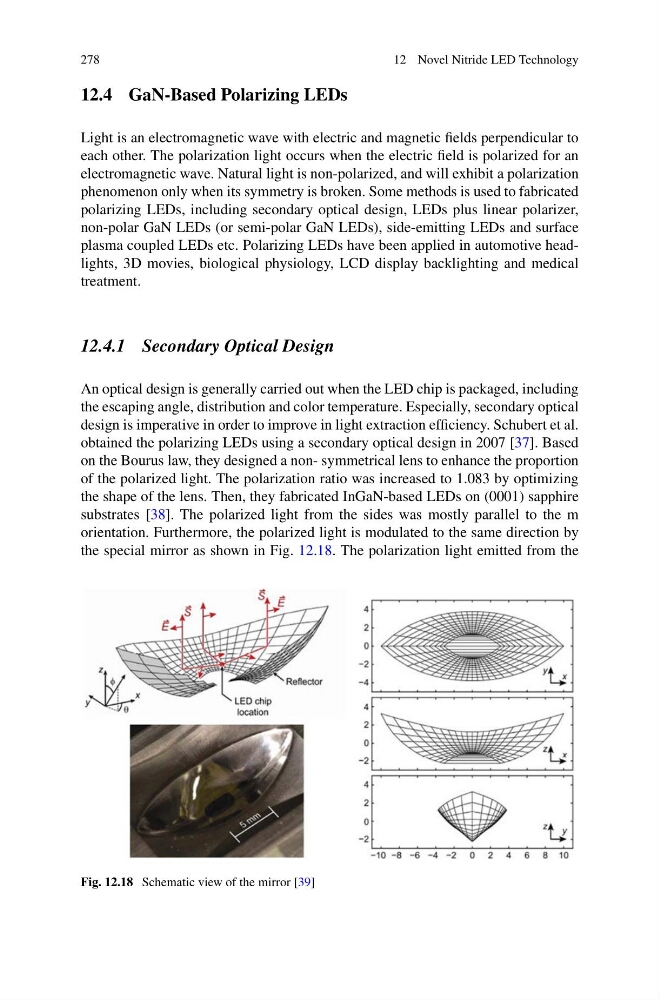
orientation. Furthermore, the polarized light is modulated to the same direction by
the special mirror as shown in Fig. 12.18. The polarization light emitted from the
Fig. 12.18 Schematic view of the mirror [39]
12 Novel Nitride LED Technology
12.4 GaN-Based Polarizing LEDs
Light is an electromagnetic wave with electric and magnetic fields perpendicular to
each other. The polarization light occurs when the electric field is polarized for an
electromagnetic wave. Natural light is non-polarized, and will exhibit a polarization
phenomenon only when its symmetry is broken. Some methods is used to fabricated
polarizing LEDs, including secondary optical design, LEDs plus linear polarizer,
non-polar GaN LEDs (or semi-polar GaN LEDs), side-emitting LEDs and surface
plasma coupled LEDs etc. Polarizing LEDs have been applied in automotive headlights, 3D movies, biological physiology, LCD display backlighting and medical
treatment.
12.4.1 Secondary Optical Design
An optical design is generally carried out when the LED chip is packaged, including
the escaping angle, distribution and color temperature. Especially, secondary optical
design is imperative in order to improve in light extraction efficiency. Schubert et al.
obtained the polarizing LEDs using a secondary optical design in 2007 [37]. Based
on the Bourus law, they designed a non- symmetrical lens to enhance the proportion
of the polarized light. The polarization ratio was increased to 1.083 by optimizing
the shape of the lens. Then, they fabricated InGaN-based LEDs on (0001) sapphire
substrates [38]. The polarized light from the sides was mostly parallel to the m
orientation. Furthermore, the polarized light is modulated to the same direction by
the special mirror as shown in Fig. 12.18. The polarization light emitted from the
Fig. 12.18 Schematic view of the mirror [39]