

12.3 Surface Plasmon Enhanced GaN-Based LED
277
12.3.4 Surface Plasmon Application in Improving LED’s
Modulation Bandwidth
As already mentioned, surface plasmons can increase electron-hole pairs’ radiation
recombination rate. With this feature, high-speed, high-power LEDs show great
potential in the field of visible light communication.
Bandwidth refers to the frequency bandwidth occupied by the signal. When used
to describe the channel, bandwidth refers to the maximum frequency bandwidth
of a signal that can effectively pass through the channel. LED’s modulation bandwidth refers to the maximum frequency bandwidth of the loaded signal that the LED
can carry. When the LED’s AC optical power drops to half (−3 dB) at a certain
reference frequency, this corresponding frequency is defined as LED’s modulation
bandwidth. The LED’s modulation bandwidth can be affected by many factors such
as the actual modulation depth. The I-V characteristics of the device determine the
channel capacity and transmission rate of visible light communication system.
Surface plasmons increase the LED’s modulation bandwidth through the reduction
of the carrier’s radiation lifetime. Okamoto et al. first studied how surface plasmon
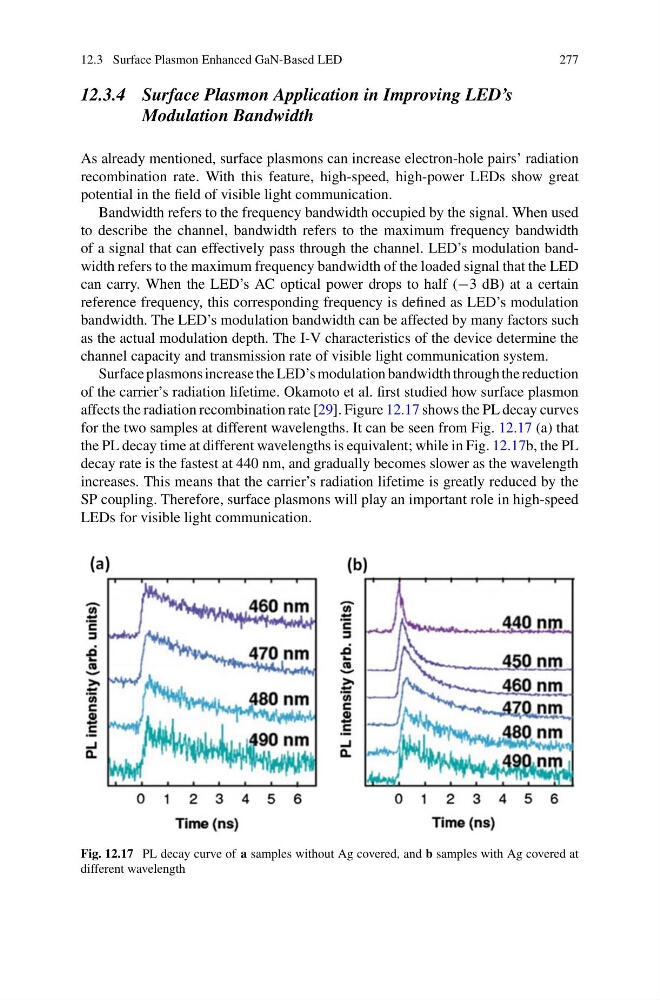
affects the radiation recombination rate [29]. Figure 12.17 shows the PL decay curves
for the two samples at different wavelengths. It can be seen from Fig. 12.17 (a) that
the PL decay time at different wavelengths is equivalent; while in Fig. 12.17b, the PL
decay rate is the fastest at 440 nm, and gradually becomes slower as the wavelength
increases. This means that the carrier’s radiation lifetime is greatly reduced by the
SP coupling. Therefore, surface plasmons will play an important role in high-speed
LEDs for visible light communication.
Fig. 12.17 PL decay curve of a samples without Ag covered, and b samples with Ag covered at
different wavelength
277
12.3.4 Surface Plasmon Application in Improving LED’s
Modulation Bandwidth
As already mentioned, surface plasmons can increase electron-hole pairs’ radiation
recombination rate. With this feature, high-speed, high-power LEDs show great
potential in the field of visible light communication.
Bandwidth refers to the frequency bandwidth occupied by the signal. When used
to describe the channel, bandwidth refers to the maximum frequency bandwidth
of a signal that can effectively pass through the channel. LED’s modulation bandwidth refers to the maximum frequency bandwidth of the loaded signal that the LED
can carry. When the LED’s AC optical power drops to half (−3 dB) at a certain
reference frequency, this corresponding frequency is defined as LED’s modulation
bandwidth. The LED’s modulation bandwidth can be affected by many factors such
as the actual modulation depth. The I-V characteristics of the device determine the
channel capacity and transmission rate of visible light communication system.
Surface plasmons increase the LED’s modulation bandwidth through the reduction
of the carrier’s radiation lifetime. Okamoto et al. first studied how surface plasmon
affects the radiation recombination rate [29]. Figure 12.17 shows the PL decay curves
for the two samples at different wavelengths. It can be seen from Fig. 12.17 (a) that
the PL decay time at different wavelengths is equivalent; while in Fig. 12.17b, the PL
decay rate is the fastest at 440 nm, and gradually becomes slower as the wavelength
increases. This means that the carrier’s radiation lifetime is greatly reduced by the
SP coupling. Therefore, surface plasmons will play an important role in high-speed
LEDs for visible light communication.
Fig. 12.17 PL decay curve of a samples without Ag covered, and b samples with Ag covered at
different wavelength