

280
12 Novel Nitride LED Technology
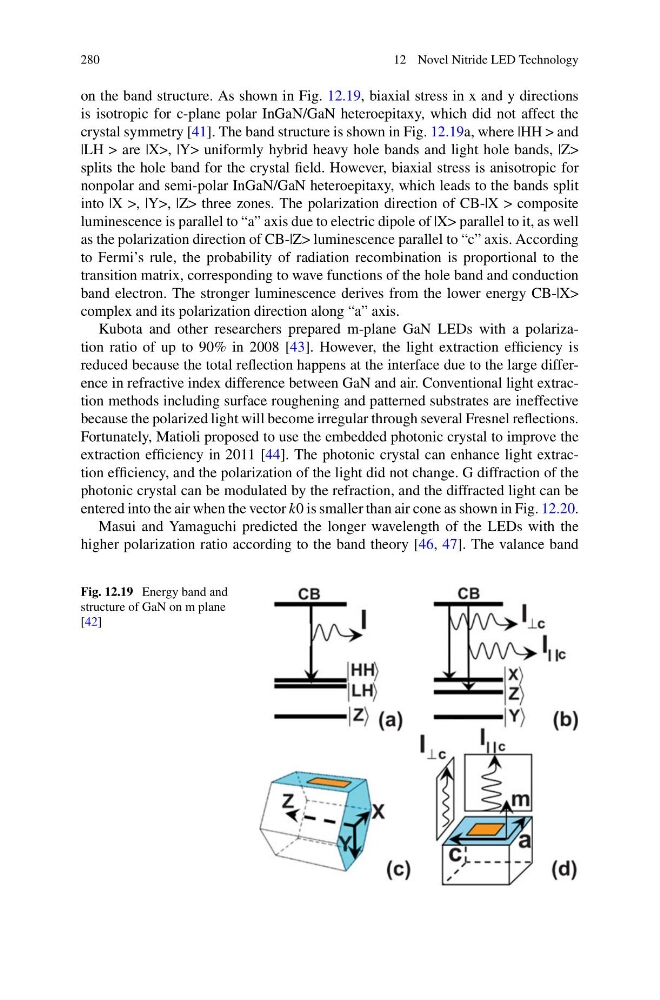
on the band structure. As shown in Fig. 12.19, biaxial stress in x and y directions
is isotropic for c-plane polar InGaN/GaN heteroepitaxy, which did not affect the
crystal symmetry [41]. The band structure is shown in Fig. 12.19a, where |HH > and
|LH > are |X>, |Y> uniformly hybrid heavy hole bands and light hole bands, |Z>
splits the hole band for the crystal field. However, biaxial stress is anisotropic for
nonpolar and semi-polar InGaN/GaN heteroepitaxy, which leads to the bands split
into |X >, |Y>, |Z> three zones. The polarization direction of CB-|X > composite
luminescence is parallel to “a” axis due to electric dipole of |X> parallel to it, as well
as the polarization direction of CB-|Z> luminescence parallel to “c” axis. According
to Fermi’s rule, the probability of radiation recombination is proportional to the
transition matrix, corresponding to wave functions of the hole band and conduction
band electron. The stronger luminescence derives from the lower energy CB-|X>
complex and its polarization direction along “a” axis.
Kubota and other researchers prepared m-plane GaN LEDs with a polarization ratio of up to 90% in 2008 [43]. However, the light extraction efficiency is
reduced because the total reflection happens at the interface due to the large difference in refractive index difference between GaN and air. Conventional light extraction methods including surface roughening and patterned substrates are ineffective
because the polarized light will become irregular through several Fresnel reflections.
Fortunately, Matioli proposed to use the embedded photonic crystal to improve the
extraction efficiency in 2011 [44]. The photonic crystal can enhance light extraction efficiency, and the polarization of the light did not change. G diffraction of the
photonic crystal can be modulated by the refraction, and the diffracted light can be
entered into the air when the vector k0 is smaller than air cone as shown in Fig. 12.20.
Masui and Yamaguchi predicted the longer wavelength of the LEDs with the
higher polarization ratio according to the band theory [46, 47]. The valance band
Fig. 12.19 Energy band and
structure of GaN on m plane
[42]
12 Novel Nitride LED Technology
on the band structure. As shown in Fig. 12.19, biaxial stress in x and y directions
is isotropic for c-plane polar InGaN/GaN heteroepitaxy, which did not affect the
crystal symmetry [41]. The band structure is shown in Fig. 12.19a, where |HH > and
|LH > are |X>, |Y> uniformly hybrid heavy hole bands and light hole bands, |Z>
splits the hole band for the crystal field. However, biaxial stress is anisotropic for
nonpolar and semi-polar InGaN/GaN heteroepitaxy, which leads to the bands split
into |X >, |Y>, |Z> three zones. The polarization direction of CB-|X > composite
luminescence is parallel to “a” axis due to electric dipole of |X> parallel to it, as well
as the polarization direction of CB-|Z> luminescence parallel to “c” axis. According
to Fermi’s rule, the probability of radiation recombination is proportional to the
transition matrix, corresponding to wave functions of the hole band and conduction
band electron. The stronger luminescence derives from the lower energy CB-|X>
complex and its polarization direction along “a” axis.
Kubota and other researchers prepared m-plane GaN LEDs with a polarization ratio of up to 90% in 2008 [43]. However, the light extraction efficiency is
reduced because the total reflection happens at the interface due to the large difference in refractive index difference between GaN and air. Conventional light extraction methods including surface roughening and patterned substrates are ineffective
because the polarized light will become irregular through several Fresnel reflections.
Fortunately, Matioli proposed to use the embedded photonic crystal to improve the
extraction efficiency in 2011 [44]. The photonic crystal can enhance light extraction efficiency, and the polarization of the light did not change. G diffraction of the
photonic crystal can be modulated by the refraction, and the diffracted light can be
entered into the air when the vector k0 is smaller than air cone as shown in Fig. 12.20.
Masui and Yamaguchi predicted the longer wavelength of the LEDs with the
higher polarization ratio according to the band theory [46, 47]. The valance band
Fig. 12.19 Energy band and
structure of GaN on m plane
[42]