

12.1 GaN-Based Nanorod LED
261
will inevitably cause structural and surface damage, which leads to an increase of
surface defects. In addition, the reduction of the active area, the waste of GaN materials, and the increase of leakage also limit its application. In contrast, the driving
force of the “bottom-up” approach is the reduction of Gibbs free energy, making
nanostructures and nanomaterials closer to thermodynamic equilibrium. That is to
say, “bottom-up” method is easier to obtain a GaN nanorod structure with uniform
chemical composition and reduced defects. Among them, the nanorod structure
obtained by self-organized growth in the “bottom-up” method is not uniform in size
and diverse in crystal orientation. The wavelength of the nanorod LED is strongly
dependent on the size of the nanorod, the position and the alloy component of the
quantum well. Thus, this method is difficult to control the emission wavelength of
LED, and is not suitable for mass production. In contrast, “bottom-up” method of
selective area growth possesses almost all the advantages of nanorods LED due to
its orderly and controllable growth characteristics, which is the trends of nanorods
LED and has become the future mainstream R&D technology of nanorod LED.
12.1.3 Application of Nanorod LED
Monochromatic light LED:
Since the quantum well of the nanorod LED grows radially, the quantum-limited
Stark effect caused by the polarized electric field can be effectively alleviated. Thus,
the In composition can be more efficiently incorporated into the quantum well of the
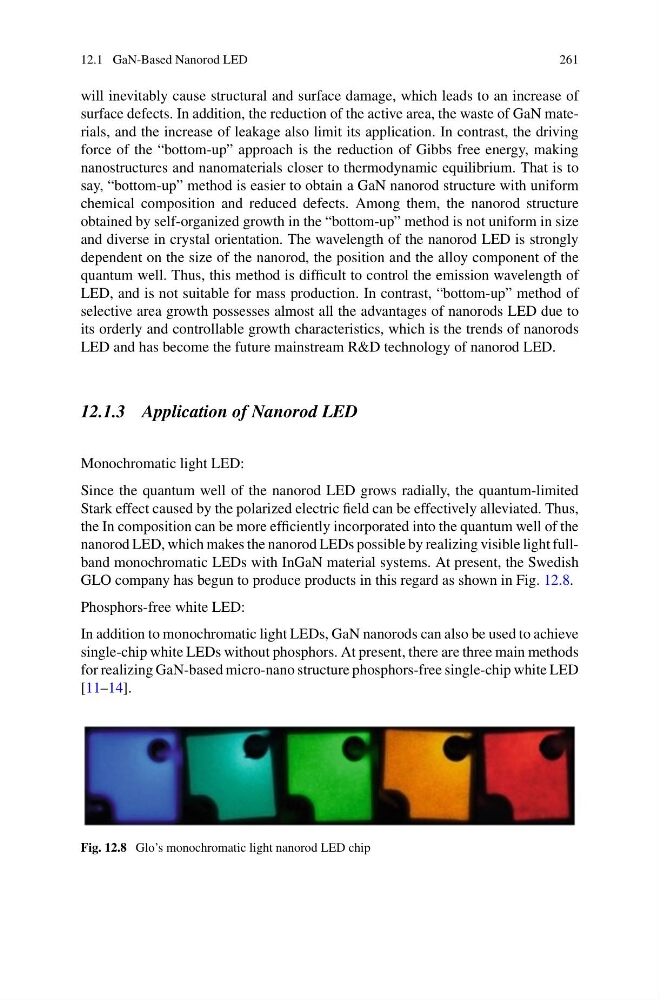
nanorod LED, which makes the nanorod LEDs possible by realizing visible light fullband monochromatic LEDs with InGaN material systems. At present, the Swedish
GLO company has begun to produce products in this regard as shown in Fig. 12.8.
Phosphors-free white LED:
In addition to monochromatic light LEDs, GaN nanorods can also be used to achieve
single-chip white LEDs without phosphors. At present, there are three main methods
for realizing GaN-based micro-nano structure phosphors-free single-chip white LED
[11–14].
Fig. 12.8 Glo’s monochromatic light nanorod LED chip
261
will inevitably cause structural and surface damage, which leads to an increase of
surface defects. In addition, the reduction of the active area, the waste of GaN materials, and the increase of leakage also limit its application. In contrast, the driving
force of the “bottom-up” approach is the reduction of Gibbs free energy, making
nanostructures and nanomaterials closer to thermodynamic equilibrium. That is to
say, “bottom-up” method is easier to obtain a GaN nanorod structure with uniform
chemical composition and reduced defects. Among them, the nanorod structure
obtained by self-organized growth in the “bottom-up” method is not uniform in size
and diverse in crystal orientation. The wavelength of the nanorod LED is strongly
dependent on the size of the nanorod, the position and the alloy component of the
quantum well. Thus, this method is difficult to control the emission wavelength of
LED, and is not suitable for mass production. In contrast, “bottom-up” method of
selective area growth possesses almost all the advantages of nanorods LED due to
its orderly and controllable growth characteristics, which is the trends of nanorods
LED and has become the future mainstream R&D technology of nanorod LED.
12.1.3 Application of Nanorod LED
Monochromatic light LED:
Since the quantum well of the nanorod LED grows radially, the quantum-limited
Stark effect caused by the polarized electric field can be effectively alleviated. Thus,
the In composition can be more efficiently incorporated into the quantum well of the
nanorod LED, which makes the nanorod LEDs possible by realizing visible light fullband monochromatic LEDs with InGaN material systems. At present, the Swedish
GLO company has begun to produce products in this regard as shown in Fig. 12.8.
Phosphors-free white LED:
In addition to monochromatic light LEDs, GaN nanorods can also be used to achieve
single-chip white LEDs without phosphors. At present, there are three main methods
for realizing GaN-based micro-nano structure phosphors-free single-chip white LED
[11–14].
Fig. 12.8 Glo’s monochromatic light nanorod LED chip