

12.1 GaN-Based Nanorod LED
259
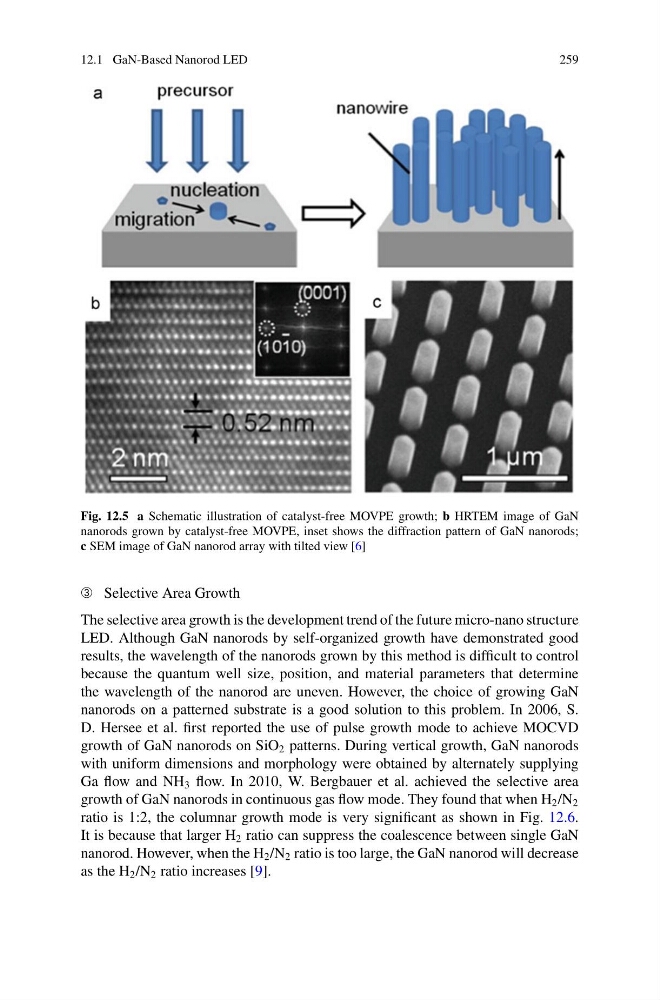
Fig. 12.5 a Schematic illustration of catalyst-free MOVPE growth; b HRTEM image of GaN
nanorods grown by catalyst-free MOVPE, inset shows the diffraction pattern of GaN nanorods;
c SEM image of GaN nanorod array with tilted view [6]
➂ Selective Area Growth
The selective area growth is the development trend of the future micro-nano structure
LED. Although GaN nanorods by self-organized growth have demonstrated good
results, the wavelength of the nanorods grown by this method is difficult to control
because the quantum well size, position, and material parameters that determine
the wavelength of the nanorod are uneven. However, the choice of growing GaN
nanorods on a patterned substrate is a good solution to this problem. In 2006, S.
D. Hersee et al. first reported the use of pulse growth mode to achieve MOCVD
growth of GaN nanorods on SiO 2 patterns. During vertical growth, GaN nanorods
with uniform dimensions and morphology were obtained by alternately supplying
Ga flow and NH 3 flow. In 2010, W. Bergbauer et al. achieved the selective area
growth of GaN nanorods in continuous gas flow mode. They found that when H 2 /N 2
ratio is 1:2, the columnar growth mode is very significant as shown in Fig. 12.6.
It is because that larger H 2 ratio can suppress the coalescence between single GaN
nanorod. However, when the H 2 /N 2 ratio is too large, the GaN nanorod will decrease
as the H 2 /N 2 ratio increases [9].
259
Fig. 12.5 a Schematic illustration of catalyst-free MOVPE growth; b HRTEM image of GaN
nanorods grown by catalyst-free MOVPE, inset shows the diffraction pattern of GaN nanorods;
c SEM image of GaN nanorod array with tilted view [6]
➂ Selective Area Growth
The selective area growth is the development trend of the future micro-nano structure
LED. Although GaN nanorods by self-organized growth have demonstrated good
results, the wavelength of the nanorods grown by this method is difficult to control
because the quantum well size, position, and material parameters that determine
the wavelength of the nanorod are uneven. However, the choice of growing GaN
nanorods on a patterned substrate is a good solution to this problem. In 2006, S.
D. Hersee et al. first reported the use of pulse growth mode to achieve MOCVD
growth of GaN nanorods on SiO 2 patterns. During vertical growth, GaN nanorods
with uniform dimensions and morphology were obtained by alternately supplying
Ga flow and NH 3 flow. In 2010, W. Bergbauer et al. achieved the selective area
growth of GaN nanorods in continuous gas flow mode. They found that when H 2 /N 2
ratio is 1:2, the columnar growth mode is very significant as shown in Fig. 12.6.
It is because that larger H 2 ratio can suppress the coalescence between single GaN
nanorod. However, when the H 2 /N 2 ratio is too large, the GaN nanorod will decrease
as the H 2 /N 2 ratio increases [9].