

258
12 Novel Nitride LED Technology
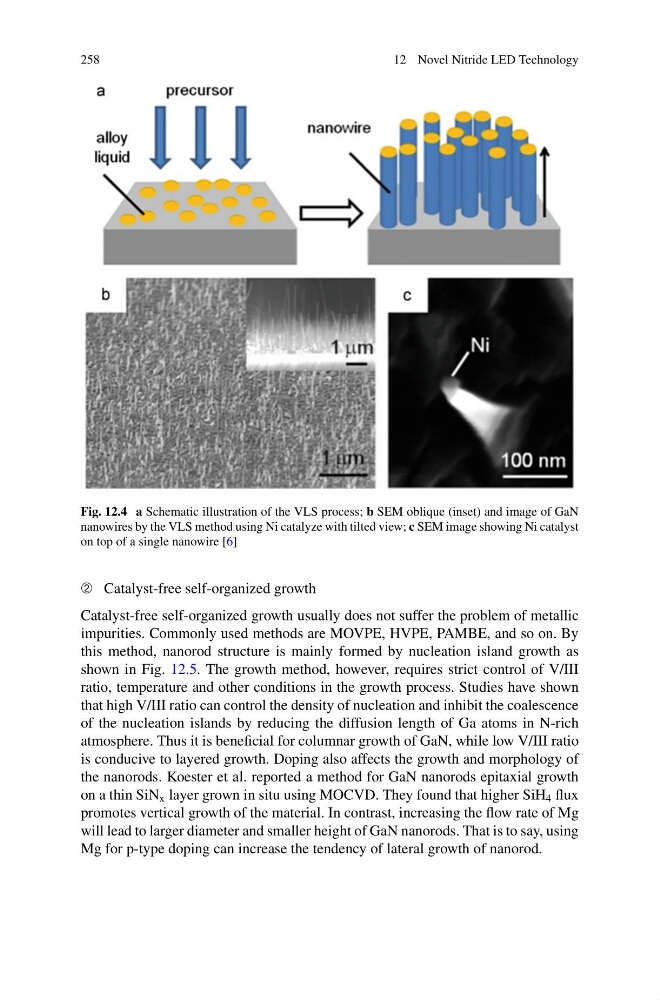
Fig. 12.4 a Schematic illustration of the VLS process; b SEM oblique (inset) and image of GaN
nanowires by the VLS method using Ni catalyze with tilted view; c SEM image showing Ni catalyst
on top of a single nanowire [6]
➁ Catalyst-free self-organized growth
Catalyst-free self-organized growth usually does not suffer the problem of metallic
impurities. Commonly used methods are MOVPE, HVPE, PAMBE, and so on. By
this method, nanorod structure is mainly formed by nucleation island growth as
shown in Fig. 12.5. The growth method, however, requires strict control of V/III
ratio, temperature and other conditions in the growth process. Studies have shown
that high V/III ratio can control the density of nucleation and inhibit the coalescence
of the nucleation islands by reducing the diffusion length of Ga atoms in N-rich
atmosphere. Thus it is beneficial for columnar growth of GaN, while low V/III ratio
is conducive to layered growth. Doping also affects the growth and morphology of
the nanorods. Koester et al. reported a method for GaN nanorods epitaxial growth
on a thin SiN x layer grown in situ using MOCVD. They found that higher SiH 4 flux
promotes vertical growth of the material. In contrast, increasing the flow rate of Mg
will lead to larger diameter and smaller height of GaN nanorods. That is to say, using
Mg for p-type doping can increase the tendency of lateral growth of nanorod.
12 Novel Nitride LED Technology
Fig. 12.4 a Schematic illustration of the VLS process; b SEM oblique (inset) and image of GaN
nanowires by the VLS method using Ni catalyze with tilted view; c SEM image showing Ni catalyst
on top of a single nanowire [6]
➁ Catalyst-free self-organized growth
Catalyst-free self-organized growth usually does not suffer the problem of metallic
impurities. Commonly used methods are MOVPE, HVPE, PAMBE, and so on. By
this method, nanorod structure is mainly formed by nucleation island growth as
shown in Fig. 12.5. The growth method, however, requires strict control of V/III
ratio, temperature and other conditions in the growth process. Studies have shown
that high V/III ratio can control the density of nucleation and inhibit the coalescence
of the nucleation islands by reducing the diffusion length of Ga atoms in N-rich
atmosphere. Thus it is beneficial for columnar growth of GaN, while low V/III ratio
is conducive to layered growth. Doping also affects the growth and morphology of
the nanorods. Koester et al. reported a method for GaN nanorods epitaxial growth
on a thin SiN x layer grown in situ using MOCVD. They found that higher SiH 4 flux
promotes vertical growth of the material. In contrast, increasing the flow rate of Mg
will lead to larger diameter and smaller height of GaN nanorods. That is to say, using
Mg for p-type doping can increase the tendency of lateral growth of nanorod.