

142
7 III-Nitride LED Quantum Efficiency Improvement Technology
In InGaN MQWs, the radiative recombination of carriers and non-radiative recombination process are schematically shown in in Fig. 7.8, where four processes are
highlighted.
(1) SRH recombination: It mainly refers to the recombination process in which
the defect level captures carriers. The SRH recombination coefficient A S R H is
closely related to the defect density. The SRH recombination term is proportional
to the power of the carrier concentration n [35, 36].
(2) Radiation recombination: It refers to the effective recombination process in
which electron and hole pairs recombine and produce photons. The radiation
recombination B mainly depends on the carrier concentration in the active region
and the probability of overlapping of electron and hole wave functions. The
recombination term is proportional to the second power of n [37, 38].
(3) Auger recombination: It refers to the recombination of electrons and hole pairs,
transferring the generated energy to the third carrier and causing it to transition to
a higher energy level, or generating an acoustic wave oscillation to consume the
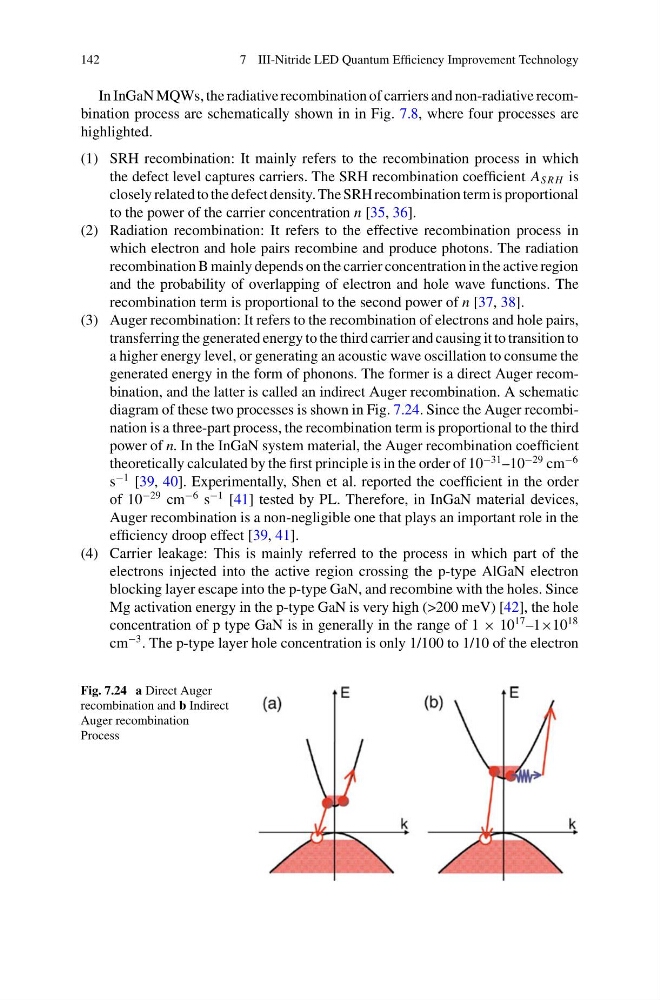
generated energy in the form of phonons. The former is a direct Auger recombination, and the latter is called an indirect Auger recombination. A schematic
diagram of these two processes is shown in Fig. 7.24. Since the Auger recombination is a three-part process, the recombination term is proportional to the third
power of n. In the InGaN system material, the Auger recombination coefficient
theoretically calculated by the first principle is in the order of 10
−31 –10
−29 cm
−6
s
−1 [39, 40]. Experimentally, Shen et al. reported the coefficient in the order
of 10
−29 cm
−6 s
−1 [41] tested by PL. Therefore, in InGaN material devices,
Auger recombination is a non-negligible one that plays an important role in the
efficiency droop effect [39, 41].
(4) Carrier leakage: This is mainly referred to the process in which part of the
electrons injected into the active region crossing the p-type AlGaN electron
blocking layer escape into the p-type GaN, and recombine with the holes. Since
Mg activation energy in the p-type GaN is very high (>200 meV) [42], the hole
concentration of p type GaN is in generally in the range of 1 × 10
17 –1×10
18
cm
−3 . The p-type layer hole concentration is only 1/100 to 1/10 of the electron
Fig. 7.24 a Direct Auger
recombination and b Indirect
Auger recombination
Process
7 III-Nitride LED Quantum Efficiency Improvement Technology
In InGaN MQWs, the radiative recombination of carriers and non-radiative recombination process are schematically shown in in Fig. 7.8, where four processes are
highlighted.
(1) SRH recombination: It mainly refers to the recombination process in which
the defect level captures carriers. The SRH recombination coefficient A S R H is
closely related to the defect density. The SRH recombination term is proportional
to the power of the carrier concentration n [35, 36].
(2) Radiation recombination: It refers to the effective recombination process in
which electron and hole pairs recombine and produce photons. The radiation
recombination B mainly depends on the carrier concentration in the active region
and the probability of overlapping of electron and hole wave functions. The
recombination term is proportional to the second power of n [37, 38].
(3) Auger recombination: It refers to the recombination of electrons and hole pairs,
transferring the generated energy to the third carrier and causing it to transition to
a higher energy level, or generating an acoustic wave oscillation to consume the
generated energy in the form of phonons. The former is a direct Auger recombination, and the latter is called an indirect Auger recombination. A schematic
diagram of these two processes is shown in Fig. 7.24. Since the Auger recombination is a three-part process, the recombination term is proportional to the third
power of n. In the InGaN system material, the Auger recombination coefficient
theoretically calculated by the first principle is in the order of 10
−31 –10
−29 cm
−6
s
−1 [39, 40]. Experimentally, Shen et al. reported the coefficient in the order
of 10
−29 cm
−6 s
−1 [41] tested by PL. Therefore, in InGaN material devices,
Auger recombination is a non-negligible one that plays an important role in the
efficiency droop effect [39, 41].
(4) Carrier leakage: This is mainly referred to the process in which part of the
electrons injected into the active region crossing the p-type AlGaN electron
blocking layer escape into the p-type GaN, and recombine with the holes. Since
Mg activation energy in the p-type GaN is very high (>200 meV) [42], the hole
concentration of p type GaN is in generally in the range of 1 × 10
17 –1×10
18
cm
−3 . The p-type layer hole concentration is only 1/100 to 1/10 of the electron
Fig. 7.24 a Direct Auger
recombination and b Indirect
Auger recombination
Process