

7.5 Droop Effect
143
concentration (1 × 10
19 cm
−3 ) in the n-type GaN. In conventional InGaNbased LEDs, the introduction of a p-type AlGaN electron blocking layer is to
restrict excess electrons in the active region from escaping into the p-type layer.
However, due to insufficient holes in the active region and excessive electron
excess, some electrons will inevitably escape from the active region. The electron blocking layer is restricted to reach the p-type layer. This electron leakage
phenomenon is more pronounced under high current drive. Electron leakage
also causes insufficient hole injection, which further restricts the injection of
holes in the p-layer, resulting in a decrease in luminous efficiency. Recent studies
have confirmed that carrier leakage is a key factor in the effects droop effect
[43, 44].
7.5.1 Auger Recombination Effect
Shen et al. [45] from Philips Lumileds reported that Auger recombination dominates
at high injection current, which is a main cause for LED light emission efficiency
droop. Auger recombination is a non-radiative recombination process. The energy
generated by the recombination of electrons and holes does not generate photons,
but transfers energy to another carrier (electrons or holes), causing this carrier to
transition to the higher energy level. This energy is then available in the form of
phonons to release. The Auger recombination probability is proportional to n
2 p or np
2
(n and p are electron concentration and hole concentration, respectively). Therefore,
as the injection current in the LED increases, the carrier concentration also increases,
causing the Auger recombination probability to become bigger. In response to this
mechanism, Lumileds proposed to increase the width of the quantum well layer or
use a double heterojunction instead of a multiple quantum well as the active region
to reduce the carrier concentration therein, thereby weakening the efficiency droop
[46].
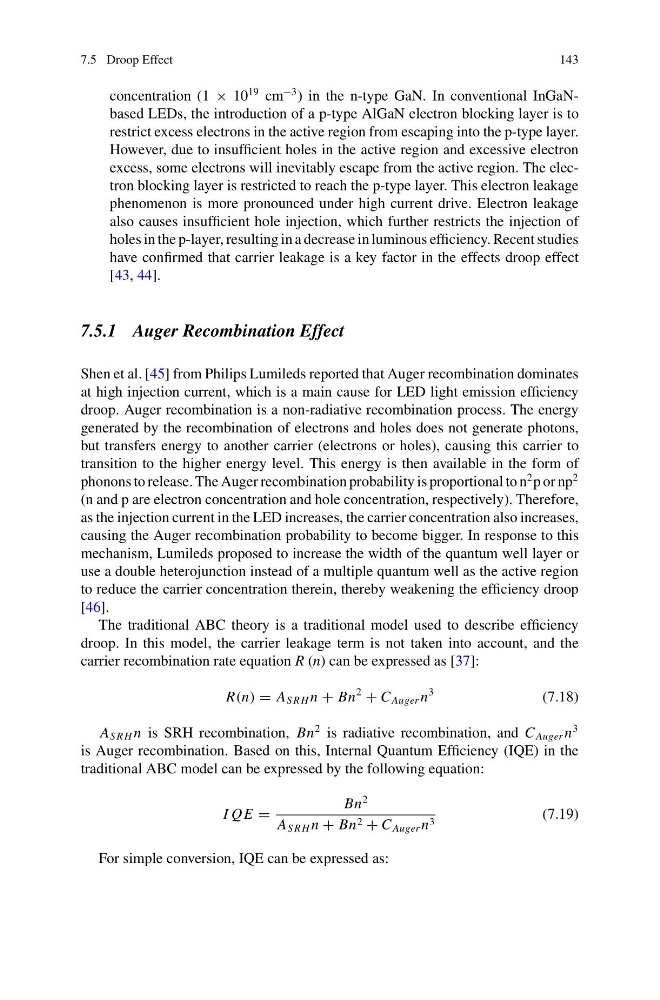
The traditional ABC theory is a traditional model used to describe efficiency
droop. In this model, the carrier leakage term is not taken into account, and the
carrier recombination rate equation R (n) can be expressed as [37]:
R(n) = A S R H n + Bn
2
+ C Auger n
3
(7.18)
A S R H n is SRH recombination, Bn
2 is radiative recombination, and C Auger n
3
is Auger recombination. Based on this, Internal Quantum Efficiency (IQE) in the
traditional ABC model can be expressed by the following equation:
I Q E =
Bn
2
A S R H n + Bn 2 + C Auger n 3
(7.19)
For simple conversion, IQE can be expressed as:
143
concentration (1 × 10
19 cm
−3 ) in the n-type GaN. In conventional InGaNbased LEDs, the introduction of a p-type AlGaN electron blocking layer is to
restrict excess electrons in the active region from escaping into the p-type layer.
However, due to insufficient holes in the active region and excessive electron
excess, some electrons will inevitably escape from the active region. The electron blocking layer is restricted to reach the p-type layer. This electron leakage
phenomenon is more pronounced under high current drive. Electron leakage
also causes insufficient hole injection, which further restricts the injection of
holes in the p-layer, resulting in a decrease in luminous efficiency. Recent studies
have confirmed that carrier leakage is a key factor in the effects droop effect
[43, 44].
7.5.1 Auger Recombination Effect
Shen et al. [45] from Philips Lumileds reported that Auger recombination dominates
at high injection current, which is a main cause for LED light emission efficiency
droop. Auger recombination is a non-radiative recombination process. The energy
generated by the recombination of electrons and holes does not generate photons,
but transfers energy to another carrier (electrons or holes), causing this carrier to
transition to the higher energy level. This energy is then available in the form of
phonons to release. The Auger recombination probability is proportional to n
2 p or np
2
(n and p are electron concentration and hole concentration, respectively). Therefore,
as the injection current in the LED increases, the carrier concentration also increases,
causing the Auger recombination probability to become bigger. In response to this
mechanism, Lumileds proposed to increase the width of the quantum well layer or
use a double heterojunction instead of a multiple quantum well as the active region
to reduce the carrier concentration therein, thereby weakening the efficiency droop
[46].
The traditional ABC theory is a traditional model used to describe efficiency
droop. In this model, the carrier leakage term is not taken into account, and the
carrier recombination rate equation R (n) can be expressed as [37]:
R(n) = A S R H n + Bn
2
+ C Auger n
3
(7.18)
A S R H n is SRH recombination, Bn
2 is radiative recombination, and C Auger n
3
is Auger recombination. Based on this, Internal Quantum Efficiency (IQE) in the
traditional ABC model can be expressed by the following equation:
I Q E =
Bn
2
A S R H n + Bn 2 + C Auger n 3
(7.19)
For simple conversion, IQE can be expressed as: