

7.4 Current Injection Efficiency Improvement Technology
141
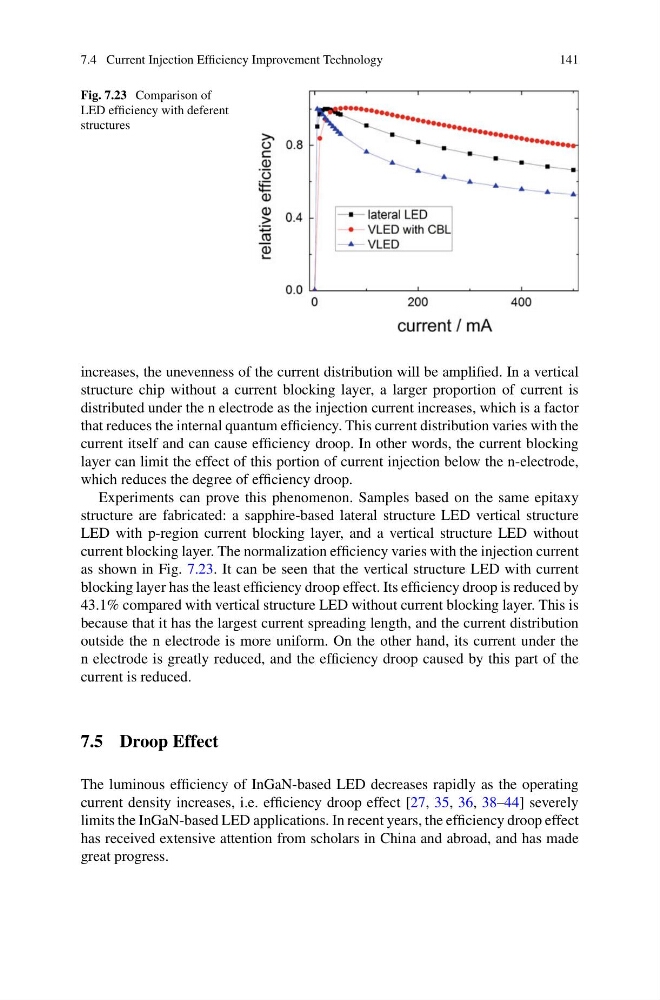
Fig. 7.23 Comparison of
LED efficiency with deferent
structures
increases, the unevenness of the current distribution will be amplified. In a vertical
structure chip without a current blocking layer, a larger proportion of current is
distributed under the n electrode as the injection current increases, which is a factor
that reduces the internal quantum efficiency. This current distribution varies with the
current itself and can cause efficiency droop. In other words, the current blocking
layer can limit the effect of this portion of current injection below the n-electrode,
which reduces the degree of efficiency droop.
Experiments can prove this phenomenon. Samples based on the same epitaxy
structure are fabricated: a sapphire-based lateral structure LED vertical structure
LED with p-region current blocking layer, and a vertical structure LED without
current blocking layer. The normalization efficiency varies with the injection current
as shown in Fig. 7.23. It can be seen that the vertical structure LED with current
blocking layer has the least efficiency droop effect. Its efficiency droop is reduced by
43.1% compared with vertical structure LED without current blocking layer. This is
because that it has the largest current spreading length, and the current distribution
outside the n electrode is more uniform. On the other hand, its current under the
n electrode is greatly reduced, and the efficiency droop caused by this part of the
current is reduced.
7.5 Droop Effect
The luminous efficiency of InGaN-based LED decreases rapidly as the operating
current density increases, i.e. efficiency droop effect [27, 35, 36, 38–44] severely
limits the InGaN-based LED applications. In recent years, the efficiency droop effect
has received extensive attention from scholars in China and abroad, and has made
great progress.
141
Fig. 7.23 Comparison of
LED efficiency with deferent
structures
increases, the unevenness of the current distribution will be amplified. In a vertical
structure chip without a current blocking layer, a larger proportion of current is
distributed under the n electrode as the injection current increases, which is a factor
that reduces the internal quantum efficiency. This current distribution varies with the
current itself and can cause efficiency droop. In other words, the current blocking
layer can limit the effect of this portion of current injection below the n-electrode,
which reduces the degree of efficiency droop.
Experiments can prove this phenomenon. Samples based on the same epitaxy
structure are fabricated: a sapphire-based lateral structure LED vertical structure
LED with p-region current blocking layer, and a vertical structure LED without
current blocking layer. The normalization efficiency varies with the injection current
as shown in Fig. 7.23. It can be seen that the vertical structure LED with current
blocking layer has the least efficiency droop effect. Its efficiency droop is reduced by
43.1% compared with vertical structure LED without current blocking layer. This is
because that it has the largest current spreading length, and the current distribution
outside the n electrode is more uniform. On the other hand, its current under the
n electrode is greatly reduced, and the efficiency droop caused by this part of the
current is reduced.
7.5 Droop Effect
The luminous efficiency of InGaN-based LED decreases rapidly as the operating
current density increases, i.e. efficiency droop effect [27, 35, 36, 38–44] severely
limits the InGaN-based LED applications. In recent years, the efficiency droop effect
has received extensive attention from scholars in China and abroad, and has made
great progress.