

7.4 Current Injection Efficiency Improvement Technology
139
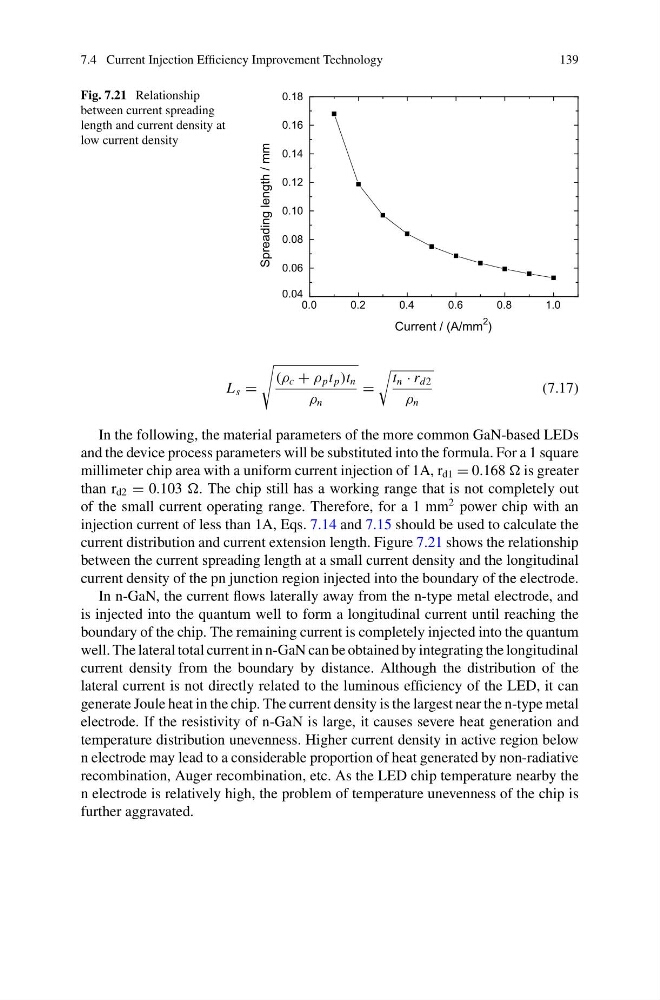
Fig. 7.21 Relationship
between current spreading
length and current density at
low current density
0.0
0.2
0.4
0.6
0.8
1.0
0.04
0.06
0.08
0.10
0.12
0.14
0.16
0.18
Spreading length / mm
Current / (A/mm
2
)
L s =
(ρ c + ρ p t p )t n
ρ n
=
t n · r d2
ρ n
(7.17)
In the following, the material parameters of the more common GaN-based LEDs
and the device process parameters will be substituted into the formula. For a 1 square
millimeter chip area with a uniform current injection of 1A, r d1 = 0.168 is greater
than r d2 = 0.103 . The chip still has a working range that is not completely out
of the small current operating range. Therefore, for a 1 mm
2 power chip with an
injection current of less than 1A, Eqs. 7.14 and 7.15 should be used to calculate the
current distribution and current extension length. Figure 7.21 shows the relationship
between the current spreading length at a small current density and the longitudinal
current density of the pn junction region injected into the boundary of the electrode.
In n-GaN, the current flows laterally away from the n-type metal electrode, and
is injected into the quantum well to form a longitudinal current until reaching the
boundary of the chip. The remaining current is completely injected into the quantum
well. The lateral total current in n-GaN can be obtained by integrating the longitudinal
current density from the boundary by distance. Although the distribution of the
lateral current is not directly related to the luminous efficiency of the LED, it can
generate Joule heat in the chip. The current density is the largest near the n-type metal
electrode. If the resistivity of n-GaN is large, it causes severe heat generation and
temperature distribution unevenness. Higher current density in active region below
n electrode may lead to a considerable proportion of heat generated by non-radiative
recombination, Auger recombination, etc. As the LED chip temperature nearby the
n electrode is relatively high, the problem of temperature unevenness of the chip is
further aggravated.
139
Fig. 7.21 Relationship
between current spreading
length and current density at
low current density
0.0
0.2
0.4
0.6
0.8
1.0
0.04
0.06
0.08
0.10
0.12
0.14
0.16
0.18
Spreading length / mm
Current / (A/mm
2
)
L s =
(ρ c + ρ p t p )t n
ρ n
=
t n · r d2
ρ n
(7.17)
In the following, the material parameters of the more common GaN-based LEDs
and the device process parameters will be substituted into the formula. For a 1 square
millimeter chip area with a uniform current injection of 1A, r d1 = 0.168 is greater
than r d2 = 0.103 . The chip still has a working range that is not completely out
of the small current operating range. Therefore, for a 1 mm
2 power chip with an
injection current of less than 1A, Eqs. 7.14 and 7.15 should be used to calculate the
current distribution and current extension length. Figure 7.21 shows the relationship
between the current spreading length at a small current density and the longitudinal
current density of the pn junction region injected into the boundary of the electrode.
In n-GaN, the current flows laterally away from the n-type metal electrode, and
is injected into the quantum well to form a longitudinal current until reaching the
boundary of the chip. The remaining current is completely injected into the quantum
well. The lateral total current in n-GaN can be obtained by integrating the longitudinal
current density from the boundary by distance. Although the distribution of the
lateral current is not directly related to the luminous efficiency of the LED, it can
generate Joule heat in the chip. The current density is the largest near the n-type metal
electrode. If the resistivity of n-GaN is large, it causes severe heat generation and
temperature distribution unevenness. Higher current density in active region below
n electrode may lead to a considerable proportion of heat generated by non-radiative
recombination, Auger recombination, etc. As the LED chip temperature nearby the
n electrode is relatively high, the problem of temperature unevenness of the chip is
further aggravated.