

124
7 III-Nitride LED Quantum Efficiency Improvement Technology
7.3 Light Extraction Efficiency Improvement Technology
Approaches to enhance the light extraction efficiency include patterning substrate,
surface roughening, utilizing reflector and photonic crystal.
7.3.1 Patterned Sapphire Substrate
Lattice mismatch between the sapphire substrate and the GaN epitaxial layer is about
14% and the thermal mismatch is 25.5%. Such mismatches can lead to high density
defects in the GaN epitaxial layer. The defect density can reach 10
8 –10
10 cm
−2 . Due
to the poor crystal quality, the transfer rate of carriers and the injection efficiency of
the device are decreased. At the same time, non-radiative recombination is likely to
occur due to the impurity level at the defect. The photons generated by the radiate
recombination are also easily absorbed by the defects to generate heat. Further, there
are multiple interfaces where a large change of refractive index happens in GaNbased LED chip. These interfaces can be from between the GaN and sapphire or
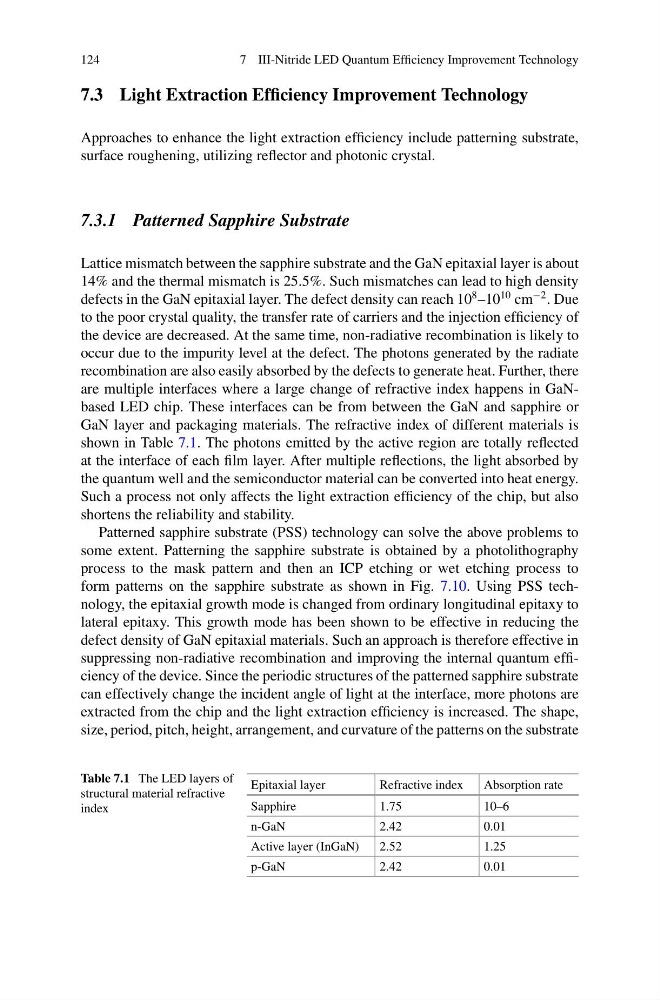
GaN layer and packaging materials. The refractive index of different materials is
shown in Table 7.1. The photons emitted by the active region are totally reflected
at the interface of each film layer. After multiple reflections, the light absorbed by
the quantum well and the semiconductor material can be converted into heat energy.
Such a process not only affects the light extraction efficiency of the chip, but also
shortens the reliability and stability.
Patterned sapphire substrate (PSS) technology can solve the above problems to
some extent. Patterning the sapphire substrate is obtained by a photolithography
process to the mask pattern and then an ICP etching or wet etching process to
form patterns on the sapphire substrate as shown in Fig. 7.10. Using PSS technology, the epitaxial growth mode is changed from ordinary longitudinal epitaxy to
lateral epitaxy. This growth mode has been shown to be effective in reducing the
defect density of GaN epitaxial materials. Such an approach is therefore effective in
suppressing non-radiative recombination and improving the internal quantum efficiency of the device. Since the periodic structures of the patterned sapphire substrate
can effectively change the incident angle of light at the interface, more photons are
extracted from the chip and the light extraction efficiency is increased. The shape,
size, period, pitch, height, arrangement, and curvature of the patterns on the substrate
Table 7.1 The LED layers of
structural material refractive
index
Epitaxial layer
Refractive index
Absorption rate
Sapphire
1.75
10–6
n-GaN
2.42
0.01
Active layer (InGaN)
2.52
1.25
p-GaN
2.42
0.01
7 III-Nitride LED Quantum Efficiency Improvement Technology
7.3 Light Extraction Efficiency Improvement Technology
Approaches to enhance the light extraction efficiency include patterning substrate,
surface roughening, utilizing reflector and photonic crystal.
7.3.1 Patterned Sapphire Substrate
Lattice mismatch between the sapphire substrate and the GaN epitaxial layer is about
14% and the thermal mismatch is 25.5%. Such mismatches can lead to high density
defects in the GaN epitaxial layer. The defect density can reach 10
8 –10
10 cm
−2 . Due
to the poor crystal quality, the transfer rate of carriers and the injection efficiency of
the device are decreased. At the same time, non-radiative recombination is likely to
occur due to the impurity level at the defect. The photons generated by the radiate
recombination are also easily absorbed by the defects to generate heat. Further, there
are multiple interfaces where a large change of refractive index happens in GaNbased LED chip. These interfaces can be from between the GaN and sapphire or
GaN layer and packaging materials. The refractive index of different materials is
shown in Table 7.1. The photons emitted by the active region are totally reflected
at the interface of each film layer. After multiple reflections, the light absorbed by
the quantum well and the semiconductor material can be converted into heat energy.
Such a process not only affects the light extraction efficiency of the chip, but also
shortens the reliability and stability.
Patterned sapphire substrate (PSS) technology can solve the above problems to
some extent. Patterning the sapphire substrate is obtained by a photolithography
process to the mask pattern and then an ICP etching or wet etching process to
form patterns on the sapphire substrate as shown in Fig. 7.10. Using PSS technology, the epitaxial growth mode is changed from ordinary longitudinal epitaxy to
lateral epitaxy. This growth mode has been shown to be effective in reducing the
defect density of GaN epitaxial materials. Such an approach is therefore effective in
suppressing non-radiative recombination and improving the internal quantum efficiency of the device. Since the periodic structures of the patterned sapphire substrate
can effectively change the incident angle of light at the interface, more photons are
extracted from the chip and the light extraction efficiency is increased. The shape,
size, period, pitch, height, arrangement, and curvature of the patterns on the substrate
Table 7.1 The LED layers of
structural material refractive
index
Epitaxial layer
Refractive index
Absorption rate
Sapphire
1.75
10–6
n-GaN
2.42
0.01
Active layer (InGaN)
2.52
1.25
p-GaN
2.42
0.01