

5 Control of Crystal Size Distribution and Polymorphs …
87
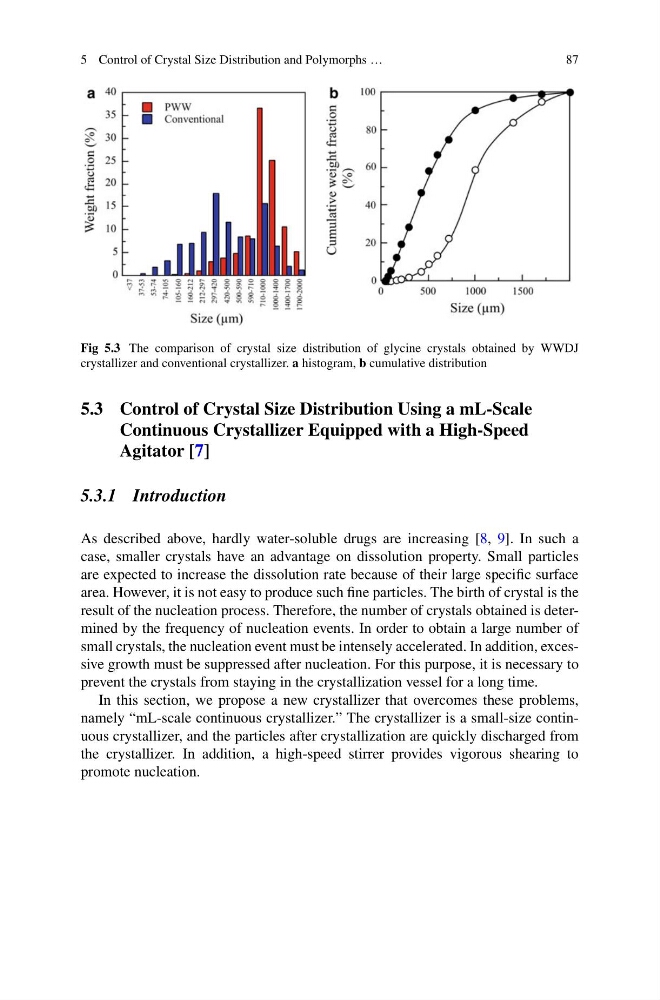
Fig 5.3 The comparison of crystal size distribution of glycine crystals obtained by WWDJ
crystallizer and conventional crystallizer. a histogram, b cumulative distribution
5.3 Control of Crystal Size Distribution Using a mL-Scale
Continuous Crystallizer Equipped with a High-Speed
Agitator [7]
5.3.1 Introduction
As described above, hardly water-soluble drugs are increasing [8, 9]. In such a
case, smaller crystals have an advantage on dissolution property. Small particles
are expected to increase the dissolution rate because of their large specific surface
area. However, it is not easy to produce such fine particles. The birth of crystal is the
result of the nucleation process. Therefore, the number of crystals obtained is determined by the frequency of nucleation events. In order to obtain a large number of
small crystals, the nucleation event must be intensely accelerated. In addition, excessive growth must be suppressed after nucleation. For this purpose, it is necessary to
prevent the crystals from staying in the crystallization vessel for a long time.
In this section, we propose a new crystallizer that overcomes these problems,
namely “mL-scale continuous crystallizer.” The crystallizer is a small-size continuous crystallizer, and the particles after crystallization are quickly discharged from
the crystallizer. In addition, a high-speed stirrer provides vigorous shearing to
promote nucleation.
87
Fig 5.3 The comparison of crystal size distribution of glycine crystals obtained by WWDJ
crystallizer and conventional crystallizer. a histogram, b cumulative distribution
5.3 Control of Crystal Size Distribution Using a mL-Scale
Continuous Crystallizer Equipped with a High-Speed
Agitator [7]
5.3.1 Introduction
As described above, hardly water-soluble drugs are increasing [8, 9]. In such a
case, smaller crystals have an advantage on dissolution property. Small particles
are expected to increase the dissolution rate because of their large specific surface
area. However, it is not easy to produce such fine particles. The birth of crystal is the
result of the nucleation process. Therefore, the number of crystals obtained is determined by the frequency of nucleation events. In order to obtain a large number of
small crystals, the nucleation event must be intensely accelerated. In addition, excessive growth must be suppressed after nucleation. For this purpose, it is necessary to
prevent the crystals from staying in the crystallization vessel for a long time.
In this section, we propose a new crystallizer that overcomes these problems,
namely “mL-scale continuous crystallizer.” The crystallizer is a small-size continuous crystallizer, and the particles after crystallization are quickly discharged from
the crystallizer. In addition, a high-speed stirrer provides vigorous shearing to
promote nucleation.