

3 Anti-solvent Crystallization Method for Production …
63
experimental results (Fig. 3.7). As the experimental result under Profile-A condition,
the product crystal identified to be γ -form.
3.4.5 Operation Strategies of Solution Addition Method
In order to establish a production method of the target polymorph in the anti-solvent
crystallization, the simulation model was proposed [5] to determine anti-solvent
feed rate based on the ternary phase diagram. The stability of the polymorph of
indomethacin (IMC) crystal in the solution changed not only with temperature but
with the composition of the mixed solvent. And the design strategy of anti-solvent
crystallization was proposed. It was reported that the modulation operation is effective for the improvement of crystal quality. The temperature modulated operation [17]
was effective for improvement of crystal size distributions. So, the crystal quality
may be further improved by integrating some crystallization operations. In the case
of anti-solvent crystallization, desired crystal polymorphism may be achieved by
integrating with solution addition method and temperature change operation.
Three kinds of anti-solvent addition methods were carried out. The anti-solvent
addition rates in each experiment were determined by the simulation. Method A is
the method that an anti-solvent is added at the constant flow rate. Method B is the
method that the addition rate of anti-solvent increases in three stages. Method C
is the method that an anti-solvent is added intermittently at the constant rate. The
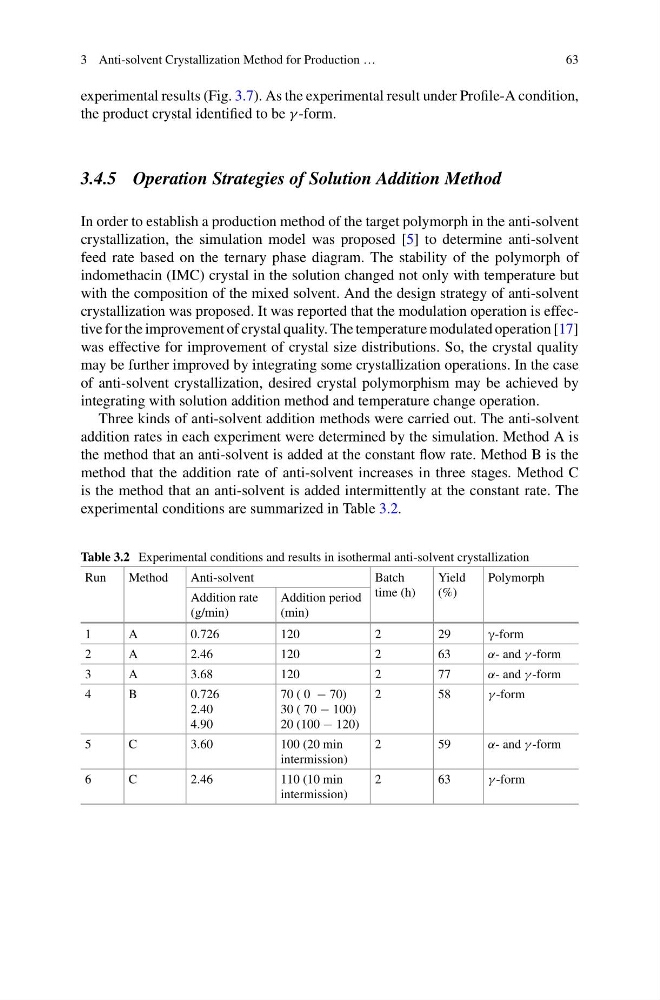
experimental conditions are summarized in Table 3.2.
Table 3.2 Experimental conditions and results in isothermal anti-solvent crystallization
Run
Method
Anti-solvent
Batch
time (h)
Yield
(%)
Polymorph
Addition rate
(g/min)
Addition period
(min)
1
A
0.726
120
2
29
γ-form
2
A
2.46
120
2
63
α- and γ -form
3
A
3.68
120
2
77
α- and γ -form
4
B
0.726
2.40
4.90
70 ( 0 − 70)
30 ( 70 − 100)
20 (100 − 120)
2
58
γ -form
5
C
3.60
100 (20 min
intermission)
2
59
α- and γ -form
6
C
2.46
110 (10 min
intermission)
2
63
γ -form
63
experimental results (Fig. 3.7). As the experimental result under Profile-A condition,
the product crystal identified to be γ -form.
3.4.5 Operation Strategies of Solution Addition Method
In order to establish a production method of the target polymorph in the anti-solvent
crystallization, the simulation model was proposed [5] to determine anti-solvent
feed rate based on the ternary phase diagram. The stability of the polymorph of
indomethacin (IMC) crystal in the solution changed not only with temperature but
with the composition of the mixed solvent. And the design strategy of anti-solvent
crystallization was proposed. It was reported that the modulation operation is effective for the improvement of crystal quality. The temperature modulated operation [17]
was effective for improvement of crystal size distributions. So, the crystal quality
may be further improved by integrating some crystallization operations. In the case
of anti-solvent crystallization, desired crystal polymorphism may be achieved by
integrating with solution addition method and temperature change operation.
Three kinds of anti-solvent addition methods were carried out. The anti-solvent
addition rates in each experiment were determined by the simulation. Method A is
the method that an anti-solvent is added at the constant flow rate. Method B is the
method that the addition rate of anti-solvent increases in three stages. Method C
is the method that an anti-solvent is added intermittently at the constant rate. The
experimental conditions are summarized in Table 3.2.
Table 3.2 Experimental conditions and results in isothermal anti-solvent crystallization
Run
Method
Anti-solvent
Batch
time (h)
Yield
(%)
Polymorph
Addition rate
(g/min)
Addition period
(min)
1
A
0.726
120
2
29
γ-form
2
A
2.46
120
2
63
α- and γ -form
3
A
3.68
120
2
77
α- and γ -form
4
B
0.726
2.40
4.90
70 ( 0 − 70)
30 ( 70 − 100)
20 (100 − 120)
2
58
γ -form
5
C
3.60
100 (20 min
intermission)
2
59
α- and γ -form
6
C
2.46
110 (10 min
intermission)
2
63
γ -form