

534
K. Sada and K. Kokado
porphyrin-based organic thin films after removal of metal ions by immersing in an
EDTA solution. The morphology and thickness of the porphyrin polymer thin films
were not significantly changed during the decomposition of the coordination bonds.
The open framework of the MOF acts as a template for the two-dimensional polymer
thin film. The generation of singlet oxygen by visible light irradiation was monitored
for its antimicrobial activity. The other reactions such as light-induced thiol-ene click
reaction (Scheme 25.5b) and the coupling reaction of the terminal alkynes were used
for the crosslinking of the organic ligands in SURMOF by the same group [49, 50].
The bioconjugation of the MOF and biomacromolecules has attracted considerable interest as functional composites. As described in the previous section, SPAAC
should expand the possibility of the utility for the PSM of the MOF by the CuACC.
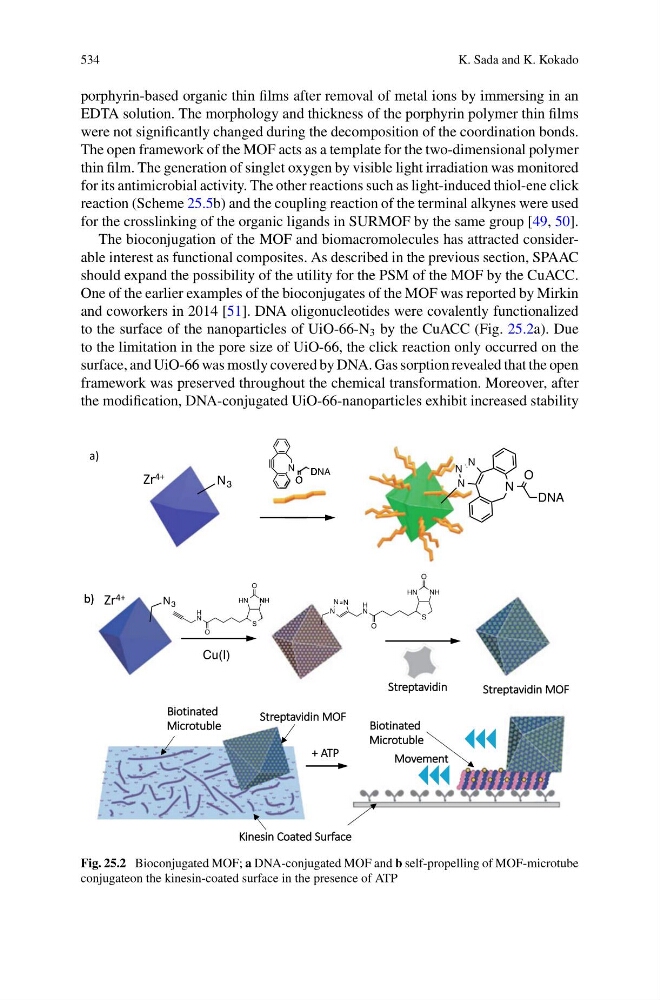
One of the earlier examples of the bioconjugates of the MOF was reported by Mirkin
and coworkers in 2014 [51]. DNA oligonucleotides were covalently functionalized
to the surface of the nanoparticles of UiO-66-N 3 by the CuACC (Fig. 25.2a). Due
to the limitation in the pore size of UiO-66, the click reaction only occurred on the
surface, and UiO-66 was mostly covered by DNA. Gas sorption revealed that the open
framework was preserved throughout the chemical transformation. Moreover, after
the modification, DNA-conjugated UiO-66-nanoparticles exhibit increased stability
Fig. 25.2 Bioconjugated MOF; a DNA-conjugated MOF and b self-propelling of MOF-microtube
conjugateon the kinesin-coated surface in the presence of ATP
K. Sada and K. Kokado
porphyrin-based organic thin films after removal of metal ions by immersing in an
EDTA solution. The morphology and thickness of the porphyrin polymer thin films
were not significantly changed during the decomposition of the coordination bonds.
The open framework of the MOF acts as a template for the two-dimensional polymer
thin film. The generation of singlet oxygen by visible light irradiation was monitored
for its antimicrobial activity. The other reactions such as light-induced thiol-ene click
reaction (Scheme 25.5b) and the coupling reaction of the terminal alkynes were used
for the crosslinking of the organic ligands in SURMOF by the same group [49, 50].
The bioconjugation of the MOF and biomacromolecules has attracted considerable interest as functional composites. As described in the previous section, SPAAC
should expand the possibility of the utility for the PSM of the MOF by the CuACC.
One of the earlier examples of the bioconjugates of the MOF was reported by Mirkin
and coworkers in 2014 [51]. DNA oligonucleotides were covalently functionalized
to the surface of the nanoparticles of UiO-66-N 3 by the CuACC (Fig. 25.2a). Due
to the limitation in the pore size of UiO-66, the click reaction only occurred on the
surface, and UiO-66 was mostly covered by DNA. Gas sorption revealed that the open
framework was preserved throughout the chemical transformation. Moreover, after
the modification, DNA-conjugated UiO-66-nanoparticles exhibit increased stability
Fig. 25.2 Bioconjugated MOF; a DNA-conjugated MOF and b self-propelling of MOF-microtube
conjugateon the kinesin-coated surface in the presence of ATP