

25 Click Chemistry to Metal-Organic …
533
on the open framework of the MOF as the monomers by CuAAC with external guest
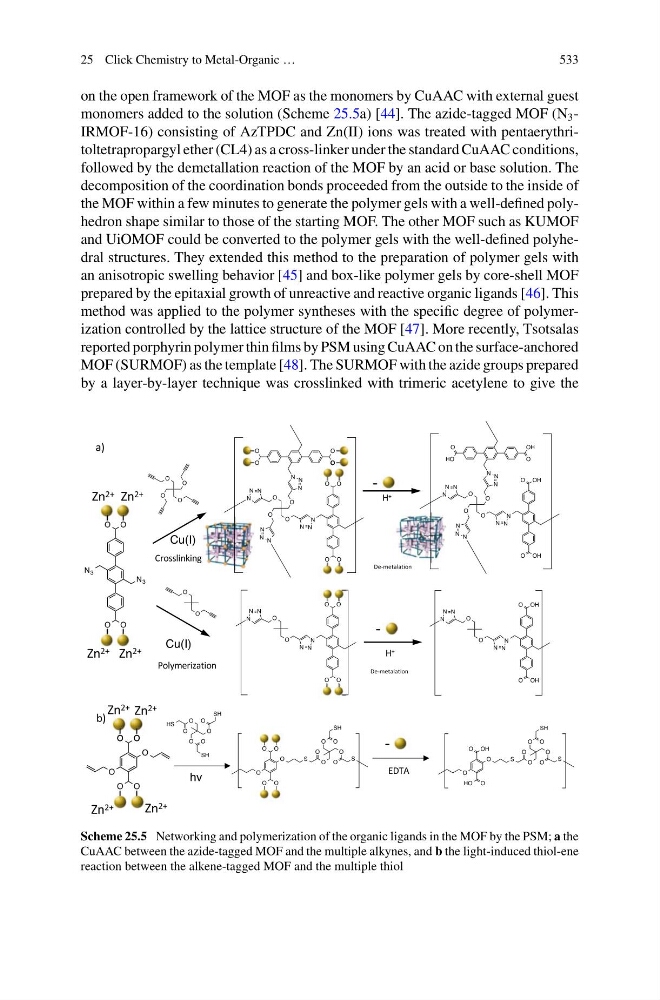
monomers added to the solution (Scheme 25.5a) [44]. The azide-tagged MOF (N 3 -
IRMOF-16) consisting of AzTPDC and Zn(II) ions was treated with pentaerythritoltetrapropargyl ether (CL4) as a cross-linker under the standard CuAAC conditions,
followed by the demetallation reaction of the MOF by an acid or base solution. The
decomposition of the coordination bonds proceeded from the outside to the inside of
the MOF within a few minutes to generate the polymer gels with a well-defined polyhedron shape similar to those of the starting MOF. The other MOF such as KUMOF
and UiOMOF could be converted to the polymer gels with the well-defined polyhedral structures. They extended this method to the preparation of polymer gels with
an anisotropic swelling behavior [45] and box-like polymer gels by core-shell MOF
prepared by the epitaxial growth of unreactive and reactive organic ligands [46]. This
method was applied to the polymer syntheses with the specific degree of polymerization controlled by the lattice structure of the MOF [47]. More recently, Tsotsalas
reported porphyrin polymer thin films by PSM using CuAAC on the surface-anchored
MOF (SURMOF) as the template [48]. The SURMOF with the azide groups prepared
by a layer-by-layer technique was crosslinked with trimeric acetylene to give the
Scheme 25.5 Networking and polymerization of the organic ligands in the MOF by the PSM; a the
CuAAC between the azide-tagged MOF and the multiple alkynes, and b the light-induced thiol-ene
reaction between the alkene-tagged MOF and the multiple thiol
533
on the open framework of the MOF as the monomers by CuAAC with external guest
monomers added to the solution (Scheme 25.5a) [44]. The azide-tagged MOF (N 3 -
IRMOF-16) consisting of AzTPDC and Zn(II) ions was treated with pentaerythritoltetrapropargyl ether (CL4) as a cross-linker under the standard CuAAC conditions,
followed by the demetallation reaction of the MOF by an acid or base solution. The
decomposition of the coordination bonds proceeded from the outside to the inside of
the MOF within a few minutes to generate the polymer gels with a well-defined polyhedron shape similar to those of the starting MOF. The other MOF such as KUMOF
and UiOMOF could be converted to the polymer gels with the well-defined polyhedral structures. They extended this method to the preparation of polymer gels with
an anisotropic swelling behavior [45] and box-like polymer gels by core-shell MOF
prepared by the epitaxial growth of unreactive and reactive organic ligands [46]. This
method was applied to the polymer syntheses with the specific degree of polymerization controlled by the lattice structure of the MOF [47]. More recently, Tsotsalas
reported porphyrin polymer thin films by PSM using CuAAC on the surface-anchored
MOF (SURMOF) as the template [48]. The SURMOF with the azide groups prepared
by a layer-by-layer technique was crosslinked with trimeric acetylene to give the
Scheme 25.5 Networking and polymerization of the organic ligands in the MOF by the PSM; a the
CuAAC between the azide-tagged MOF and the multiple alkynes, and b the light-induced thiol-ene
reaction between the alkene-tagged MOF and the multiple thiol