

46
F. Ito
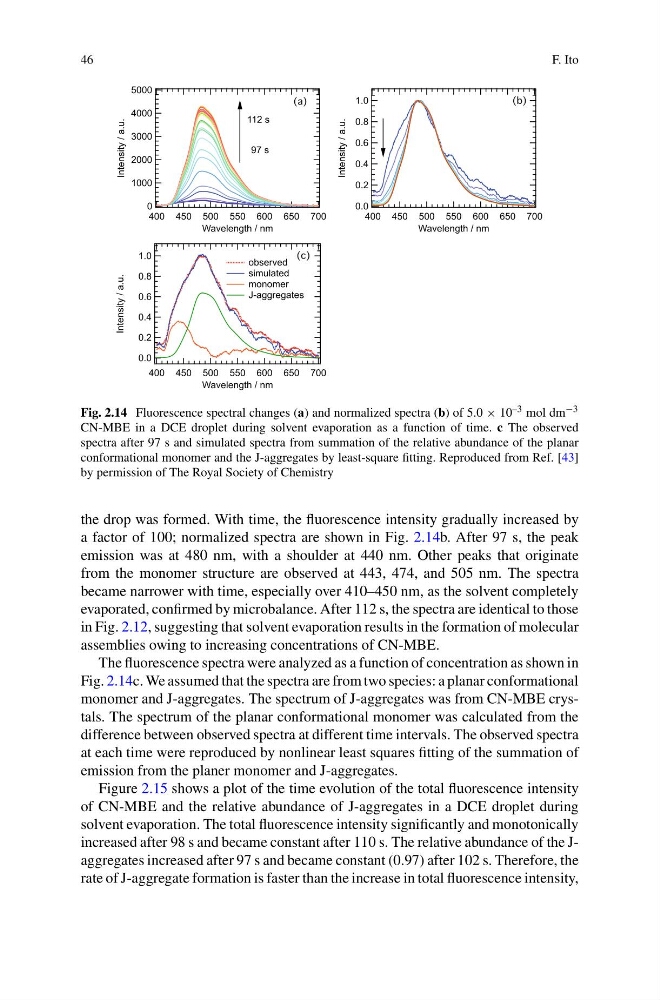
Fig. 2.14 Fluorescence spectral changes (a) and normalized spectra (b) of 5.0 × 10 –3 mol dm −3
CN-MBE in a DCE droplet during solvent evaporation as a function of time. c The observed
spectra after 97 s and simulated spectra from summation of the relative abundance of the planar
conformational monomer and the J-aggregates by least-square fitting. Reproduced from Ref. [43]
by permission of The Royal Society of Chemistry
the drop was formed. With time, the fluorescence intensity gradually increased by
a factor of 100; normalized spectra are shown in Fig. 2.14b. After 97 s, the peak
emission was at 480 nm, with a shoulder at 440 nm. Other peaks that originate
from the monomer structure are observed at 443, 474, and 505 nm. The spectra
became narrower with time, especially over 410–450 nm, as the solvent completely
evaporated, confirmed by microbalance. After 112 s, the spectra are identical to those
in Fig. 2.12, suggesting that solvent evaporation results in the formation of molecular
assemblies owing to increasing concentrations of CN-MBE.
The fluorescence spectra were analyzed as a function of concentration as shown in
Fig. 2.14c. We assumed that the spectra are from two species: a planar conformational
monomer and J-aggregates. The spectrum of J-aggregates was from CN-MBE crystals. The spectrum of the planar conformational monomer was calculated from the
difference between observed spectra at different time intervals. The observed spectra
at each time were reproduced by nonlinear least squares fitting of the summation of
emission from the planer monomer and J-aggregates.
Figure 2.15 shows a plot of the time evolution of the total fluorescence intensity
of CN-MBE and the relative abundance of J-aggregates in a DCE droplet during
solvent evaporation. The total fluorescence intensity significantly and monotonically
increased after 98 s and became constant after 110 s. The relative abundance of the Jaggregates increased after 97 s and became constant (0.97) after 102 s. Therefore, the
rate of J-aggregate formation is faster than the increase in total fluorescence intensity,
F. Ito
Fig. 2.14 Fluorescence spectral changes (a) and normalized spectra (b) of 5.0 × 10 –3 mol dm −3
CN-MBE in a DCE droplet during solvent evaporation as a function of time. c The observed
spectra after 97 s and simulated spectra from summation of the relative abundance of the planar
conformational monomer and the J-aggregates by least-square fitting. Reproduced from Ref. [43]
by permission of The Royal Society of Chemistry
the drop was formed. With time, the fluorescence intensity gradually increased by
a factor of 100; normalized spectra are shown in Fig. 2.14b. After 97 s, the peak
emission was at 480 nm, with a shoulder at 440 nm. Other peaks that originate
from the monomer structure are observed at 443, 474, and 505 nm. The spectra
became narrower with time, especially over 410–450 nm, as the solvent completely
evaporated, confirmed by microbalance. After 112 s, the spectra are identical to those
in Fig. 2.12, suggesting that solvent evaporation results in the formation of molecular
assemblies owing to increasing concentrations of CN-MBE.
The fluorescence spectra were analyzed as a function of concentration as shown in
Fig. 2.14c. We assumed that the spectra are from two species: a planar conformational
monomer and J-aggregates. The spectrum of J-aggregates was from CN-MBE crystals. The spectrum of the planar conformational monomer was calculated from the
difference between observed spectra at different time intervals. The observed spectra
at each time were reproduced by nonlinear least squares fitting of the summation of
emission from the planer monomer and J-aggregates.
Figure 2.15 shows a plot of the time evolution of the total fluorescence intensity
of CN-MBE and the relative abundance of J-aggregates in a DCE droplet during
solvent evaporation. The total fluorescence intensity significantly and monotonically
increased after 98 s and became constant after 110 s. The relative abundance of the Jaggregates increased after 97 s and became constant (0.97) after 102 s. Therefore, the
rate of J-aggregate formation is faster than the increase in total fluorescence intensity,