

514
S. Okada et al.
connected by conjugated acetylenes in each repeating unit. The resulting polymers
showed unique absorption bands at the longer wavelength than the excitonic bands
of the polydiacetylene, which were considered to be originated from π-conjugation
between two π-conjugated backbones. On the other hand, in the case of the monomer
with two butadiyne moieties connected by –(CH=CH) 3 – in the all-trans form, regular
polymerization did not occur [47].
24.4.1 Monomers with Phenylene Linkage
As mentioned above, when the π-conjugated linkage is introduced between
two butadiyne moieties, π-conjugation between two polydiacetylene backbones
is expected. Since phenylene group can be another π-conjugated linkage, the
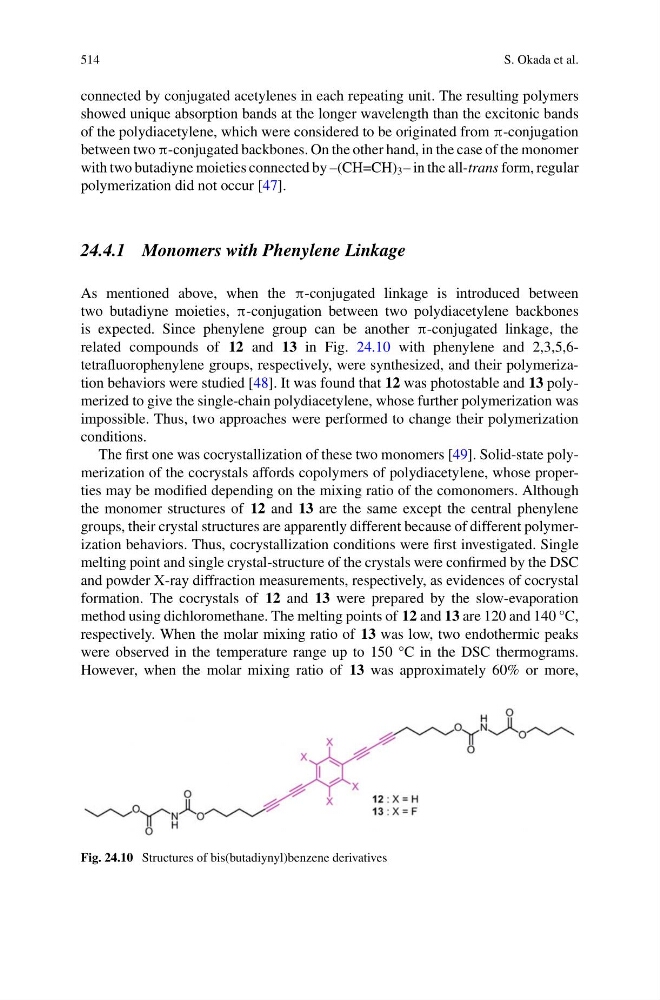
related compounds of 12 and 13 in Fig. 24.10 with phenylene and 2,3,5,6tetrafluorophenylene groups, respectively, were synthesized, and their polymerization behaviors were studied [48]. It was found that 12 was photostable and 13 polymerized to give the single-chain polydiacetylene, whose further polymerization was
impossible. Thus, two approaches were performed to change their polymerization
conditions.
The first one was cocrystallization of these two monomers [49]. Solid-state polymerization of the cocrystals affords copolymers of polydiacetylene, whose properties may be modified depending on the mixing ratio of the comonomers. Although
the monomer structures of 12 and 13 are the same except the central phenylene
groups, their crystal structures are apparently different because of different polymerization behaviors. Thus, cocrystallization conditions were first investigated. Single
melting point and single crystal-structure of the crystals were confirmed by the DSC
and powder X-ray diffraction measurements, respectively, as evidences of cocrystal
formation. The cocrystals of 12 and 13 were prepared by the slow-evaporation
method using dichloromethane. The melting points of 12 and 13 are 120 and 140 °C,
respectively. When the molar mixing ratio of 13 was low, two endothermic peaks
were observed in the temperature range up to 150 °C in the DSC thermograms.
However, when the molar mixing ratio of 13 was approximately 60% or more,
Fig. 24.10 Structures of bis(butadiynyl)benzene derivatives
S. Okada et al.
connected by conjugated acetylenes in each repeating unit. The resulting polymers
showed unique absorption bands at the longer wavelength than the excitonic bands
of the polydiacetylene, which were considered to be originated from π-conjugation
between two π-conjugated backbones. On the other hand, in the case of the monomer
with two butadiyne moieties connected by –(CH=CH) 3 – in the all-trans form, regular
polymerization did not occur [47].
24.4.1 Monomers with Phenylene Linkage
As mentioned above, when the π-conjugated linkage is introduced between
two butadiyne moieties, π-conjugation between two polydiacetylene backbones
is expected. Since phenylene group can be another π-conjugated linkage, the
related compounds of 12 and 13 in Fig. 24.10 with phenylene and 2,3,5,6tetrafluorophenylene groups, respectively, were synthesized, and their polymerization behaviors were studied [48]. It was found that 12 was photostable and 13 polymerized to give the single-chain polydiacetylene, whose further polymerization was
impossible. Thus, two approaches were performed to change their polymerization
conditions.
The first one was cocrystallization of these two monomers [49]. Solid-state polymerization of the cocrystals affords copolymers of polydiacetylene, whose properties may be modified depending on the mixing ratio of the comonomers. Although
the monomer structures of 12 and 13 are the same except the central phenylene
groups, their crystal structures are apparently different because of different polymerization behaviors. Thus, cocrystallization conditions were first investigated. Single
melting point and single crystal-structure of the crystals were confirmed by the DSC
and powder X-ray diffraction measurements, respectively, as evidences of cocrystal
formation. The cocrystals of 12 and 13 were prepared by the slow-evaporation
method using dichloromethane. The melting points of 12 and 13 are 120 and 140 °C,
respectively. When the molar mixing ratio of 13 was low, two endothermic peaks
were observed in the temperature range up to 150 °C in the DSC thermograms.
However, when the molar mixing ratio of 13 was approximately 60% or more,
Fig. 24.10 Structures of bis(butadiynyl)benzene derivatives