

24 Solid-State Polymerization of Conjugated …
513
24.4 Monomers with Two Butadiyne Moieties
When the monomers have two polymerizable moieties and are fully polymerized,
one-dimensional ladder polymers or two-dimensional network polymers can be
obtained depending on the monomer structures and the polymerization sites, which
will be discussed later. Stepwise polymerization scheme of the monomers with two
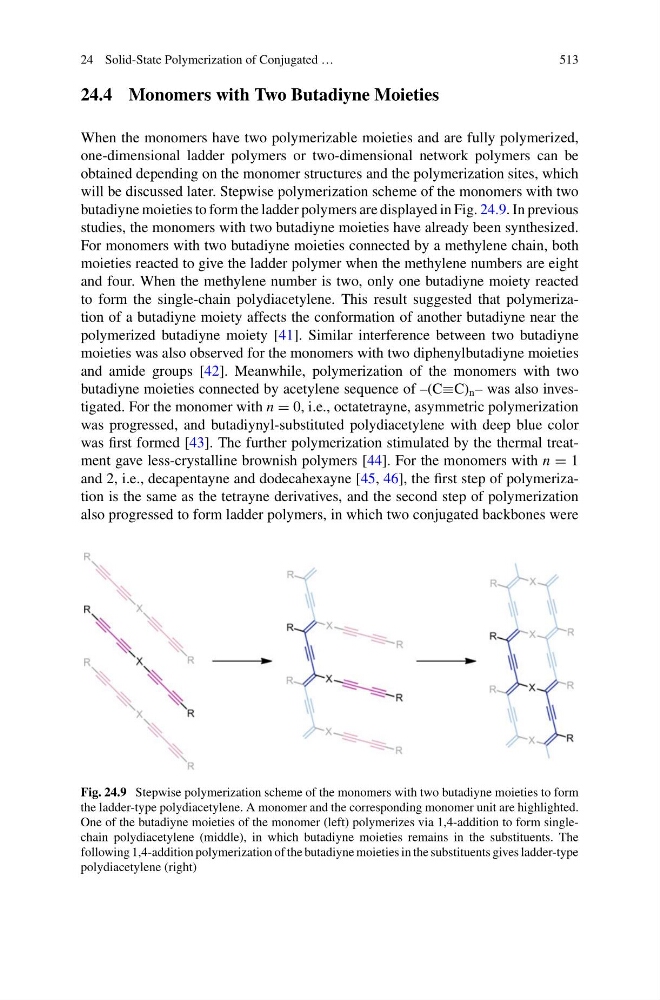
butadiyne moieties to form the ladder polymers are displayed in Fig. 24.9. In previous
studies, the monomers with two butadiyne moieties have already been synthesized.
For monomers with two butadiyne moieties connected by a methylene chain, both
moieties reacted to give the ladder polymer when the methylene numbers are eight
and four. When the methylene number is two, only one butadiyne moiety reacted
to form the single-chain polydiacetylene. This result suggested that polymerization of a butadiyne moiety affects the conformation of another butadiyne near the
polymerized butadiyne moiety [41]. Similar interference between two butadiyne
moieties was also observed for the monomers with two diphenylbutadiyne moieties
and amide groups [42]. Meanwhile, polymerization of the monomers with two
butadiyne moieties connected by acetylene sequence of –(C≡C) n – was also investigated. For the monomer with n = 0, i.e., octatetrayne, asymmetric polymerization
was progressed, and butadiynyl-substituted polydiacetylene with deep blue color
was first formed [43]. The further polymerization stimulated by the thermal treatment gave less-crystalline brownish polymers [44]. For the monomers with n = 1
and 2, i.e., decapentayne and dodecahexayne [45, 46], the first step of polymerization is the same as the tetrayne derivatives, and the second step of polymerization
also progressed to form ladder polymers, in which two conjugated backbones were
Fig. 24.9 Stepwise polymerization scheme of the monomers with two butadiyne moieties to form
the ladder-type polydiacetylene. A monomer and the corresponding monomer unit are highlighted.
One of the butadiyne moieties of the monomer (left) polymerizes via 1,4-addition to form singlechain polydiacetylene (middle), in which butadiyne moieties remains in the substituents. The
following 1,4-addition polymerization of the butadiyne moieties in the substituents gives ladder-type
polydiacetylene (right)
513
24.4 Monomers with Two Butadiyne Moieties
When the monomers have two polymerizable moieties and are fully polymerized,
one-dimensional ladder polymers or two-dimensional network polymers can be
obtained depending on the monomer structures and the polymerization sites, which
will be discussed later. Stepwise polymerization scheme of the monomers with two
butadiyne moieties to form the ladder polymers are displayed in Fig. 24.9. In previous
studies, the monomers with two butadiyne moieties have already been synthesized.
For monomers with two butadiyne moieties connected by a methylene chain, both
moieties reacted to give the ladder polymer when the methylene numbers are eight
and four. When the methylene number is two, only one butadiyne moiety reacted
to form the single-chain polydiacetylene. This result suggested that polymerization of a butadiyne moiety affects the conformation of another butadiyne near the
polymerized butadiyne moiety [41]. Similar interference between two butadiyne
moieties was also observed for the monomers with two diphenylbutadiyne moieties
and amide groups [42]. Meanwhile, polymerization of the monomers with two
butadiyne moieties connected by acetylene sequence of –(C≡C) n – was also investigated. For the monomer with n = 0, i.e., octatetrayne, asymmetric polymerization
was progressed, and butadiynyl-substituted polydiacetylene with deep blue color
was first formed [43]. The further polymerization stimulated by the thermal treatment gave less-crystalline brownish polymers [44]. For the monomers with n = 1
and 2, i.e., decapentayne and dodecahexayne [45, 46], the first step of polymerization is the same as the tetrayne derivatives, and the second step of polymerization
also progressed to form ladder polymers, in which two conjugated backbones were
Fig. 24.9 Stepwise polymerization scheme of the monomers with two butadiyne moieties to form
the ladder-type polydiacetylene. A monomer and the corresponding monomer unit are highlighted.
One of the butadiyne moieties of the monomer (left) polymerizes via 1,4-addition to form singlechain polydiacetylene (middle), in which butadiyne moieties remains in the substituents. The
following 1,4-addition polymerization of the butadiyne moieties in the substituents gives ladder-type
polydiacetylene (right)