

512
S. Okada et al.
Table 24.2 Gel formability of 7–11 in various solvents
Solvent
Gel formability a
7
8
9
10
11
Hexane
T(1)
T(1)
T(2)
T(3)
T(1)
Cyclohexane
T(1)
T(1)
T(3)
T(3)
T(3)
Carbon tetrachloride
T(2)
T(1)
–
–
–
Toluene
T(2)
T(2)
–
–
–
Diethyl ether
–
–
T(2)
O(3)
O(2)
Ethyl acetate
O(1)
O(1)
O(2)
O(1)
O(2)
Acetone
O(2)
O(1)
O(1)
O(1)
O(2)
Ethanol
–
O(1)
O(1)
O(5)
O(1)
a Symbols for the gel formability: T, formation of transparent or translucent gels; O, formation of
opaque gels; –, no gel formation even in the 5wt% concentration solution. Numbers in parentheses
are minimum concentration for gel formation in wt%
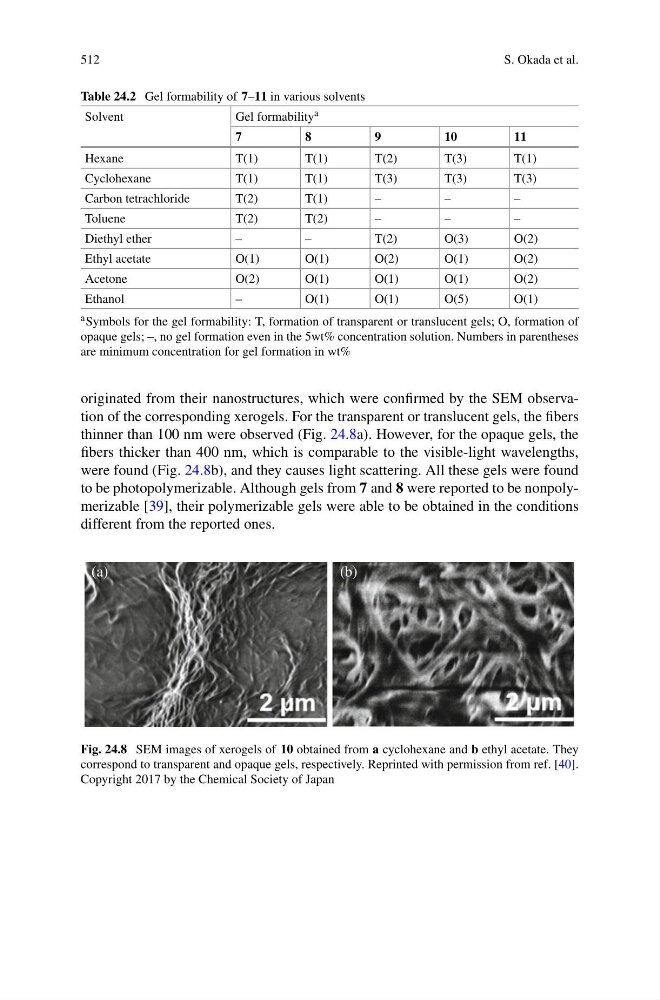
originated from their nanostructures, which were confirmed by the SEM observation of the corresponding xerogels. For the transparent or translucent gels, the fibers
thinner than 100 nm were observed (Fig. 24.8a). However, for the opaque gels, the
fibers thicker than 400 nm, which is comparable to the visible-light wavelengths,
were found (Fig. 24.8b), and they causes light scattering. All these gels were found
to be photopolymerizable. Although gels from 7 and 8 were reported to be nonpolymerizable [39], their polymerizable gels were able to be obtained in the conditions
different from the reported ones.
(b)
(a)
Fig. 24.8 SEM images of xerogels of 10 obtained from a cyclohexane and b ethyl acetate. They
correspond to transparent and opaque gels, respectively. Reprinted with permission from ref. [40].
Copyright 2017 by the Chemical Society of Japan
S. Okada et al.
Table 24.2 Gel formability of 7–11 in various solvents
Solvent
Gel formability a
7
8
9
10
11
Hexane
T(1)
T(1)
T(2)
T(3)
T(1)
Cyclohexane
T(1)
T(1)
T(3)
T(3)
T(3)
Carbon tetrachloride
T(2)
T(1)
–
–
–
Toluene
T(2)
T(2)
–
–
–
Diethyl ether
–
–
T(2)
O(3)
O(2)
Ethyl acetate
O(1)
O(1)
O(2)
O(1)
O(2)
Acetone
O(2)
O(1)
O(1)
O(1)
O(2)
Ethanol
–
O(1)
O(1)
O(5)
O(1)
a Symbols for the gel formability: T, formation of transparent or translucent gels; O, formation of
opaque gels; –, no gel formation even in the 5wt% concentration solution. Numbers in parentheses
are minimum concentration for gel formation in wt%
originated from their nanostructures, which were confirmed by the SEM observation of the corresponding xerogels. For the transparent or translucent gels, the fibers
thinner than 100 nm were observed (Fig. 24.8a). However, for the opaque gels, the
fibers thicker than 400 nm, which is comparable to the visible-light wavelengths,
were found (Fig. 24.8b), and they causes light scattering. All these gels were found
to be photopolymerizable. Although gels from 7 and 8 were reported to be nonpolymerizable [39], their polymerizable gels were able to be obtained in the conditions
different from the reported ones.
(b)
(a)
Fig. 24.8 SEM images of xerogels of 10 obtained from a cyclohexane and b ethyl acetate. They
correspond to transparent and opaque gels, respectively. Reprinted with permission from ref. [40].
Copyright 2017 by the Chemical Society of Japan