

24 Solid-State Polymerization of Conjugated …
511
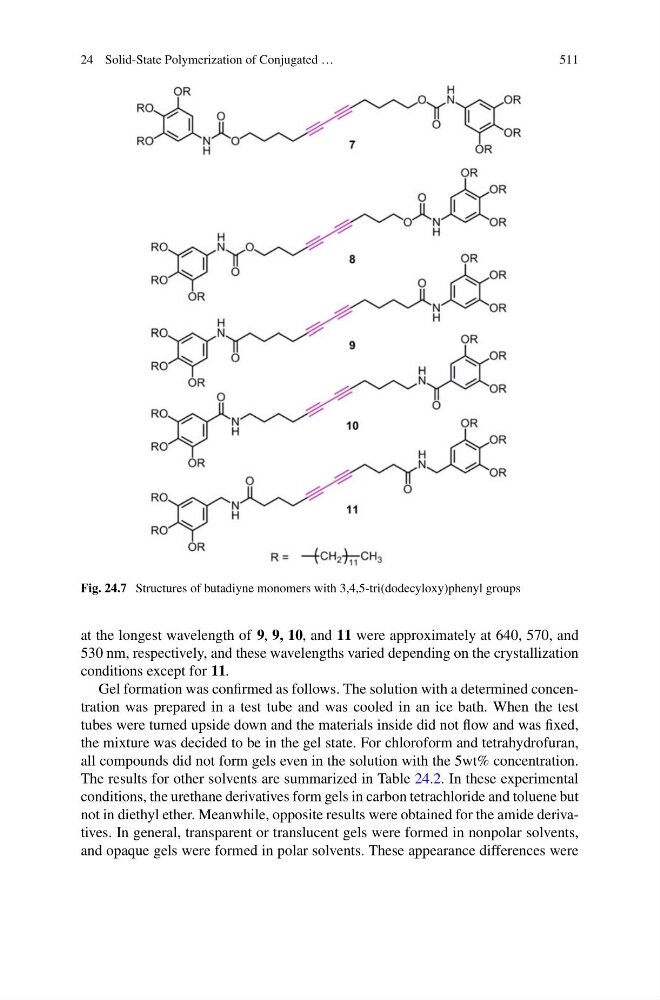
Fig. 24.7 Structures of butadiyne monomers with 3,4,5-tri(dodecyloxy)phenyl groups
at the longest wavelength of 9, 9, 10, and 11 were approximately at 640, 570, and
530 nm, respectively, and these wavelengths varied depending on the crystallization
conditions except for 11.
Gel formation was confirmed as follows. The solution with a determined concentration was prepared in a test tube and was cooled in an ice bath. When the test
tubes were turned upside down and the materials inside did not flow and was fixed,
the mixture was decided to be in the gel state. For chloroform and tetrahydrofuran,
all compounds did not form gels even in the solution with the 5wt% concentration.
The results for other solvents are summarized in Table 24.2. In these experimental
conditions, the urethane derivatives form gels in carbon tetrachloride and toluene but
not in diethyl ether. Meanwhile, opposite results were obtained for the amide derivatives. In general, transparent or translucent gels were formed in nonpolar solvents,
and opaque gels were formed in polar solvents. These appearance differences were
511
Fig. 24.7 Structures of butadiyne monomers with 3,4,5-tri(dodecyloxy)phenyl groups
at the longest wavelength of 9, 9, 10, and 11 were approximately at 640, 570, and
530 nm, respectively, and these wavelengths varied depending on the crystallization
conditions except for 11.
Gel formation was confirmed as follows. The solution with a determined concentration was prepared in a test tube and was cooled in an ice bath. When the test
tubes were turned upside down and the materials inside did not flow and was fixed,
the mixture was decided to be in the gel state. For chloroform and tetrahydrofuran,
all compounds did not form gels even in the solution with the 5wt% concentration.
The results for other solvents are summarized in Table 24.2. In these experimental
conditions, the urethane derivatives form gels in carbon tetrachloride and toluene but
not in diethyl ether. Meanwhile, opposite results were obtained for the amide derivatives. In general, transparent or translucent gels were formed in nonpolar solvents,
and opaque gels were formed in polar solvents. These appearance differences were