

44
F. Ito
similar emission of the amorphous solid. The result of the two-step mass changes
suggests that the liquid-like cluster has a finite size and then undergoes the phase
transition to a crystal with desolvation during growth.
2.4 Molecular Assembling Probed by Aggregation-Induced
Emission
Over the past decade, there have been many reports on aggregation-induced (or
enhanced) emission (AIE or AIEE) in organic molecules [40], even though the fluorescence quantum yield is low in solution, as reported by Hong et al. [41]. AIEE
enables selective detection of the assembly dynamics for aggregates and crystals.
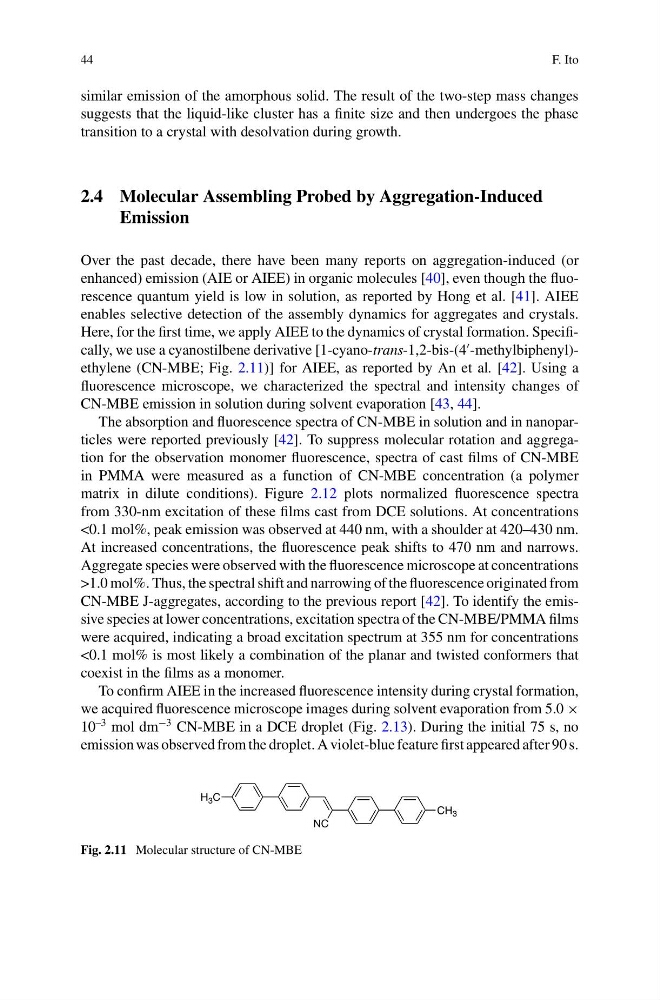
Here, for the first time, we apply AIEE to the dynamics of crystal formation. Specifically, we use a cyanostilbene derivative [1-cyano-trans-1,2-bis-(4
-methylbiphenyl)ethylene (CN-MBE; Fig. 2.11)] for AIEE, as reported by An et al. [42]. Using a
fluorescence microscope, we characterized the spectral and intensity changes of
CN-MBE emission in solution during solvent evaporation [43, 44].
The absorption and fluorescence spectra of CN-MBE in solution and in nanoparticles were reported previously [42]. To suppress molecular rotation and aggregation for the observation monomer fluorescence, spectra of cast films of CN-MBE
in PMMA were measured as a function of CN-MBE concentration (a polymer
matrix in dilute conditions). Figure 2.12 plots normalized fluorescence spectra
from 330-nm excitation of these films cast from DCE solutions. At concentrations
<0.1 mol%, peak emission was observed at 440 nm, with a shoulder at 420–430 nm.
At increased concentrations, the fluorescence peak shifts to 470 nm and narrows.
Aggregate species were observed with the fluorescence microscope at concentrations
>1.0 mol%. Thus, the spectral shift and narrowing of the fluorescence originated from
CN-MBE J-aggregates, according to the previous report [42]. To identify the emissive species at lower concentrations, excitation spectra of the CN-MBE/PMMA films
were acquired, indicating a broad excitation spectrum at 355 nm for concentrations
<0.1 mol% is most likely a combination of the planar and twisted conformers that
coexist in the films as a monomer.
To confirm AIEE in the increased fluorescence intensity during crystal formation,
we acquired fluorescence microscope images during solvent evaporation from 5.0 ×
10
–3 mol dm
−3 CN-MBE in a DCE droplet (Fig. 2.13). During the initial 75 s, no
emission was observed from the droplet. A violet-blue feature first appeared after 90 s.
Fig. 2.11 Molecular structure of CN-MBE
F. Ito
similar emission of the amorphous solid. The result of the two-step mass changes
suggests that the liquid-like cluster has a finite size and then undergoes the phase
transition to a crystal with desolvation during growth.
2.4 Molecular Assembling Probed by Aggregation-Induced
Emission
Over the past decade, there have been many reports on aggregation-induced (or
enhanced) emission (AIE or AIEE) in organic molecules [40], even though the fluorescence quantum yield is low in solution, as reported by Hong et al. [41]. AIEE
enables selective detection of the assembly dynamics for aggregates and crystals.
Here, for the first time, we apply AIEE to the dynamics of crystal formation. Specifically, we use a cyanostilbene derivative [1-cyano-trans-1,2-bis-(4
-methylbiphenyl)ethylene (CN-MBE; Fig. 2.11)] for AIEE, as reported by An et al. [42]. Using a
fluorescence microscope, we characterized the spectral and intensity changes of
CN-MBE emission in solution during solvent evaporation [43, 44].
The absorption and fluorescence spectra of CN-MBE in solution and in nanoparticles were reported previously [42]. To suppress molecular rotation and aggregation for the observation monomer fluorescence, spectra of cast films of CN-MBE
in PMMA were measured as a function of CN-MBE concentration (a polymer
matrix in dilute conditions). Figure 2.12 plots normalized fluorescence spectra
from 330-nm excitation of these films cast from DCE solutions. At concentrations
<0.1 mol%, peak emission was observed at 440 nm, with a shoulder at 420–430 nm.
At increased concentrations, the fluorescence peak shifts to 470 nm and narrows.
Aggregate species were observed with the fluorescence microscope at concentrations
>1.0 mol%. Thus, the spectral shift and narrowing of the fluorescence originated from
CN-MBE J-aggregates, according to the previous report [42]. To identify the emissive species at lower concentrations, excitation spectra of the CN-MBE/PMMA films
were acquired, indicating a broad excitation spectrum at 355 nm for concentrations
<0.1 mol% is most likely a combination of the planar and twisted conformers that
coexist in the films as a monomer.
To confirm AIEE in the increased fluorescence intensity during crystal formation,
we acquired fluorescence microscope images during solvent evaporation from 5.0 ×
10
–3 mol dm
−3 CN-MBE in a DCE droplet (Fig. 2.13). During the initial 75 s, no
emission was observed from the droplet. A violet-blue feature first appeared after 90 s.
Fig. 2.11 Molecular structure of CN-MBE