

2 Direct Visualization of Crystal Formation and Growth …
43
property will change from a viscous fluid to elastic media during the crystallization,
that is, the − / value will increase after crystallization together with the fluorescence color change from orange to blue. In the early state after the dropping, the
− / value indicates a viscous fluid owing to a large amount of solvent, which
is considered to be due to the adhesion of the solvent to the substrate surface. This
indicates that the molecule is dispersed in the solution and has a large amount of
solvent attached to the substrate surface. The peak shape at 84 s of the − /
value is considered to be due to the artifact caused by the adhesion of the aggregated
amorphous state to the Au electrode, because also increased rapidly at the same
time. The fluorescence color of the droplet at 84 s was orange, suggesting the formation of the amorphous phase. The − / value from 91 to 111 s was the same as
that from 0 to 80 s, suggesting that the amorphous state has a similar viscosity as
the solution. The sudden rise of − / at 111 s is ascribed to the transition to the
elastic crystals.
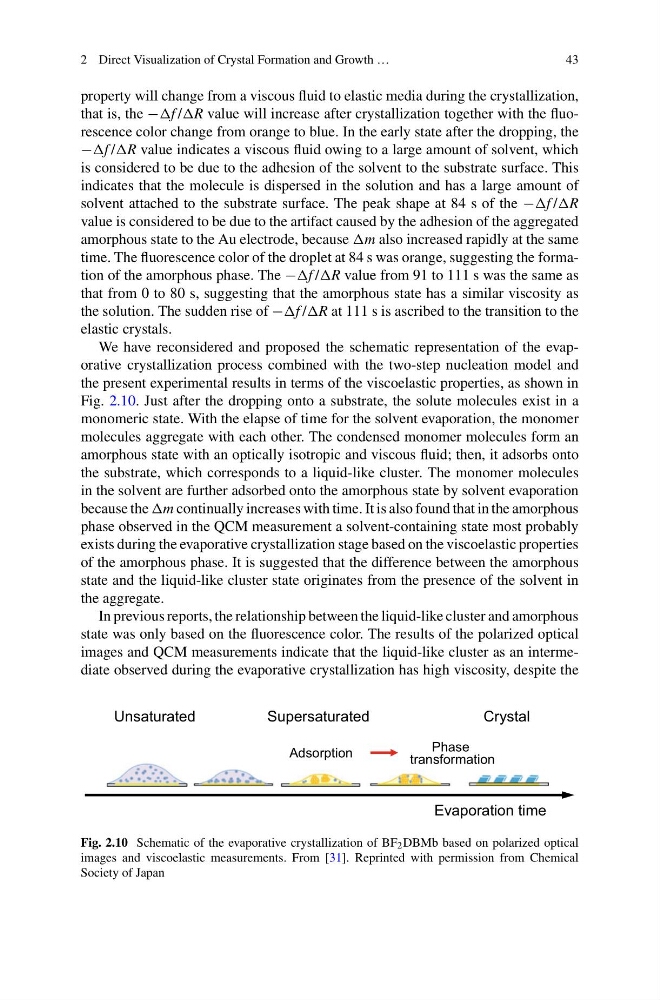
We have reconsidered and proposed the schematic representation of the evaporative crystallization process combined with the two-step nucleation model and
the present experimental results in terms of the viscoelastic properties, as shown in
Fig. 2.10. Just after the dropping onto a substrate, the solute molecules exist in a
monomeric state. With the elapse of time for the solvent evaporation, the monomer
molecules aggregate with each other. The condensed monomer molecules form an
amorphous state with an optically isotropic and viscous fluid; then, it adsorbs onto
the substrate, which corresponds to a liquid-like cluster. The monomer molecules
in the solvent are further adsorbed onto the amorphous state by solvent evaporation
because the continually increases with time. It is also found that in the amorphous
phase observed in the QCM measurement a solvent-containing state most probably
exists during the evaporative crystallization stage based on the viscoelastic properties
of the amorphous phase. It is suggested that the difference between the amorphous
state and the liquid-like cluster state originates from the presence of the solvent in
the aggregate.
In previous reports, the relationship between the liquid-like cluster and amorphous
state was only based on the fluorescence color. The results of the polarized optical
images and QCM measurements indicate that the liquid-like cluster as an intermediate observed during the evaporative crystallization has high viscosity, despite the
Evaporation time
Supersaturated
Unsaturated
Crystal
Adsorption
Phase
transformation
Fig. 2.10 Schematic of the evaporative crystallization of BF 2 DBMb based on polarized optical
images and viscoelastic measurements. From [31]. Reprinted with permission from Chemical
Society of Japan
43
property will change from a viscous fluid to elastic media during the crystallization,
that is, the − / value will increase after crystallization together with the fluorescence color change from orange to blue. In the early state after the dropping, the
− / value indicates a viscous fluid owing to a large amount of solvent, which
is considered to be due to the adhesion of the solvent to the substrate surface. This
indicates that the molecule is dispersed in the solution and has a large amount of
solvent attached to the substrate surface. The peak shape at 84 s of the − /
value is considered to be due to the artifact caused by the adhesion of the aggregated
amorphous state to the Au electrode, because also increased rapidly at the same
time. The fluorescence color of the droplet at 84 s was orange, suggesting the formation of the amorphous phase. The − / value from 91 to 111 s was the same as
that from 0 to 80 s, suggesting that the amorphous state has a similar viscosity as
the solution. The sudden rise of − / at 111 s is ascribed to the transition to the
elastic crystals.
We have reconsidered and proposed the schematic representation of the evaporative crystallization process combined with the two-step nucleation model and
the present experimental results in terms of the viscoelastic properties, as shown in
Fig. 2.10. Just after the dropping onto a substrate, the solute molecules exist in a
monomeric state. With the elapse of time for the solvent evaporation, the monomer
molecules aggregate with each other. The condensed monomer molecules form an
amorphous state with an optically isotropic and viscous fluid; then, it adsorbs onto
the substrate, which corresponds to a liquid-like cluster. The monomer molecules
in the solvent are further adsorbed onto the amorphous state by solvent evaporation
because the continually increases with time. It is also found that in the amorphous
phase observed in the QCM measurement a solvent-containing state most probably
exists during the evaporative crystallization stage based on the viscoelastic properties
of the amorphous phase. It is suggested that the difference between the amorphous
state and the liquid-like cluster state originates from the presence of the solvent in
the aggregate.
In previous reports, the relationship between the liquid-like cluster and amorphous
state was only based on the fluorescence color. The results of the polarized optical
images and QCM measurements indicate that the liquid-like cluster as an intermediate observed during the evaporative crystallization has high viscosity, despite the
Evaporation time
Supersaturated
Unsaturated
Crystal
Adsorption
Phase
transformation
Fig. 2.10 Schematic of the evaporative crystallization of BF 2 DBMb based on polarized optical
images and viscoelastic measurements. From [31]. Reprinted with permission from Chemical
Society of Japan