

42
F. Ito
to 86 s, f temporarily decreased to 7.3 μg and then reached 15 μg at 95 s. The
increase of m is ascribed to the adsorption and precipitation of BF 2 DBMb onto
the Au electrode. However, the estimated solute mass of the BF 2 DBMb solution
was 34.65 μg, which is much larger than the estimated m value. This causes the
spreading out of the effective area of Au electrode and the viscoelastic property of
the droplet as described the next paragraph. It is difficult to drop a smaller amount
of solution within the electrode area, owing to the surface tension of the droplet.
The QCM results can be used to evaluate not only the m but also the viscoelastic
properties of the adsorbed materials. Kanazawa et al. reported that the f with homogeneous viscous fluids is proportional to the square root of the viscosity coefficients
[37]. Muramatsu et al. also represented the linear relation between R and the square
root of the viscosity coefficient [38]. However, in terms of f for the viscoelastic
medium, it is complicated to evaluate both the viscosity and elasticity separately,
because f depends both on the m and viscosity. Based on the above findings,
Kubono et al. semi-quantitatively formulated the relation assuming that the f is the
sum of the two contributions from the ideal frequency shift by adsorbed mass (f m )
associated with the elasticity and that by viscous fluid (f v ) with constants (a and
b) as follows [39],
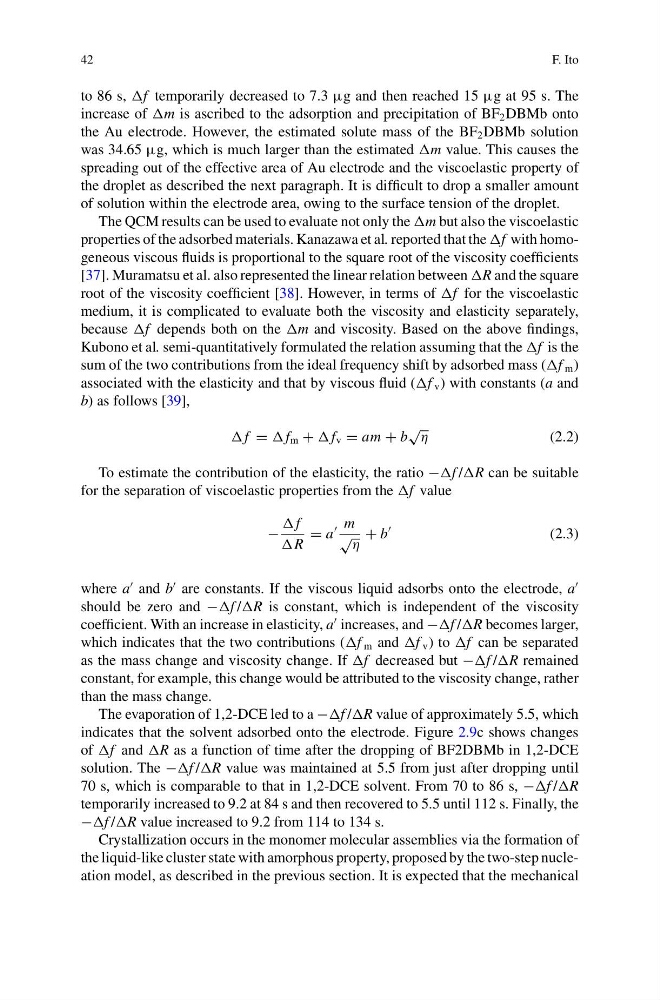
f = f m + f v = am + b
√ η
(2.2)
To estimate the contribution of the elasticity, the ratio −f /R can be suitable
for the separation of viscoelastic properties from the f value
−
f
R
= a
m
√
η
+ b
(2.3)
where a
and b
are constants. If the viscous liquid adsorbs onto the electrode, a
should be zero and −f /R is constant, which is independent of the viscosity
coefficient. With an increase in elasticity, a
increases, and −f /R becomes larger,
which indicates that the two contributions (f m and f v ) to f can be separated
as the mass change and viscosity change. If f decreased but −f /R remained
constant, for example, this change would be attributed to the viscosity change, rather
than the mass change.
The evaporation of 1,2-DCE led to a −f /R value of approximately 5.5, which
indicates that the solvent adsorbed onto the electrode. Figure 2.9c shows changes
of f and R as a function of time after the dropping of BF2DBMb in 1,2-DCE
solution. The −f /R value was maintained at 5.5 from just after dropping until
70 s, which is comparable to that in 1,2-DCE solvent. From 70 to 86 s, −f /R
temporarily increased to 9.2 at 84 s and then recovered to 5.5 until 112 s. Finally, the
−f /R value increased to 9.2 from 114 to 134 s.
Crystallization occurs in the monomer molecular assemblies via the formation of
the liquid-like cluster state with amorphous property, proposed by the two-step nucleation model, as described in the previous section. It is expected that the mechanical
F. Ito
to 86 s, f temporarily decreased to 7.3 μg and then reached 15 μg at 95 s. The
increase of m is ascribed to the adsorption and precipitation of BF 2 DBMb onto
the Au electrode. However, the estimated solute mass of the BF 2 DBMb solution
was 34.65 μg, which is much larger than the estimated m value. This causes the
spreading out of the effective area of Au electrode and the viscoelastic property of
the droplet as described the next paragraph. It is difficult to drop a smaller amount
of solution within the electrode area, owing to the surface tension of the droplet.
The QCM results can be used to evaluate not only the m but also the viscoelastic
properties of the adsorbed materials. Kanazawa et al. reported that the f with homogeneous viscous fluids is proportional to the square root of the viscosity coefficients
[37]. Muramatsu et al. also represented the linear relation between R and the square
root of the viscosity coefficient [38]. However, in terms of f for the viscoelastic
medium, it is complicated to evaluate both the viscosity and elasticity separately,
because f depends both on the m and viscosity. Based on the above findings,
Kubono et al. semi-quantitatively formulated the relation assuming that the f is the
sum of the two contributions from the ideal frequency shift by adsorbed mass (f m )
associated with the elasticity and that by viscous fluid (f v ) with constants (a and
b) as follows [39],
f = f m + f v = am + b
√ η
(2.2)
To estimate the contribution of the elasticity, the ratio −f /R can be suitable
for the separation of viscoelastic properties from the f value
−
f
R
= a
m
√
η
+ b
(2.3)
where a
and b
are constants. If the viscous liquid adsorbs onto the electrode, a
should be zero and −f /R is constant, which is independent of the viscosity
coefficient. With an increase in elasticity, a
increases, and −f /R becomes larger,
which indicates that the two contributions (f m and f v ) to f can be separated
as the mass change and viscosity change. If f decreased but −f /R remained
constant, for example, this change would be attributed to the viscosity change, rather
than the mass change.
The evaporation of 1,2-DCE led to a −f /R value of approximately 5.5, which
indicates that the solvent adsorbed onto the electrode. Figure 2.9c shows changes
of f and R as a function of time after the dropping of BF2DBMb in 1,2-DCE
solution. The −f /R value was maintained at 5.5 from just after dropping until
70 s, which is comparable to that in 1,2-DCE solvent. From 70 to 86 s, −f /R
temporarily increased to 9.2 at 84 s and then recovered to 5.5 until 112 s. Finally, the
−f /R value increased to 9.2 from 114 to 134 s.
Crystallization occurs in the monomer molecular assemblies via the formation of
the liquid-like cluster state with amorphous property, proposed by the two-step nucleation model, as described in the previous section. It is expected that the mechanical