

21 Asymmetric Synthesis Involving Dynamic Enantioselective …
451
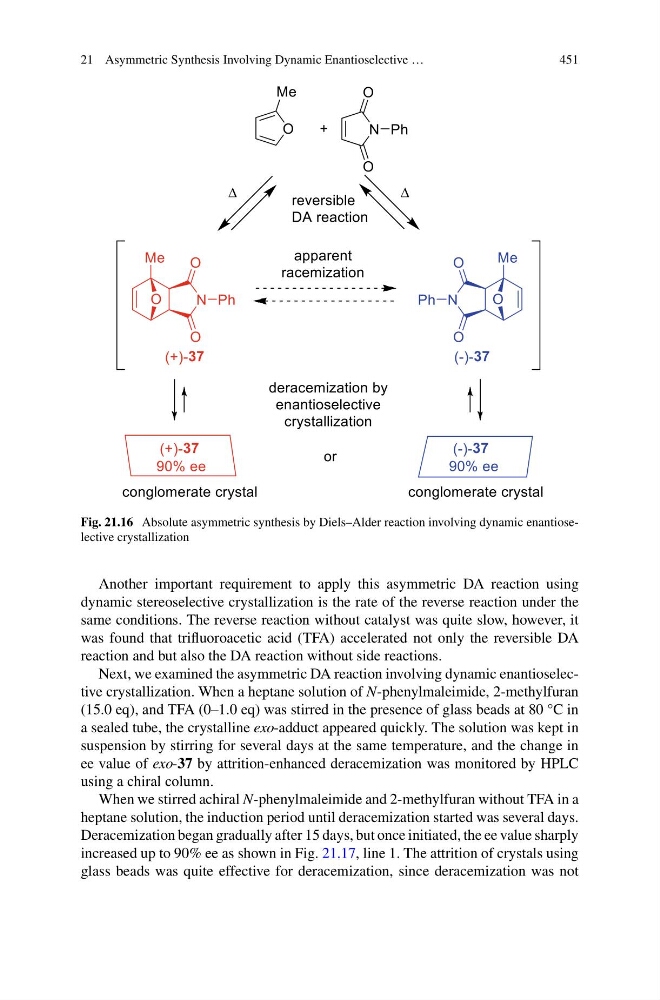
Fig. 21.16 Absolute asymmetric synthesis by Diels–Alder reaction involving dynamic enantioselective crystallization
Another important requirement to apply this asymmetric DA reaction using
dynamic stereoselective crystallization is the rate of the reverse reaction under the
same conditions. The reverse reaction without catalyst was quite slow, however, it
was found that trifluoroacetic acid (TFA) accelerated not only the reversible DA
reaction and but also the DA reaction without side reactions.
Next, we examined the asymmetric DA reaction involving dynamic enantioselective crystallization. When a heptane solution of N-phenylmaleimide, 2-methylfuran
(15.0 eq), and TFA (0–1.0 eq) was stirred in the presence of glass beads at 80 °C in
a sealed tube, the crystalline exo-adduct appeared quickly. The solution was kept in
suspension by stirring for several days at the same temperature, and the change in
ee value of exo-37 by attrition-enhanced deracemization was monitored by HPLC
using a chiral column.
When we stirred achiral N-phenylmaleimide and 2-methylfuran without TFA in a
heptane solution, the induction period until deracemization started was several days.
Deracemization began gradually after 15 days, but once initiated, the ee value sharply
increased up to 90% ee as shown in Fig. 21.17, line 1. The attrition of crystals using
glass beads was quite effective for deracemization, since deracemization was not
451
Fig. 21.16 Absolute asymmetric synthesis by Diels–Alder reaction involving dynamic enantioselective crystallization
Another important requirement to apply this asymmetric DA reaction using
dynamic stereoselective crystallization is the rate of the reverse reaction under the
same conditions. The reverse reaction without catalyst was quite slow, however, it
was found that trifluoroacetic acid (TFA) accelerated not only the reversible DA
reaction and but also the DA reaction without side reactions.
Next, we examined the asymmetric DA reaction involving dynamic enantioselective crystallization. When a heptane solution of N-phenylmaleimide, 2-methylfuran
(15.0 eq), and TFA (0–1.0 eq) was stirred in the presence of glass beads at 80 °C in
a sealed tube, the crystalline exo-adduct appeared quickly. The solution was kept in
suspension by stirring for several days at the same temperature, and the change in
ee value of exo-37 by attrition-enhanced deracemization was monitored by HPLC
using a chiral column.
When we stirred achiral N-phenylmaleimide and 2-methylfuran without TFA in a
heptane solution, the induction period until deracemization started was several days.
Deracemization began gradually after 15 days, but once initiated, the ee value sharply
increased up to 90% ee as shown in Fig. 21.17, line 1. The attrition of crystals using
glass beads was quite effective for deracemization, since deracemization was not