

450
M. Sakamoto
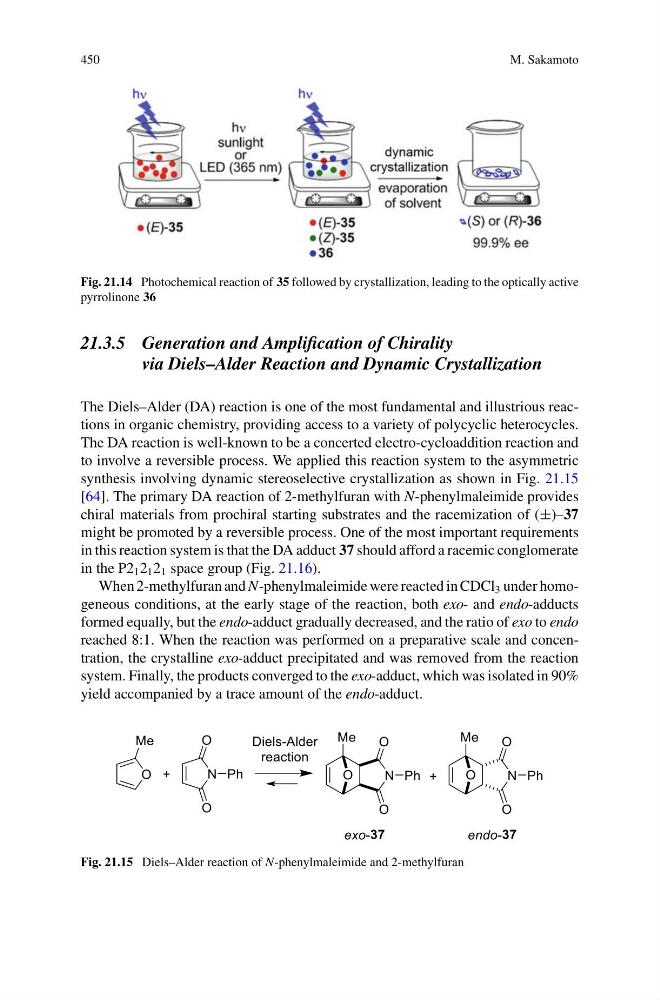
Fig. 21.14 Photochemical reaction of 35 followed by crystallization, leading to the optically active
pyrrolinone 36
21.3.5 Generation and Amplification of Chirality
via Diels–Alder Reaction and Dynamic Crystallization
The Diels–Alder (DA) reaction is one of the most fundamental and illustrious reactions in organic chemistry, providing access to a variety of polycyclic heterocycles.
The DA reaction is well-known to be a concerted electro-cycloaddition reaction and
to involve a reversible process. We applied this reaction system to the asymmetric
synthesis involving dynamic stereoselective crystallization as shown in Fig. 21.15
[64]. The primary DA reaction of 2-methylfuran with N-phenylmaleimide provides
chiral materials from prochiral starting substrates and the racemization of (±)–37
might be promoted by a reversible process. One of the most important requirements
in this reaction system is that the DA adduct 37 should afford a racemic conglomerate
in the P2 1 2 1 2 1 space group (Fig. 21.16).
When 2-methylfuran and N-phenylmaleimide were reacted in CDCl 3 under homogeneous conditions, at the early stage of the reaction, both exo- and endo-adducts
formed equally, but the endo-adduct gradually decreased, and the ratio of exo to endo
reached 8:1. When the reaction was performed on a preparative scale and concentration, the crystalline exo-adduct precipitated and was removed from the reaction
system. Finally, the products converged to the exo-adduct, which was isolated in 90%
yield accompanied by a trace amount of the endo-adduct.
Fig. 21.15 Diels–Alder reaction of N-phenylmaleimide and 2-methylfuran
M. Sakamoto
Fig. 21.14 Photochemical reaction of 35 followed by crystallization, leading to the optically active
pyrrolinone 36
21.3.5 Generation and Amplification of Chirality
via Diels–Alder Reaction and Dynamic Crystallization
The Diels–Alder (DA) reaction is one of the most fundamental and illustrious reactions in organic chemistry, providing access to a variety of polycyclic heterocycles.
The DA reaction is well-known to be a concerted electro-cycloaddition reaction and
to involve a reversible process. We applied this reaction system to the asymmetric
synthesis involving dynamic stereoselective crystallization as shown in Fig. 21.15
[64]. The primary DA reaction of 2-methylfuran with N-phenylmaleimide provides
chiral materials from prochiral starting substrates and the racemization of (±)–37
might be promoted by a reversible process. One of the most important requirements
in this reaction system is that the DA adduct 37 should afford a racemic conglomerate
in the P2 1 2 1 2 1 space group (Fig. 21.16).
When 2-methylfuran and N-phenylmaleimide were reacted in CDCl 3 under homogeneous conditions, at the early stage of the reaction, both exo- and endo-adducts
formed equally, but the endo-adduct gradually decreased, and the ratio of exo to endo
reached 8:1. When the reaction was performed on a preparative scale and concentration, the crystalline exo-adduct precipitated and was removed from the reaction
system. Finally, the products converged to the exo-adduct, which was isolated in 90%
yield accompanied by a trace amount of the endo-adduct.
Fig. 21.15 Diels–Alder reaction of N-phenylmaleimide and 2-methylfuran