

428
R. Tamura et al.
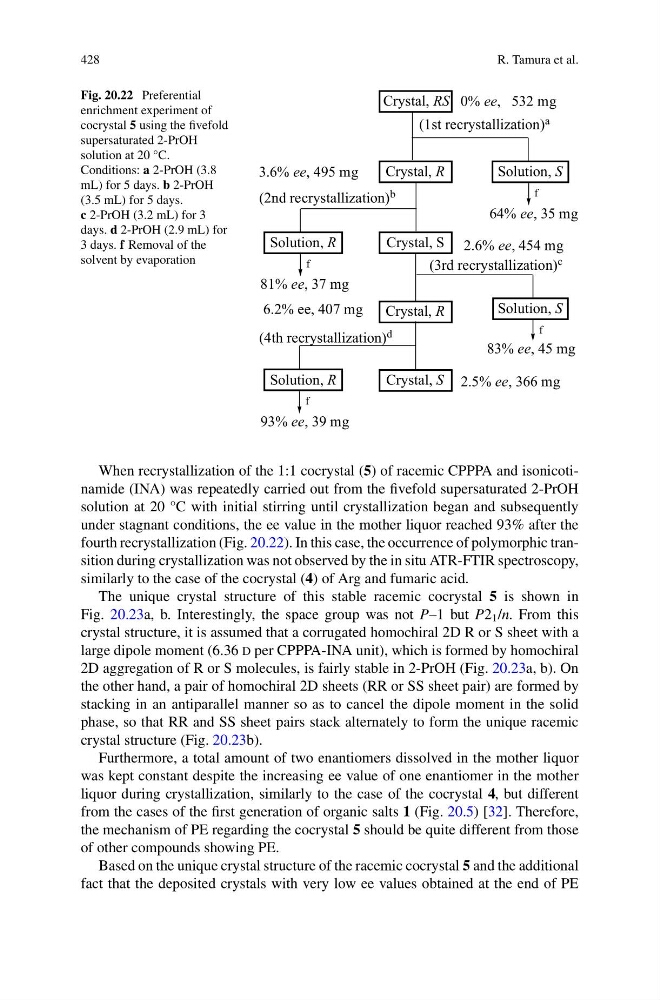
Fig. 20.22 Preferential
enrichment experiment of
cocrystal 5 using the fivefold
supersaturated 2-PrOH
solution at 20 °C.
Conditions: a 2-PrOH (3.8
mL) for 5 days. b 2-PrOH
(3.5 mL) for 5 days.
c 2-PrOH (3.2 mL) for 3
days. d 2-PrOH (2.9 mL) for
3 days. f Removal of the
solvent by evaporation
Crystal, RS
Crystal, R
Solution, S
0% ee, 532 mg
64% ee, 35 mg
3.6% ee, 495 mg
Crystal, S
Solution, R
81% ee, 37 mg
2.6% ee, 454 mg
(1st recrystallization) a
(2nd recrystallization) b
f
f
Solution, S
83% ee, 45 mg
f
93% ee, 39 mg
f
(3rd recrystallization) c
(4th recrystallization) d
2.5% ee, 366 mg
6.2% ee, 407 mg
Crystal, S
Crystal, R
Solution, R
When recrystallization of the 1:1 cocrystal (5) of racemic CPPPA and isonicotinamide (INA) was repeatedly carried out from the fivefold supersaturated 2-PrOH
solution at 20 °C with initial stirring until crystallization began and subsequently
under stagnant conditions, the ee value in the mother liquor reached 93% after the
fourth recrystallization (Fig. 20.22). In this case, the occurrence of polymorphic transition during crystallization was not observed by the in situ ATR-FTIR spectroscopy,
similarly to the case of the cocrystal (4) of Arg and fumaric acid.
The unique crystal structure of this stable racemic cocrystal 5 is shown in
Fig. 20.23a, b. Interestingly, the space group was not P–1 but P2 1 /n. From this
crystal structure, it is assumed that a corrugated homochiral 2D R or S sheet with a
large dipole moment (6.36 d per CPPPA-INA unit), which is formed by homochiral
2D aggregation of R or S molecules, is fairly stable in 2-PrOH (Fig. 20.23a, b). On
the other hand, a pair of homochiral 2D sheets (RR or SS sheet pair) are formed by
stacking in an antiparallel manner so as to cancel the dipole moment in the solid
phase, so that RR and SS sheet pairs stack alternately to form the unique racemic
crystal structure (Fig. 20.23b).
Furthermore, a total amount of two enantiomers dissolved in the mother liquor
was kept constant despite the increasing ee value of one enantiomer in the mother
liquor during crystallization, similarly to the case of the cocrystal 4, but different
from the cases of the first generation of organic salts 1 (Fig. 20.5) [32]. Therefore,
the mechanism of PE regarding the cocrystal 5 should be quite different from those
of other compounds showing PE.
Based on the unique crystal structure of the racemic cocrystal 5 and the additional
fact that the deposited crystals with very low ee values obtained at the end of PE
R. Tamura et al.
Fig. 20.22 Preferential
enrichment experiment of
cocrystal 5 using the fivefold
supersaturated 2-PrOH
solution at 20 °C.
Conditions: a 2-PrOH (3.8
mL) for 5 days. b 2-PrOH
(3.5 mL) for 5 days.
c 2-PrOH (3.2 mL) for 3
days. d 2-PrOH (2.9 mL) for
3 days. f Removal of the
solvent by evaporation
Crystal, RS
Crystal, R
Solution, S
0% ee, 532 mg
64% ee, 35 mg
3.6% ee, 495 mg
Crystal, S
Solution, R
81% ee, 37 mg
2.6% ee, 454 mg
(1st recrystallization) a
(2nd recrystallization) b
f
f
Solution, S
83% ee, 45 mg
f
93% ee, 39 mg
f
(3rd recrystallization) c
(4th recrystallization) d
2.5% ee, 366 mg
6.2% ee, 407 mg
Crystal, S
Crystal, R
Solution, R
When recrystallization of the 1:1 cocrystal (5) of racemic CPPPA and isonicotinamide (INA) was repeatedly carried out from the fivefold supersaturated 2-PrOH
solution at 20 °C with initial stirring until crystallization began and subsequently
under stagnant conditions, the ee value in the mother liquor reached 93% after the
fourth recrystallization (Fig. 20.22). In this case, the occurrence of polymorphic transition during crystallization was not observed by the in situ ATR-FTIR spectroscopy,
similarly to the case of the cocrystal (4) of Arg and fumaric acid.
The unique crystal structure of this stable racemic cocrystal 5 is shown in
Fig. 20.23a, b. Interestingly, the space group was not P–1 but P2 1 /n. From this
crystal structure, it is assumed that a corrugated homochiral 2D R or S sheet with a
large dipole moment (6.36 d per CPPPA-INA unit), which is formed by homochiral
2D aggregation of R or S molecules, is fairly stable in 2-PrOH (Fig. 20.23a, b). On
the other hand, a pair of homochiral 2D sheets (RR or SS sheet pair) are formed by
stacking in an antiparallel manner so as to cancel the dipole moment in the solid
phase, so that RR and SS sheet pairs stack alternately to form the unique racemic
crystal structure (Fig. 20.23b).
Furthermore, a total amount of two enantiomers dissolved in the mother liquor
was kept constant despite the increasing ee value of one enantiomer in the mother
liquor during crystallization, similarly to the case of the cocrystal 4, but different
from the cases of the first generation of organic salts 1 (Fig. 20.5) [32]. Therefore,
the mechanism of PE regarding the cocrystal 5 should be quite different from those
of other compounds showing PE.
Based on the unique crystal structure of the racemic cocrystal 5 and the additional
fact that the deposited crystals with very low ee values obtained at the end of PE