

20 Twenty-Five Years’ History, Mechanism, and Generality …
429
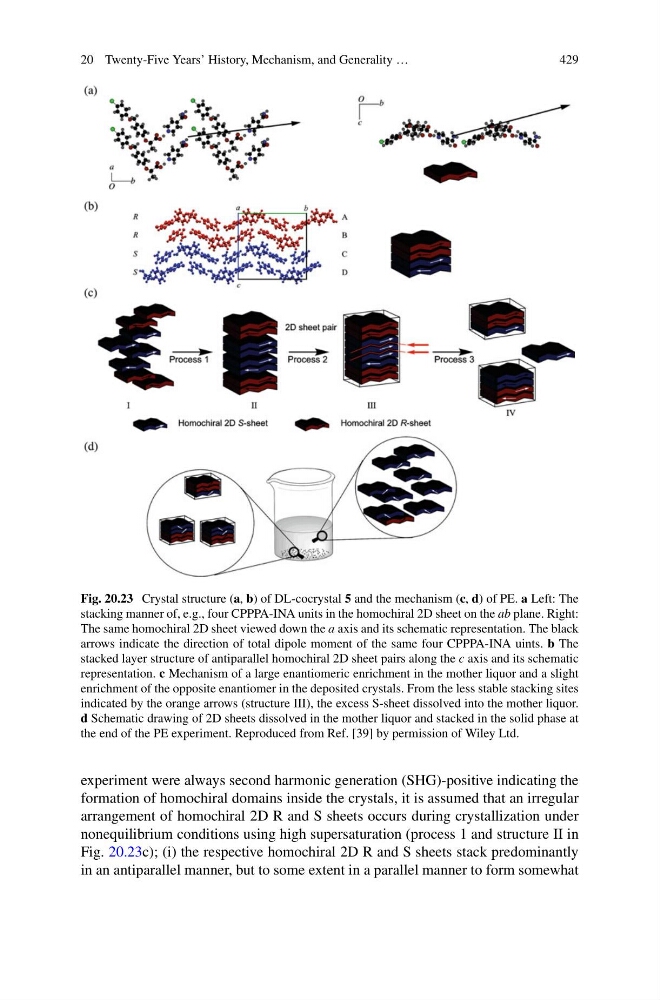
Fig. 20.23 Crystal structure (a, b) of DL-cocrystal 5 and the mechanism (c, d) of PE. a Left: The
stacking manner of, e.g., four CPPPA-INA units in the homochiral 2D sheet on the ab plane. Right:
The same homochiral 2D sheet viewed down the a axis and its schematic representation. The black
arrows indicate the direction of total dipole moment of the same four CPPPA-INA uints. b The
stacked layer structure of antiparallel homochiral 2D sheet pairs along the c axis and its schematic
representation. c Mechanism of a large enantiomeric enrichment in the mother liquor and a slight
enrichment of the opposite enantiomer in the deposited crystals. From the less stable stacking sites
indicated by the orange arrows (structure III), the excess S-sheet dissolved into the mother liquor.
d Schematic drawing of 2D sheets dissolved in the mother liquor and stacked in the solid phase at
the end of the PE experiment. Reproduced from Ref. [39] by permission of Wiley Ltd.
experiment were always second harmonic generation (SHG)-positive indicating the
formation of homochiral domains inside the crystals, it is assumed that an irregular
arrangement of homochiral 2D R and S sheets occurs during crystallization under
nonequilibrium conditions using high supersaturation (process 1 and structure II in
Fig. 20.23c); (i) the respective homochiral 2D R and S sheets stack predominantly
in an antiparallel manner, but to some extent in a parallel manner to form somewhat
429
Fig. 20.23 Crystal structure (a, b) of DL-cocrystal 5 and the mechanism (c, d) of PE. a Left: The
stacking manner of, e.g., four CPPPA-INA units in the homochiral 2D sheet on the ab plane. Right:
The same homochiral 2D sheet viewed down the a axis and its schematic representation. The black
arrows indicate the direction of total dipole moment of the same four CPPPA-INA uints. b The
stacked layer structure of antiparallel homochiral 2D sheet pairs along the c axis and its schematic
representation. c Mechanism of a large enantiomeric enrichment in the mother liquor and a slight
enrichment of the opposite enantiomer in the deposited crystals. From the less stable stacking sites
indicated by the orange arrows (structure III), the excess S-sheet dissolved into the mother liquor.
d Schematic drawing of 2D sheets dissolved in the mother liquor and stacked in the solid phase at
the end of the PE experiment. Reproduced from Ref. [39] by permission of Wiley Ltd.
experiment were always second harmonic generation (SHG)-positive indicating the
formation of homochiral domains inside the crystals, it is assumed that an irregular
arrangement of homochiral 2D R and S sheets occurs during crystallization under
nonequilibrium conditions using high supersaturation (process 1 and structure II in
Fig. 20.23c); (i) the respective homochiral 2D R and S sheets stack predominantly
in an antiparallel manner, but to some extent in a parallel manner to form somewhat