

400
E. R. T. Tiekink
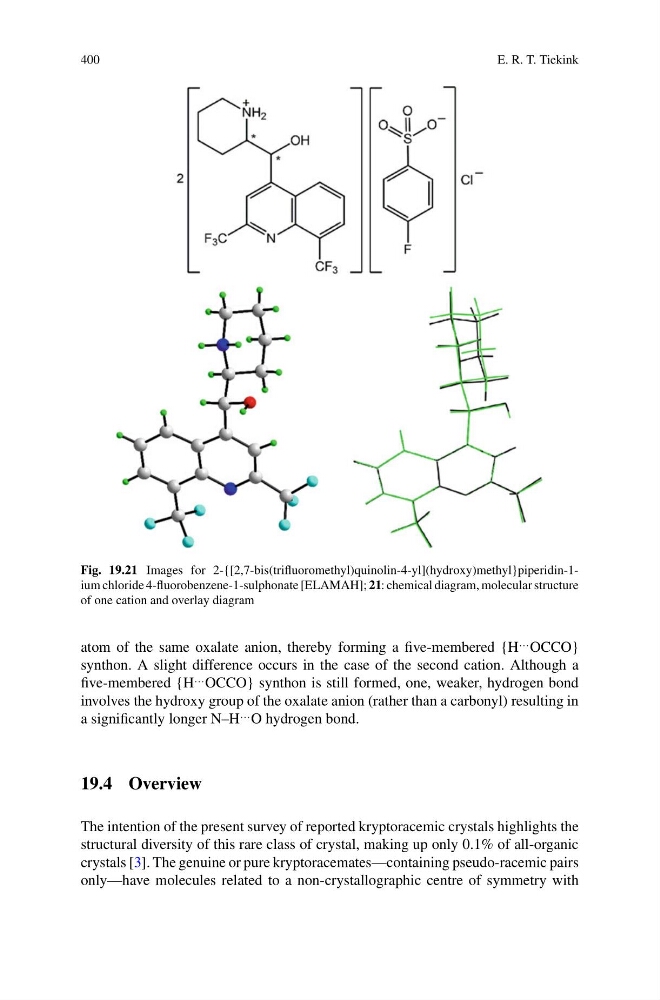
Fig. 19.21 Images for 2-{[2,7-bis(trifluoromethyl)quinolin-4-yl](hydroxy)methyl}piperidin-1ium chloride 4-fluorobenzene-1-sulphonate [ELAMAH]; 21: chemical diagram, molecular structure
of one cation and overlay diagram
atom of the same oxalate anion, thereby forming a five-membered {H
… OCCO}
synthon. A slight difference occurs in the case of the second cation. Although a
five-membered {H
… OCCO} synthon is still formed, one, weaker, hydrogen bond
involves the hydroxy group of the oxalate anion (rather than a carbonyl) resulting in
a significantly longer N–H
… O hydrogen bond.
19.4 Overview
The intention of the present survey of reported kryptoracemic crystals highlights the
structural diversity of this rare class of crystal, making up only 0.1% of all-organic
crystals [3]. The genuine or pure kryptoracemates—containing pseudo-racemic pairs
only—have molecules related to a non-crystallographic centre of symmetry with
E. R. T. Tiekink
Fig. 19.21 Images for 2-{[2,7-bis(trifluoromethyl)quinolin-4-yl](hydroxy)methyl}piperidin-1ium chloride 4-fluorobenzene-1-sulphonate [ELAMAH]; 21: chemical diagram, molecular structure
of one cation and overlay diagram
atom of the same oxalate anion, thereby forming a five-membered {H
… OCCO}
synthon. A slight difference occurs in the case of the second cation. Although a
five-membered {H
… OCCO} synthon is still formed, one, weaker, hydrogen bond
involves the hydroxy group of the oxalate anion (rather than a carbonyl) resulting in
a significantly longer N–H
… O hydrogen bond.
19.4 Overview
The intention of the present survey of reported kryptoracemic crystals highlights the
structural diversity of this rare class of crystal, making up only 0.1% of all-organic
crystals [3]. The genuine or pure kryptoracemates—containing pseudo-racemic pairs
only—have molecules related to a non-crystallographic centre of symmetry with