

19 Kryptoracemates
399
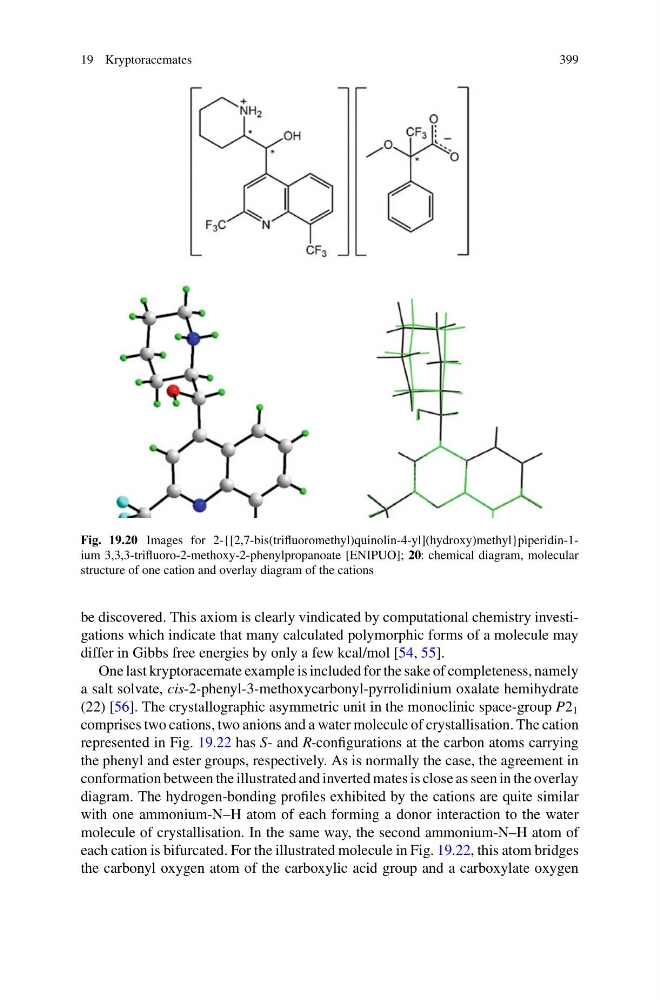
Fig. 19.20 Images for 2-{[2,7-bis(trifluoromethyl)quinolin-4-yl](hydroxy)methyl}piperidin-1ium 3,3,3-trifluoro-2-methoxy-2-phenylpropanoate [ENIPUO]; 20: chemical diagram, molecular
structure of one cation and overlay diagram of the cations
be discovered. This axiom is clearly vindicated by computational chemistry investigations which indicate that many calculated polymorphic forms of a molecule may
differ in Gibbs free energies by only a few kcal/mol [54, 55].
One last kryptoracemate example is included for the sake of completeness, namely
a salt solvate, cis-2-phenyl-3-methoxycarbonyl-pyrrolidinium oxalate hemihydrate
(22) [56]. The crystallographic asymmetric unit in the monoclinic space-group P2 1
comprises two cations, two anions and a water molecule of crystallisation. The cation
represented in Fig. 19.22 has S- and R-configurations at the carbon atoms carrying
the phenyl and ester groups, respectively. As is normally the case, the agreement in
conformation between the illustrated and inverted mates is close as seen in the overlay
diagram. The hydrogen-bonding profiles exhibited by the cations are quite similar
with one ammonium-N–H atom of each forming a donor interaction to the water
molecule of crystallisation. In the same way, the second ammonium-N–H atom of
each cation is bifurcated. For the illustrated molecule in Fig. 19.22, this atom bridges
the carbonyl oxygen atom of the carboxylic acid group and a carboxylate oxygen
399
Fig. 19.20 Images for 2-{[2,7-bis(trifluoromethyl)quinolin-4-yl](hydroxy)methyl}piperidin-1ium 3,3,3-trifluoro-2-methoxy-2-phenylpropanoate [ENIPUO]; 20: chemical diagram, molecular
structure of one cation and overlay diagram of the cations
be discovered. This axiom is clearly vindicated by computational chemistry investigations which indicate that many calculated polymorphic forms of a molecule may
differ in Gibbs free energies by only a few kcal/mol [54, 55].
One last kryptoracemate example is included for the sake of completeness, namely
a salt solvate, cis-2-phenyl-3-methoxycarbonyl-pyrrolidinium oxalate hemihydrate
(22) [56]. The crystallographic asymmetric unit in the monoclinic space-group P2 1
comprises two cations, two anions and a water molecule of crystallisation. The cation
represented in Fig. 19.22 has S- and R-configurations at the carbon atoms carrying
the phenyl and ester groups, respectively. As is normally the case, the agreement in
conformation between the illustrated and inverted mates is close as seen in the overlay
diagram. The hydrogen-bonding profiles exhibited by the cations are quite similar
with one ammonium-N–H atom of each forming a donor interaction to the water
molecule of crystallisation. In the same way, the second ammonium-N–H atom of
each cation is bifurcated. For the illustrated molecule in Fig. 19.22, this atom bridges
the carbonyl oxygen atom of the carboxylic acid group and a carboxylate oxygen